
Your loneliness persists despite a vast online network because digital interaction systematically lacks the core psychological ingredients of genuine human connection.
- Real-world bonding is rooted in “embodied cognition”—subtle, non-verbal cues that digital platforms cannot replicate.
- True belonging requires “psychological safety” and shared vulnerability, not just common interests in a forum.
Recommendation: Actively seek or create “Third Places”—physical spaces for regular, informal gatherings—to build the deep connections that a purely digital life cannot sustain on its own.
You have thousands of followers, a dozen active Discord servers, and a feed that never sleeps. You are, by all digital metrics, hyper-connected. Yet, a persistent, gnawing sense of isolation remains. You’ve followed the modern prescription for loneliness—find your tribe online, join communities, engage—but the cure hasn’t worked. This paradox is the defining experience for many digital natives, leaving you to wonder if you are somehow broken or doing it wrong.
The common discourse offers simplistic solutions: post more, find a more niche group, or simply try harder. But what if the problem isn’t your effort, but the very nature of the environment? What if the architecture of most online spaces is fundamentally misaligned with the deep, biological wiring of human connection? This isn’t to say online communities are useless; for many, they are a vital lifeline. However, understanding their limitations is the first step toward building a truly fulfilling social life.
This analysis moves beyond the surface-level advice. We will dissect the psychological and sociological mechanisms that differentiate fleeting digital interactions from lasting, meaningful bonds. We will explore why a local pub can foster deeper connections than a sprawling Discord server, why you feel anxious in a group of supposed friends, and how ancient human rituals hold the key to combating modern loneliness. This isn’t an attack on technology, but a reality check grounded in social science, designed to give you a new framework for understanding and building the connections you truly crave.
To navigate this complex issue, we will deconstruct the building blocks of genuine connection, from the individual’s psychological state to the power of collective experience. This guide provides a structured exploration of why you feel the way you do and offers a scientifically-backed path forward.
Summary: The Psychological Disconnect of Digital Socializing
- The “Expat Blues” That Hit at Month 3 and How to Survive It
- Discord Servers vs. Local Pubs: Measuring the Quality of Human Connection
- What Is “Psychological Safety” and Why Do You Feel Anxious in Your Group?
- How to Find Your “Third Place” (Besides Home and Work) in a New City?
- How to Reconnect with Old Friends Without It Feeling Awkward?
- Why We Take Criticism of Our Favorite Franchise Personally?
- Why Ancient Festivals Have Followed the Same Script for 500 Years?
- Why Cultural Exchange Programs Reduce Prejudice More Effectively Than Politics?
The “Expat Blues” That Hit at Month 3 and How to Survive It
To understand modern, digital loneliness, we can look to a classic case of social dislocation: the expatriate. An expat’s journey provides an accelerated model of the social integration process. It often begins with a “honeymoon period,” a phase of excitement and novelty. However, psychological research confirms that a distinct shift occurs around the three-month mark. This is when the initial excitement fades, and the deeper challenges of adapting to a new social fabric emerge. The superficial connections made are no longer enough to stave off a profound sense of isolation.
This phenomenon, known as the culture shock stage, is not a personal failing but a predictable psychological process. The initial high of a new environment is replaced by the difficult work of building a genuine support system from scratch. This is a critical parallel to the experience of the hyper-connected digital native. Your initial foray into a new online community—a new game, a new forum—can feel like a honeymoon. But after a few months, you may realize that despite constant interaction, you lack the deep, reliable bonds that provide true social support.
The culture shock stage is the most delicate stage psychologically. It begins around three months after settling in a new country. Once the honeymoon period is over, they may feel exhausted, lose confidence in themselves and start having doubts about the project.
– MSH International, The Psychological Challenges of International Mobility
Surviving this phase, whether abroad or online, requires moving from passive observation to active construction. It means recognizing that the initial thrill of novelty is not a substitute for the slow, often awkward, process of building trust and shared history. The key is to anticipate this dip and proactively seek interactions that have the potential for depth, rather than relying on the fleeting stimulation of newness.
Discord Servers vs. Local Pubs: Measuring the Quality of Human Connection
Why can an hour in a local pub with a friend feel more restorative than a whole evening on a bustling Discord server? The answer lies in a crucial concept from cognitive science: embodied cognition. This theory posits that our minds do not operate in a vacuum; our thoughts, feelings, and social perceptions are deeply intertwined with the physical reality of our bodies and environment. A text message or a voice chat transmits information, but it strips away a massive amount of data that we are biologically wired to process.
In a physical space like a pub, communication is a full-body experience. We unconsciously register minute changes in posture, the subtle rhythm of breathing, the briefest flicker of an eye. These are not mere decorative details; they are the bedrock of empathy and trust. A study on social interaction confirmed that these “co-regulated interactions,” where individuals physically and behaviorally sync up, are directly correlated with feeling the other’s presence most clearly. It’s the shared laughter that ripples through a group, the unconscious mirroring of a gesture, the feeling of “being on the same wavelength.”
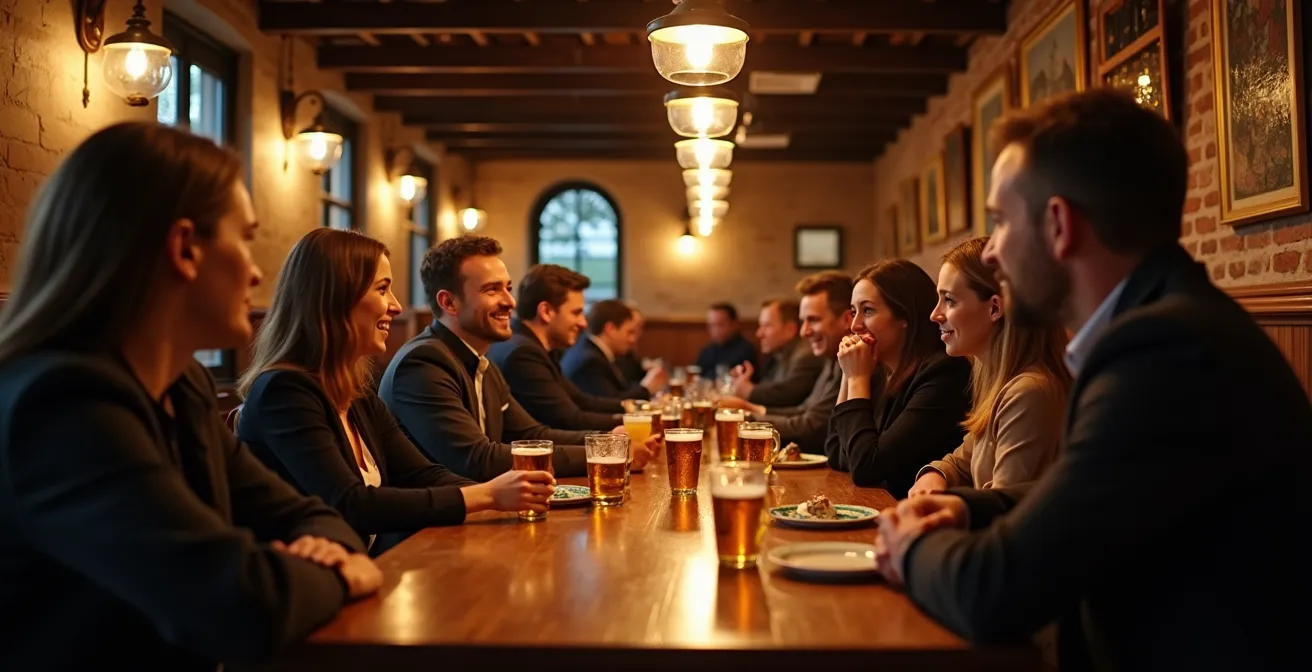
Online platforms, for all their efficiency, are fundamentally disembodied. They flatten this rich, multi-sensory experience into a stream of text or a disembodied voice. This is why even positive online interactions can leave us feeling strangely unfulfilled. Furthermore, Stanford psychiatry research reveals that investing excessive time in online-only relationships can actively detract from our capacity to engage in the more complex, nuanced, and ultimately more rewarding world of in-person connection. The very convenience of digital tools can inadvertently de-skill us in the art of embodied human interaction.
What Is “Psychological Safety” and Why Do You Feel Anxious in Your Group?
You’ve found a group that shares your niche interest. You “belong.” So why do you still feel a baseline of anxiety? Why do you hesitate to share a dissenting opinion or a personal struggle? The missing ingredient is likely psychological safety: a shared belief held by members of a team (or any group) that it is safe for interpersonal risk-taking. It’s the feeling that you won’t be punished or humiliated for speaking up with ideas, questions, concerns, or mistakes.
Many online communities, especially large and anonymous ones, are low in psychological safety. The environment is often performative, optimized for witty comments, impressive achievements, or strict adherence to group consensus. Vulnerability is a risk, not an asset. This constant, low-grade fear of social miscalculation creates a barrier to intimacy. You can have thousands of conversations without ever truly revealing yourself or feeling that others are revealing themselves to you. This is the essence of feeling lonely in a crowd—a crowd of avatars.
True connection is not built on shared interests alone; it is forged in shared vulnerability. It requires an environment where members feel secure enough to be imperfect. Without this safety, interactions remain transactional and superficial, providing entertainment or information but failing to meet our fundamental need for acceptance and belonging. The anxiety you feel is a rational response to an environment that implicitly signals that your full, authentic self is not welcome.
Action plan: Finding Psychologically Safe Online Spaces
- Target communities with explicit offline meeting components to ensure the group has a tangible, lasting presence.
- Choose groups focused on structured, collaborative activities (like a project or a book club) over open-ended chat forums.
- Prioritize communities with clear, actively enforced moderation and established group norms that encourage respectful discourse.
- Start with smaller, focused groups (ideally under 50 members) where trust and familiarity can be built more easily.
- Look for spaces that encourage vulnerability through structured sharing prompts or dedicated channels for deeper conversation.
How to Find Your “Third Place” (Besides Home and Work) in a New City?
Sociologist Ray Oldenburg coined the term “third place” to describe the vital anchors of community life that exist outside our two primary environments: the home (first place) and the workplace (second place). Third places are locations like cafés, pubs, libraries, barbershops, and community centers. They are the informal public spaces where people can gather, linger, and interact without a specific agenda. It is in these spaces that the spontaneous, serendipitous encounters that build a social fabric occur.
For many digital natives, the third place is not a physical location but a digital one: a Discord server, a subreddit, a Twitch stream. While these can provide a sense of community, they lack the crucial element of physical co-presence. The absence of physical third places in one’s life is a primary driver of modern loneliness. Despite a hyper-connected online life, recent UK statistics reveal that 37% of adults aged 16-29 report feeling lonely often or sometimes. The screen cannot replace the city square.

Finding your third place in a new city—or your own—is an active process of seeking out environments that encourage lingering and informal interaction. The key is to shift your mindset from “finding friends” to “finding a place.” It could be a weekly board game night at a local shop, an urban sketching group that meets in a park, a volunteer organization, or even just becoming a regular at a coffee shop where the barista knows your name. These places provide the container for relationships to form organically, without the pressure of a formal “social event.” They are the soil in which real community grows.
How to Reconnect with Old Friends Without It Feeling Awkward?
The prospect of reaching out to an old friend after months or years of silence can be daunting, fraught with the fear of awkwardness or rejection. The digital world can sometimes amplify this by creating an illusion of connection that isn’t there; you “see” their life on social media, but the actual bond has withered. However, it’s crucial to recognize that online tools can also serve as a powerful bridge, especially when physical distance or circumstance is a major barrier.
Consider the experience of those in isolated situations. A structured online environment can be a lifeline. As one member of a creative community for older adults shared:
“Goldster has been amazing and helped me get my life back when my husband died two years ago. It turned my life around. I live in a rural area, with limits to face-to-face activities and poor public transport. The online community gave me structure and connection when I needed it most.”
– Goldster Member, Open Access Government
This highlights a key principle: the most successful reconnections, whether online or off, are often built around a shared activity or structure, not a vague “let’s catch up.” The awkwardness of reconnection stems from the pressure to summarize vast swathes of life. Instead, frame the interaction around a new, shared experience. Suggest an activity you once enjoyed together, like seeing a band or playing a game. Propose creating a new, low-pressure ritual, like a monthly video call dedicated to discussing a book or film. The goal is not to perfectly recreate the past, but to acknowledge that you are both new versions of yourselves and to start building a new chapter of your relationship from where you are now.
Why We Take Criticism of Our Favorite Franchise Personally?
Have you ever felt a surge of genuine anger when someone criticizes your favorite movie, video game, or TV show? This seemingly irrational response is a powerful symptom of a modern psychological phenomenon: the parasocial relationship. This is a one-sided, unreciprocated relationship where one party feels a strong connection to a media figure or fictional character who is unaware of their existence. In the age of online fandoms and content creators who speak directly to “you,” these relationships have become pervasive.
When a significant portion of our social and emotional life is invested in a franchise or a creator, that entity becomes an extension of our own identity. A criticism of it feels like a criticism of us. This is the danger of substituting parasocial bonds for reciprocal ones. As Stanford psychiatrist Dr. Elias Aboujaoude notes, there is a significant risk of a feedback loop:
The risk is that the person who started out feeling lonely because of a lack of real-life friends and real-life connections, that person goes online, develops some online connections, and as a result ends up spending more and more time online.
– Dr. Elias Aboujaoude, Stanford University psychiatrist on technology and psychology
Case Study: The #StayHome #WithMe Phenomenon
During the COVID-19 pandemic, Clark University researchers analyzed over 1,400 YouTube videos tagged #StayHome #WithMe. They found that creators who adopted a parental or sibling-like persona, offering comfort and companionship, received significantly higher engagement. These parasocial bonds effectively moderated feelings of loneliness for many viewers. However, the study highlighted the core issue: these are one-sided, intimate connections that can ultimately substitute for, rather than supplement, the messy, complex, and reciprocal relationships that are essential for long-term mental health.
These parasocial bonds provide a predictable, safe form of connection without the risks of rejection or conflict inherent in real relationships. But they cannot fulfill the fundamental human need to be seen, known, and cared for by another person who is equally invested in the relationship. Recognizing when your investment in a fandom is becoming a substitute for real-world connection is the first step toward rebalancing your social portfolio.
Key Takeaways
- Digital loneliness is often a problem of quality, not quantity; it stems from a lack of embodied, psychologically safe interactions.
- True connection requires moving beyond shared interests to shared vulnerability, which is often difficult in performative online spaces.
- Actively creating or seeking out physical “Third Places” is a more effective strategy for building a social fabric than passively consuming digital content.
Why Ancient Festivals Have Followed the Same Script for 500 Years?
From the vibrant chaos of Holi in India to the solemn processions of Semana Santa in Spain, human cultures are built around collective rituals. These festivals are not just historical curiosities; they are powerful social technologies that have been refined over centuries to solve a fundamental problem: how to bind individuals together into a cohesive whole. The “script” they follow—involving synchronized movement, music, shared food, and distinctive attire—is designed to generate what sociologist Émile Durkheim called “collective effervescence.”
Collective effervescence is the palpable sense of energy, unity, and shared identity that emerges when a group comes together to participate in a ritual. It’s a psychological state where the individual ego dissolves into a larger social body. This is the feeling you get singing in unison at a concert, chanting at a sports match, or dancing in a crowd. It’s a deeply embodied, multi-sensory experience that cannot be replicated through a screen. This ancient human need for synchronous, collective experience is a stark contrast to the individuated, asynchronous nature of most online interaction.

The irony of our modern, connected age is that we have fewer opportunities for this kind of collective effervescence. This may partly explain a startling finding from Cigna research that demonstrates that younger, digitally native Americans are twice as likely to report feeling lonely as their senior counterparts. While older generations may have had stronger ties to community-based third places and rituals (local clubs, churches, town festivals), younger generations often seek connection in digital spaces that, by their very nature, struggle to generate this powerful, unifying energy.
Why Cultural Exchange Programs Reduce Prejudice More Effectively Than Politics?
Ultimately, curing loneliness and fostering a connected society hinge on our ability to bridge divides between “us” and “them.” For decades, social psychology has explored this through the lens of the Contact Hypothesis, a theory which posits that under the right conditions, interpersonal contact is one of the most effective ways to reduce prejudice between majority and minority group members. Political rhetoric often fails because it remains abstract, whereas direct, personal interaction makes the “other” real and relatable.
Even in the digital realm, this holds true. A large-scale meta-analysis of digital contact studies found that online interactions between different groups produced a small but statistically significant prejudice reduction (an effect size of g = 0.25). This shows that digital contact is better than no contact, but it also highlights its limitations. The most effective programs, like cultural exchanges, succeed because they meticulously engineer the “right conditions” for contact, conditions which are often absent in casual online forums.
So, what are these conditions? They provide a powerful summary of everything we’ve discussed and a clear roadmap for building genuine connection in any context.
Case Study: The Three Conditions for Meaningful Contact
Research on intercultural programs, such as one at Japan’s Yokohama City International Exchange Lounge, demonstrates the three critical conditions for contact to be effective, as first outlined by psychologist Gordon Allport. First, participants must have Equal Status within the group, dismantling hierarchies. Second, they must pursue Common Goals through cooperative activity, like organizing a community festival, which forces them to rely on each other. Third, there must be Institutional Support from authority figures or established rules that explicitly sanction the contact and promote norms of acceptance. These three pillars transform simple proximity into genuine connection.
These principles are the antidote to the passive, disembodied, and often unsafe nature of generic online communities. Whether you are building a new social circle or strengthening an online group, the path forward is the same: seek or create environments that foster equality, unite people in a shared purpose, and are governed by norms of respect and safety. This is the science of belonging.
To put these insights into practice, the next logical step is to stop passively consuming online content and start actively building or joining communities—online or off—that are deliberately structured around these principles of shared goals, equal status, and psychological safety.