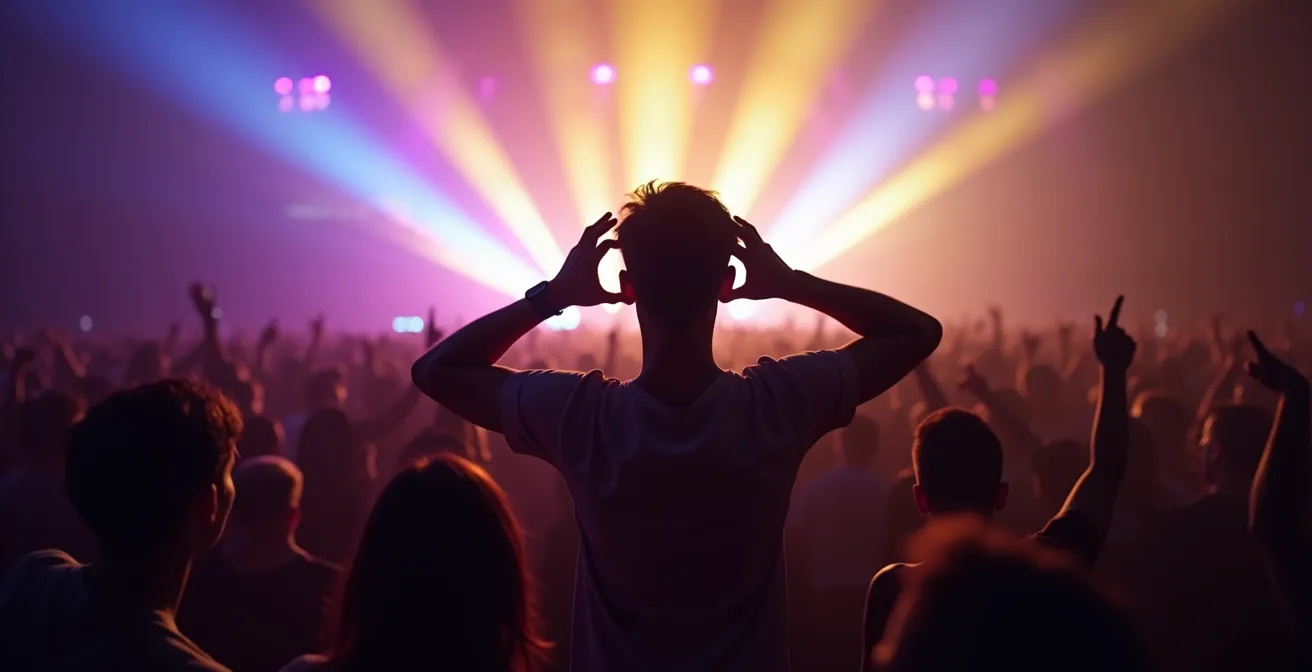
Forgetting a concert isn’t a sign of a bad memory; it’s proof your brain was prioritizing the intense, in-the-moment experience over creating a detailed recording.
- Extreme volume and emotional highs create “cognitive overload,” forcing your brain to allocate resources away from memory encoding.
- Actions like filming or worrying about tickets actively disrupt the memory-making process by consuming your limited attention.
Recommendation: Use high-fidelity earplugs and manage pre-show stress to reduce this cognitive load, helping your brain capture more lasting memories of the event.
You leave the venue, ears ringing, heart pounding, wrapped in the euphoric afterglow of a truly phenomenal concert. You try to recount the show to a friend, to relive the magic, but when you try to recall the second song of the encore or the exact order of the setlist, you draw a blank. It’s a frustratingly common experience for any dedicated fan: a vivid emotional memory paired with a blurry, fragmented recollection of the details. This phenomenon, often called “post-concert amnesia,” leaves many feeling like their own minds have betrayed them.
The common explanations often point to simple sensory overload or being “too excited.” While these factors play a role, they only scratch the surface. The advice to simply “put your phone away and be present” is well-intentioned but fails to address the powerful cognitive mechanics at play. The truth is far more complex and fascinating. Your brain isn’t failing; it’s performing a kind of cognitive triage, making split-second decisions about where to allocate its limited resources.
This article reframes the conversation. Instead of treating memory as a faulty recording device, we will explore it as a resource-allocation system. We’ll delve into the cognitive science of why your brain actively chooses the immediate, overwhelming experience over meticulous long-term encoding. By understanding this trade-off, you can learn to work *with* your brain’s natural processes, not against them. We will dissect how factors like sound, stress, and focus directly impact your brain’s ability to form lasting memories and provide strategies to help you hold onto more of the magic from your next show.
This guide breaks down the cognitive processes behind concert memory, offering a new perspective on how to enhance your ability to remember the shows you love. The following sections explore each critical factor, from the science of hearing to the psychology of being in a crowd.
Summary: Understanding and Overcoming Post-Concert Amnesia
- Why High-Fidelity Earplugs Are the Best Investment for Frequent Concertgoers?
- How to Secure a Front-Row Spot Without Camping Overnight?
- Stadium Spectacle vs. Club Intimacy: Which Venue Justifies the Ticket Price?
- The Resale Scam That Targets Desperate Fans 24 Hours Before the Show
- Phone Recording vs. Being Present: Does Filming Ruin Your Memory of the Show?
- The Volume Mistake That Damages Your Hearing During Headphone Use
- How to Secure a Spot in Popular Workshops Before They Sell Out in Minutes?
- Why a Live Play Affects Your Empathy Levels More Than a Movie?
Why High-Fidelity Earplugs Are the Best Investment for Frequent Concertgoers?
The first barrier to forming a stable concert memory isn’t emotional; it’s auditory. Your brain has a finite budget of cognitive resources, and when it’s overwhelmed by noise, it diverts a massive portion of that budget simply to process the sound. This is the essence of cognitive load. A loud, distorted sonic environment forces your brain to work overtime just to decode the music, leaving precious few resources for higher-order functions like memory encoding. Protecting your hearing, therefore, is not just about preventing long-term damage; it’s a direct strategy for improving memory formation.
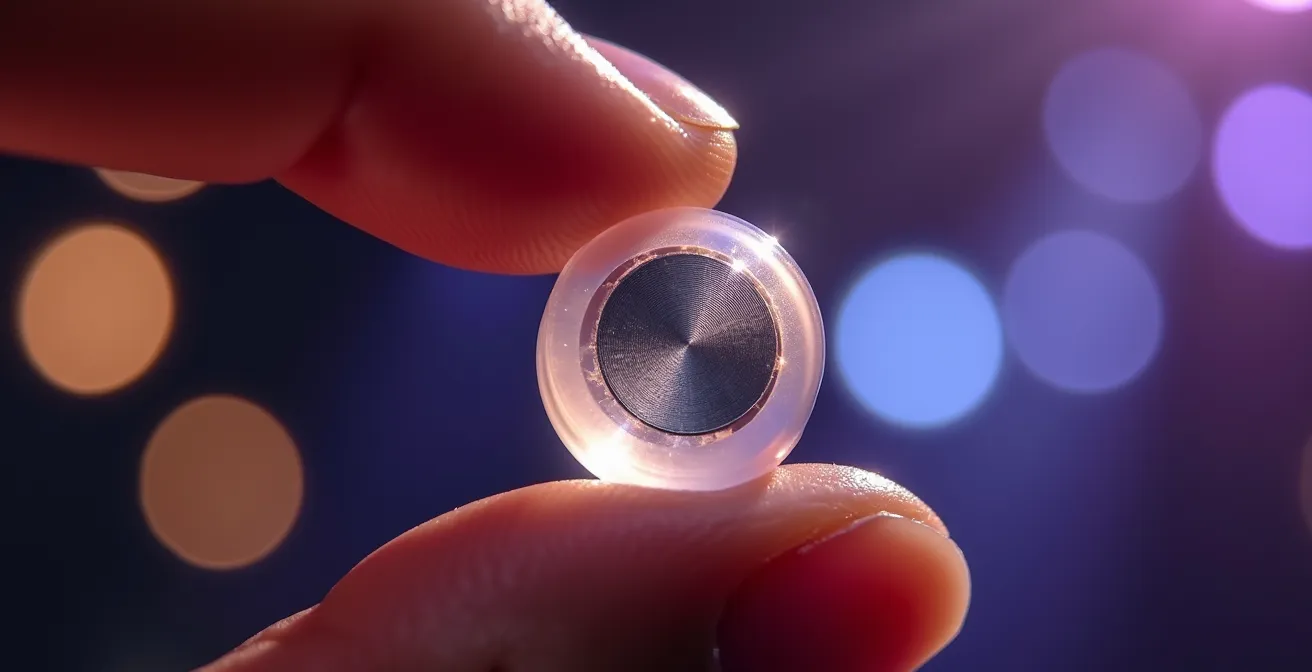
Unlike foam plugs that muffle sound indiscriminately, high-fidelity earplugs are designed with acoustic filters that lower the decibel level evenly across the frequency spectrum. This doesn’t just make the music safer to listen to; it makes it clearer. By reducing the “noise” and clarifying the “signal,” these earplugs drastically reduce the cognitive load on your auditory cortex. As Framingham Heart Study researchers have noted in a study on cognitive load, “When hearing becomes difficult, the brain reallocates resources to decode sound, leaving fewer resources for memory formation.” By making hearing easier, you free up those resources. Indeed, broad research from a meta-analysis covering over 137,000 participants shows that using hearing protection is associated with a significantly reduced risk of cognitive decline over time.
How to Secure a Front-Row Spot Without Camping Overnight?
While the title suggests a tactical guide for getting to the barricade, the underlying principle is about finding your “mental sweet spot.” Where you are physically in a venue has a profound impact on what your brain can process and, therefore, what you remember. Being crushed at the front might offer proximity, but it can also be a source of intense physical stress and sensory chaos, contributing to what research on concert-goers reveals that many experience as ‘post-concert amnesia’. The ideal spot for memory formation isn’t necessarily the closest, but the one that offers the best balance of sensory input and personal comfort.
Think of a concert as a story being told through a setlist. To remember a story, you need to be able to follow its narrative arc. If you are constantly being jostled, worrying about your personal space, or overwhelmed by a poorly mixed sound system, your brain’s resources are diverted to managing these immediate threats and discomforts. It’s stuck in “survival mode,” not “story mode.” The so-called “sweet spot” of a venue—often near the soundboard—is prized by audio engineers for a reason: it’s where the sound is most balanced and clear. Being in this location can reduce the cognitive load associated with deciphering muddy audio, allowing your brain to better engage with the music’s structure and emotional journey.
Securing this optimal spot isn’t about out-competing other fans; it’s about making a strategic choice for your own cognitive experience. It may mean sacrificing a bit of proximity for a massive gain in clarity and a reduction in environmental stress, giving your brain the best possible chance to encode the performance as a coherent memory.
Stadium Spectacle vs. Club Intimacy: Which Venue Justifies the Ticket Price?
The venue itself is a powerful variable in the memory equation. A massive stadium show and an intimate club performance engage your brain in fundamentally different ways. While the stadium offers epic spectacle, the sheer scale can be a primary source of cognitive overload. The vast crowds, echoing acoustics, and distance from the artist create a detached, impersonal experience that is often harder for the brain to consolidate into a personal, lasting memory. You might remember the flash and the scale, but the nuanced emotional connection can be lost.
Conversely, intimate venues foster an environment ripe for creating autobiographical memories—memories tied directly to your personal life and sense of self. These are among the most powerful and enduring types of memories we have. The proximity to the artist, the shared experience with a smaller crowd, and the clarity of the sound can create a potent emotional cocktail. This is reflected in brain activity. For example, a 2009 UC Davis study using fMRI scanning found that the upper medial pre-frontal cortex, a region linked to self-reflection and personal memory, shows greater activity when music triggers these autobiographical connections.
As cognitive neuroscientist Petr Janata explains, “Listening to a piece of familiar music serves as a soundtrack for a mental movie that starts playing in our head, calling back memories of a particular person or place.” A small club setting, where you can see the artist’s expressions and feel the collective energy of the room, is far more likely to forge that strong link between the music and your personal “mental movie” than a distant stadium spectacle. The ticket price, then, might be justified not by the size of the production, but by the potential for a deeper, more memorable cognitive experience.
The Resale Scam That Targets Desperate Fans 24 Hours Before the Show
The stress of securing a ticket—especially when dealing with the high-stakes, time-sensitive pressure of the resale market—is a perfect saboteur of memory. This issue isn’t just about the financial anxiety of a potential scam; it’s about how high levels of stress and excitement hijack the brain’s resources long before the first note is played. The intense emotional state triggered by the ticket-buying frenzy, a phenomenon well-documented during events like the Taylor Swift Eras Tour, floods your system with cortisol and adrenaline. While these hormones are great for high-alert situations, they are terrible for the nuanced process of memory encoding.
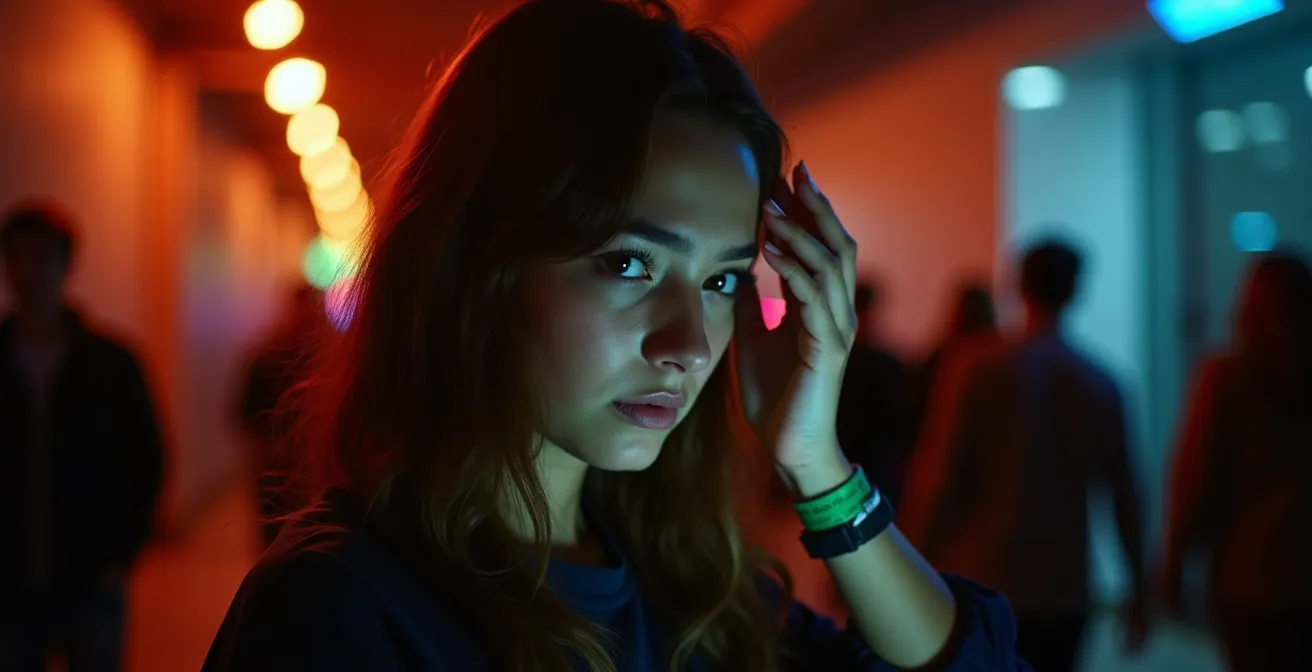
When you finally get into the venue, your brain isn’t starting from a calm baseline. It’s already been on an emotional rollercoaster. This heightened state of arousal makes it difficult to settle into the focused attention required for memory formation. Your brain is still processing the “threat” of missing out, which consumes the very cognitive bandwidth you need to absorb the show. This aligns with the idea that our brains are built for living, not just for recording. As Dr. Robert Kraft, a psychologist who has studied the phenomenon, stated in a TIME Magazine interview:
We don’t set out to remember our lives—we set out to experience them. Not remembering is actually a tribute to being in the moment and enjoying it.
– Dr. Robert Kraft, TIME Magazine
This perspective is crucial: the intense, all-consuming emotion of the experience, amplified by pre-show stress, forces your brain to allocate all resources to “experiencing.” The trade-off is that very little is left for “encoding.” The memory gap isn’t a failure; it’s a sign that you were, in a very real cognitive sense, completely overwhelmed by the moment.
Phone Recording vs. Being Present: Does Filming Ruin Your Memory of the Show?
The advice to “put your phone away” is common, but the cognitive reason why it works is often missed. The issue isn’t just that you’re “not in the moment.” When you raise your phone to record a concert, you are engaging in a process known as attentional offloading. You are, in essence, telling your brain, “You don’t need to remember this; the phone is doing it for you.” This act of delegation causes the brain to disengage the very encoding mechanisms it would otherwise use to create a long-term memory.
This isn’t just theory; it’s a measurable phenomenon. Research on the “photo-taking impairment effect” has consistently shown that dividing your attention between experiencing an event and documenting it compromises your memory of it. For instance, University of California research found that participants who extensively documented experiences showed significantly decreased recall of specific details compared to those who simply observed. The act of framing the shot, checking the focus, and holding the phone steady consumes attentional resources that would otherwise be used to process the performance itself.
So what is the alternative? If you feel the urge to document, consider a more cognitively engaging method. Research from a 2021 study in Frontiers in Psychology highlights that the physical act of handwriting activates brain regions crucial for learning and memory in ways that digital input doesn’t. Instead of filming a whole song, try quickly jotting down the title of a song that surprises you, or a specific lyric that stands out. This small, tactile act engages your brain differently, forcing a deeper level of processing and creating a stronger neural hook for that memory without pulling you completely out of the experience.
The Volume Mistake That Damages Your Hearing During Headphone Use
While the title references headphones, the principle of volume applies with even greater force to the live concert environment. The sheer volume of a typical concert is a primary antagonist to memory formation. Data from the CDC confirms that concerts average 110dB to 120dB, a level that is not just dangerous for your hearing but also creates a punishing amount of cognitive load. At these volumes, your brain isn’t just listening to music; it’s defending itself against a sonic assault. This constant, high-intensity processing depletes the mental energy needed to form detailed memories of the performance.
Your auditory system is a finely tuned instrument. Exposing it to extreme volumes without preparation is like asking an athlete to sprint a marathon without a warmup. The system becomes fatigued and less efficient. However, you can take steps to “recalibrate” your hearing before a show, making it more resilient and efficient, thereby preserving cognitive resources for memory. By resetting your auditory baseline, you can help your brain process the concert’s sound more effectively, leaving more capacity for enjoying and remembering the show.
Your Auditory Recalibration Plan
- Practice a ‘sonic detox’: For 24-48 hours before the concert, avoid using headphones or exposing yourself to loud environments.
- Prime with quiet music: Listen to quiet, uncompressed acoustic music at low volumes to increase your ears’ sensitivity and prepare them for detailed listening.
- Find silence: Spend some time in relative silence on the day of the show to fully reset your auditory baseline.
- Use the right tool: Opt for high-fidelity earplugs with a 17-20dB reduction, which lower volume without sacrificing clarity, unlike foam plugs.
- Take ‘sound breaks’: During the show, step away from the main speakers for 5-10 minutes to give your auditory system a chance to rest and recover.
How to Secure a Spot in Popular Workshops Before They Sell Out in Minutes?
The act of memory doesn’t just happen during the event. This title, while about workshops, speaks to a deeper truth about anticipation and preparation. “Securing a spot” for a memory in your brain begins long before the concert and ends long after. The process involves two key phases: priming before the event and consolidation after it. Neglecting either one is like trying to grow a plant by only watering it once.
Priming your brain involves building a mental framework for the memories to latch onto. Listening to the artist’s discography in the days leading up to the show does more than just build excitement. It activates neural pathways and creates memory “hooks.” Research has shown that listening to music we enjoy can increase dopamine levels in the brain by up to 9%, creating a powerful link between pleasure and the auditory information. When you hear those songs live, your brain already has a well-established network to connect the new, vibrant experience to.
After the show, the most critical activity for memory is sleep. This is when memory consolidation occurs. As explained by Dr. Andrew Budson of Harvard Medical School, during sleep the brain actively works to strengthen and link new memories. He describes it as a process where fragile, temporary memories (“balloons”) become interconnected with strong, permanent ones (“heavy cords”). Skipping sleep or having a restless night after a concert can severely disrupt this crucial process, causing the fragile new memories of the show to simply drift away before they can be properly stored.
Key takeaways
- Your brain has limited cognitive resources; high volume and emotional stress consume these resources, leaving less for memory.
- High-fidelity earplugs are a cognitive tool that reduces auditory load, freeing up brainpower for memory encoding.
- Actively managing pre-show stress and choosing a comfortable spot in the venue can significantly reduce cognitive overload.
Why a Live Play Affects Your Empathy Levels More Than a Movie?
Ultimately, what we truly remember from a live performance is rarely a perfect, chronological record. The title’s comparison of a play to a movie highlights a key element: the power of a shared, tangible experience. Like a play, a concert is a unique, unrepeatable event happening in real-time with a community of others. This shared emotional energy is what leaves the most profound mark on our minds. The blank spaces in your memory aren’t a defect; they are the result of your brain prioritizing the overwhelming feeling of connection and emotional resonance over the factual details of a setlist.
The most enduring memories are not the “what” but the “how it felt.” You remember the chill you got when thousands of people sang a chorus in unison. You remember the burst of joy when the band played a deep cut you love. You remember the connection you felt with your friends beside you. These are fragments of emotional residue. Your brain, in its cognitive triage, correctly identifies these peaks of emotion and connection as the most important data to save. The rest is often deemed secondary.
So, instead of fighting your brain, work with it. Lean into creating those emotional peaks. Allow yourself to be fully present in a powerful moment without the distracting urge to film it. Reduce the cognitive noise with earplugs so your brain can focus on the music’s emotional core. Prepare your mind beforehand and allow it to rest afterward. By doing so, you may not remember every single song in order, but you will build a stronger, more resonant collection of emotional moments—and in the end, that is the true purpose of a live show.
The next time you prepare for a show, don’t just think about your ticket and your outfit. Think about your cognitive state. By applying these principles, you can actively help your brain not just experience the show, but create a more lasting and satisfying memory of it.