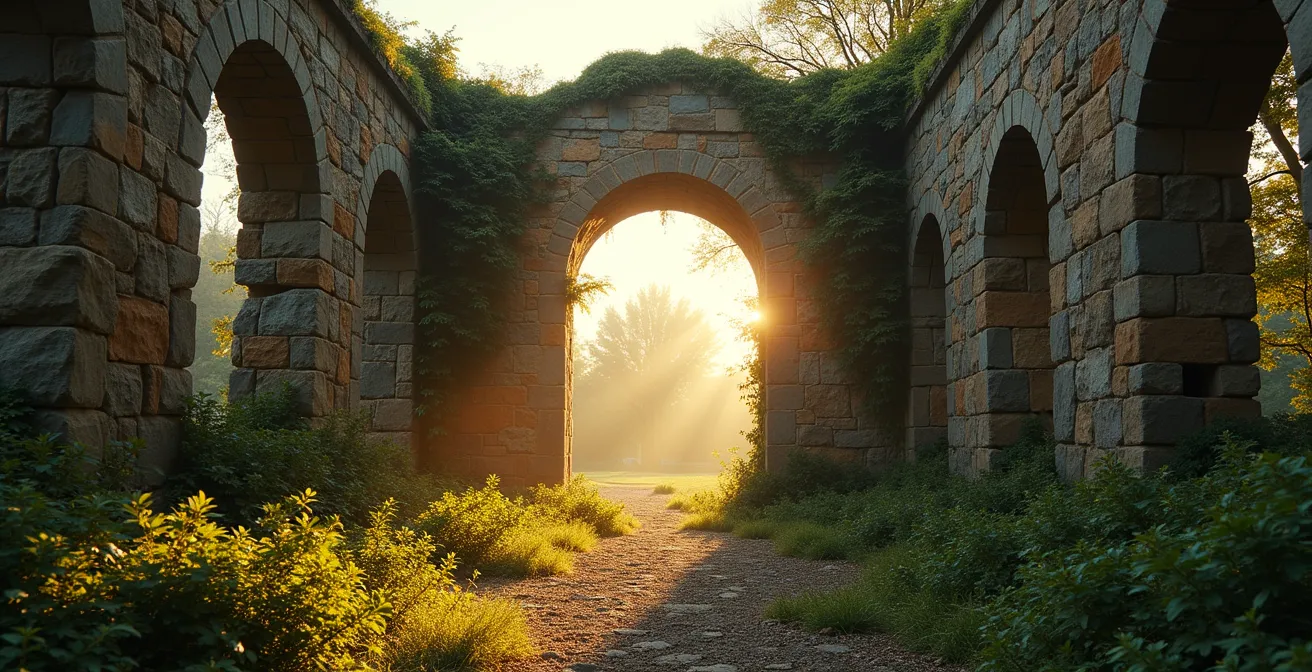
Contrary to popular belief, the beauty of ruins is not found in what they were, but in the imaginative space created by their incompleteness.
- The allure of decay transcends simple nostalgia or the thrill of discovery; it invites us into a dynamic dialogue with time itself.
- Authentic engagement with a ruin means becoming a co-creator of its narrative, filling the gaps left by destruction with our own contemplation.
Recommendation: Shift your perspective from passively viewing ruins as historical objects to actively “reading” their decay as a text about impermanence and imagination.
There is a profound and unsettling beauty in a place that has been forgotten by time. For the urban explorer or history buff weary of the polished floors and velvet ropes of pristine museums, the allure of a crumbling wall or a silent, dust-filled factory is magnetic. It’s a pull that goes far beyond a simple appreciation for history. It is an aesthetic experience, a philosophical encounter with the concepts of time, memory, and decay itself. This attraction is often dismissed as mere nostalgia or, in its most contemporary form, the controversial trend of “ruin porn”—the aestheticization of decay for social media.
While these elements play a part, they fail to capture the core of the phenomenon. The true power of a ruin lies not in a romanticized past, but in its profound and provocative incompleteness. A perfectly preserved historical site tells a finished story, leaving little room for the observer’s mind. A ruin, by contrast, is a question. Its missing roofs, fractured walls, and encroaching nature create what we can call an “imaginative gap”—a void that our consciousness instinctively rushes to fill. This article delves into that very gap.
We will dissect the superficial appeal of “ruin porn,” then pivot to the practical and ethical methods of genuine discovery. We will weigh the curated experience of a heritage site against the raw authenticity of a forgotten structure, and address the crucial safety and legal considerations that ground this poetic pursuit in harsh reality. Ultimately, this exploration will equip you not just to find abandoned places, but to understand why they find you, transforming you from a mere visitor into an active participant in their ongoing story—an observer as co-creator.
This guide offers a complete framework for understanding and engaging with the aesthetics of decay. From the ethics of online sharing to the art of reading a building’s history in its scars, the following sections will navigate the complex world of abandoned places.
Summary: The Philosophical Pull of Crumbling Stone
- How “Ruin Porn” Photography Exploits Decay for Likes?
- How to Use Google Earth to Spot Undiscovered Ruins in Your Area?
- Official Heritage Site vs. Forgotten Ruin: Which Offers True Discovery?
- The Safety Check You Must Do Before Entering an Unstable Building
- How to Explore Sensitive Sites Without Accelerating Their Destruction?
- The Trespassing Fine That Can Cost You $500 While Exploring Ruins
- Reconstructed Sites vs. Untouched Ruins: Which Is More Authentic?
- Why Reading Buildings Tells You More About a City Than a Guidebook?
How “Ruin Porn” Photography Exploits Decay for Likes?
The term “ruin porn” describes the contemporary trend of photographing and sharing images of urban decay, often without historical context or deeper commentary, purely for their dramatic and melancholic aesthetic. It is the visual consumption of decline, where the texture of peeling paint and the pathos of a collapsed roof become commodities in the attention economy of social media. This phenomenon has exploded in popularity, with some YouTube channels dedicated to exploring abandoned locations reaching massive audiences; Exploring With Josh alone has over 4.7 million subscribers and hundreds of millions of views.
The core critique of ruin porn is its potential for superficiality. It can reduce complex histories of economic collapse, community displacement, and personal loss into a single, aesthetically pleasing, and easily shareable image. The “why” behind the abandonment is often lost, replaced by a detached admiration of the visual spectacle. It is a passive appreciation, one that risks turning a place of memory into a hollow backdrop for a photograph, valuing the symptom (decay) over the cause (history).
However, not all explorations of decay fall into this trap. Thoughtful documentarians find a way to navigate this complex territory by infusing their work with context and respect. They move beyond the simple visual to unearth the human stories embedded within the walls. This approach finds a deeper resonance, tapping into a shared sense of loss and nostalgia that is specific and poignant rather than general and aestheticized. As a case study, the work of filmmaker Dan Bell shows this distinction. As one analysis notes, his “Dead Mall Series” finds beauty and sadness in the specificity of these losses, using old commercials and relics of Americana to evoke a powerful sense of time and place, rather than just empty decay.
How to Use Google Earth to Spot Undiscovered Ruins in Your Area?
Transitioning from a passive viewer of ruin photography to an active discoverer requires a new set of tools, and the most powerful of these is often already at your fingertips: digital cartography. Platforms like Google Earth and other satellite imagery services have become the modern-day treasure maps for the discerning urban explorer. They allow one to become a “digital flâneur,” wandering landscapes from above in search of the subtle signatures of abandonment. This process is a form of digital archaeology, demanding a trained eye for spotting anomalies in the landscape that betray the presence of forgotten structures.
The key is to look for the unnatural within the natural. Human construction, even after decades of neglect, leaves scars and patterns that are distinct from their surroundings. A perfectly straight line of trees might mark an old railway. A rectangular discoloration in a field could be the footprint of a demolished factory. These are the whispers of history, visible only from a perspective that transcends the ground level. Mastering this art is about learning a new visual language, one composed of shadows, textures, and geometric interruptions.
To begin your search, you must look for the subtle giveaways that nature has not yet fully erased. The image below illustrates the kind of textural and geometric clues one might find from an aerial perspective—overgrown foundations and weathered patterns that hint at a story beneath the surface.
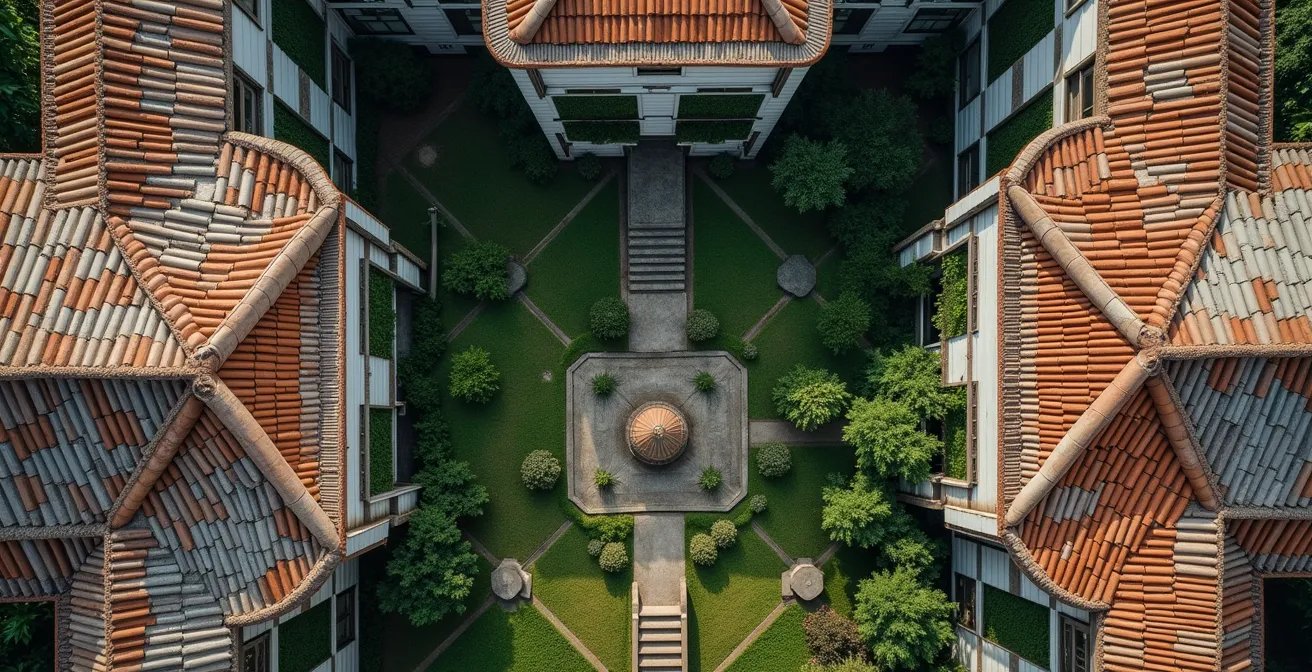
As this overhead view suggests, the landscape becomes a canvas of clues. To develop your skills in this digital archaeology, focus on identifying unnatural geometric patterns in vegetation, discolored soil patches that indicate former foundations, abandoned railway lines visible as straight paths, and areas near former industrial or mining zones. Using historical overlay features, where available, can be revelatory, allowing you to directly compare a region’s past with its present state of overgrowth and decay.
Official Heritage Site vs. Forgotten Ruin: Which Offers True Discovery?
The world offers two distinct ways to experience the past: the official heritage site and the forgotten ruin. The former is a curated, protected, and interpreted space—think of a restored castle or a national monument. It presents a clear, sanctioned narrative. The latter is an untamed, uncurated, and often unprotected entity, left to the forces of nature and the interpretation of the few who find it. For the explorer bored by pristine artifacts, the choice between them is a philosophical one, revolving around the very nature of discovery and authenticity. A heritage site offers education; a ruin offers a dialogue.
The managed site, for all its historical accuracy, presents a finished story. It is a monologue delivered by the past to the present. The experience is largely passive; you are a consumer of a pre-packaged history. The forgotten ruin, in stark contrast, is defined by its “imaginative gap.” Its state of decay is not a flaw but its most powerful feature. The missing information, the crumbling walls, the silence—these are invitations for the observer’s mind to engage, to question, to speculate. You are no longer a consumer but a co-creator of meaning. As author Christopher Woodward eloquently puts it:
Ruins do not merely represent the past; they allow us to dream. Perhaps it is for their dreams that ruins are beloved: the dream of survival; the dream of destruction
– Christopher Woodward, In Ruins
This difference is perfectly illustrated by the temples of Angkor in Cambodia. While Angkor Wat itself is a magnificently preserved monument, the nearby Ta Prohm temple offers a different kind of sublime experience. Abandoned for centuries after the fall of the Khmer Empire, Ta Prohm was consumed by the jungle. Giant silk-cotton trees wrap their roots around the stone, prying apart galleries and courtyards. While today it is managed to prevent total collapse, its stewards have wisely chosen to maintain its “ruined” state. They recognized that its power lies in this very tension between human architecture and natural reclamation. It is a testament to the beauty of impermanence, an experience of time’s passage that a fully restored temple could never provide.
The Safety Check You Must Do Before Entering an Unstable Building
The philosophical allure of decay is powerful, but it must never overshadow the raw, physical danger inherent in abandoned structures. A ruin is not a static museum piece; it is an active process of collapse. Gravity, moisture, and time are relentless forces, and every entry into an unstable building is a calculated risk. The most seasoned urban explorers are not daredevils but meticulous risk assessors who understand that survival depends on a multi-sensory evaluation of a building’s integrity before a single foot is placed inside. This assessment is not a suggestion; it is the first and most critical act of any exploration.
Your senses are your primary tools. Before even approaching an entrance, your eyes must scan for the tell-tale signs of extreme structural stress: sagging rooflines, major fissures in exterior walls, or a noticeable tilt in the entire structure. These are red flags indicating a potential for catastrophic failure. Once nearer, your hearing becomes crucial. The building speaks a language of stress; listen for creaking, groaning, or the sound of shifting debris, which can signal that the structure is actively settling or nearing a breaking point. Your sense of caution is paramount, as demonstrated by the careful explorer in the image, using a tool to test the ground ahead.

This cautious approach is vital because the most common dangers are often hidden. As documented by safety experts, floors, roofs, and staircases account for the majority of collapse incidents in derelict buildings. A floor that appears solid may be rotted from beneath by years of water damage. Never trust a surface without testing it first, ideally with a long, sturdy stick or pole to probe for soft spots before committing your full weight. Beyond structural risks, be aware of environmental hazards like friable asbestos, lead paint dust, mold, and chemical contamination, especially in former industrial sites. A proper respirator is not an over-precaution; it’s essential equipment.
Your Pre-Entry Safety Checklist: A Practical Guide
- Assess structural integrity from the outside: Look for sagging roofs, major cracks, or tilting walls.
- Test floors and stairs carefully: Use a probing stick to check for soft or weak spots before applying your full weight.
- Listen for signs of stress: Pay attention to any creaking, groaning, or shifting sounds from the structure.
- Identify environmental hazards: Be aware of the potential for asbestos, lead paint, mold, and chemical residues. Wear a respirator if needed.
- Never explore alone: Always have a partner, and inform a third party of your location and expected return time. Carry a first aid kit.
How to Explore Sensitive Sites Without Accelerating Their Destruction?
True appreciation for a ruin extends beyond personal discovery; it involves a deep commitment to its preservation. The goal of an ethical explorer is to experience a place so gently that their presence is imperceptible, leaving it exactly as they found it for the next person and for time itself. This philosophy is perfectly encapsulated in the community’s most sacred mantra: “Take nothing but pictures, leave nothing but footprints.” This is not merely a catchy phrase but the foundational principle of a practice that respects the integrity of the site above the desires of the individual.
This principle extends beyond the obvious prohibition against theft or vandalism. It is a comprehensive ethos that governs every interaction with the space. One of the most critical and often violated tenets is the protection of a site’s location. Sharing exact coordinates or geotagging photos on social media can be a death sentence for a fragile place, inviting waves of unprepared, disrespectful visitors who can accelerate its destruction. The thrill of discovery is a privilege that comes with the responsibility of secrecy.
Furthermore, an ethical explorer understands that a ruin is not a film set. They resist the urge to “stage” photographs by moving objects, as doing so erases the authentic story of the place’s final moments. They are also conscious of their biological impact. The mosses and lichens that carpet old stone can take decades, even centuries, to grow; a single careless step can destroy an ecosystem. This respect extends to wildlife that has made the ruin a habitat. To explore ethically is to be a ghost—a silent observer who documents and appreciates without altering the scene. The core tenets include:
- Never sharing specific locations publicly.
- Not moving or staging objects for better photos.
- Avoiding disturbance to wildlife and delicate biotic growth like moss.
- Documenting sites to preserve their memory, especially if demolition is imminent.
- Reporting critical structural dangers to authorities if a site poses a public risk.
The Trespassing Fine That Can Cost You $500 While Exploring Ruins
The line between an abandoned space and private property is rarely marked with a clear sign, but in the eyes of the law, it is absolute. For all the philosophical and aesthetic justifications, the act of entering a derelict building without permission is, in most jurisdictions, criminal trespassing. This is the harsh, non-negotiable reality that grounds the romantic pursuit of urban exploration. Ignoring this fact can turn an afternoon of discovery into a costly and legally fraught encounter. The consequences are not trivial; a typical trespassing fine can be around $500, and in cases involving critical infrastructure or sites deemed sensitive, charges can escalate to a felony level.
The “no harm, no foul” mentality is not a legal defense. The argument that a building is “abandoned” and therefore ownerless is almost always incorrect. Every piece of land has an owner—be it a private individual, a corporation, or a government entity. The state of disrepair does not nullify property rights. An ethical explorer must accept this risk as part of the practice or, better yet, seek ways to engage with these spaces legally. The most rewarding explorations are often those undertaken with explicit permission, transforming the explorer from a trespasser into an invited guest or a sanctioned documentarian.
Seeking permission can open doors—literally and figuratively. It can lead to richer experiences, providing access to historical information and personal stories from the owners themselves. A powerful example of this is the story of Stuart and Katie McDaniel, who didn’t just explore an abandoned church in Tulsa; they sought to save it. Their journey to acquire and preserve The Second Presbyterian Church, transforming it from a decaying structure into a future community center, shows the ultimate form of respectful engagement. It moves beyond passive observation to active preservation, a path that begins with respecting the legal status of a place rather than ignoring it.
Key takeaways
- The allure of ruins goes beyond “ruin porn”; its true value lies in the “imaginative gap” that decay creates, inviting observer participation.
- Responsible exploration is a balance of three elements: the practical skill to find sites, the critical duty to assess safety, and the unwavering ethical commitment to leave no trace.
- A ruin’s authenticity is found in its incompleteness and the dialogue it opens with time, an experience a fully reconstructed site can’t replicate.
Reconstructed Sites vs. Untouched Ruins: Which Is More Authentic?
The concept of “authenticity” lies at the heart of the debate between visiting a meticulously reconstructed heritage site and a wild, untouched ruin. What makes an experience of the past genuine? Is it the material accuracy of a rebuilt structure, or the emotional resonance of witnessing original materials succumbing to time? A reconstructed site offers an authentic glimpse into what life was like in the past. An untouched ruin offers an authentic experience of the passage of time itself. The former is a history lesson; the latter is a philosophical meditation.
As the architect Juhani Pallasmaa noted, “When old walls crumble, they yield an expanding sense of freedom and imagination.” This freedom is precisely what a fully restored building, with its prescribed narrative and singular interpretation, often lacks. The authenticity of a ruin is not material but experiential. It is found in the dialogue between original substance and the forces of decay. The weathered stone, the rust, the overgrowth—these are not imperfections but the very language of time made visible. They provide multiple layers of interpretation that a sanitized reconstruction erases.
The following table breaks down this philosophical distinction, comparing the two experiences across several aspects of authenticity. As the data from a recent comparative analysis shows, each offers a different, yet valid, form of connection to history.
| Aspect | Reconstructed Sites | Untouched Ruins |
|---|---|---|
| Historical Experience | Life in the past | Passage of time itself |
| Imagination Required | Limited – prescribed narrative | High – visitor co-creates story |
| Material Authenticity | Often replaced components | Original weathered materials |
| Emotional Response | Awe and respect for finished past | Empathy and connection to ongoing decay |
| Educational Value | Clear historical narrative | Multiple interpretive layers |
Ultimately, the untouched ruin provides a more profound connection for the explorer seeking not just facts, but feeling. It demands more from the visitor, requiring them to engage their imagination and empathy to complete the picture. This act of mental participation, this co-creation of the ruin’s story, is perhaps the most authentic experience one can have with the past.
Why Reading Buildings Tells You More About a City Than a Guidebook?
A city guidebook tells you where to look. Learning to “read” buildings tells you how to see. For the thoughtful observer, the urban landscape is not a collection of destinations but an “architectural palimpsest”—a manuscript written, erased, and rewritten over centuries. Every faded advertisement on a brick wall, every filled-in window, every mismatched style of brickwork is a word in a sentence about the city’s economic fortunes, social changes, and forgotten ambitions. This architectural literacy offers a richer, more nuanced understanding of a place’s soul than any curated tour ever could.
This is especially true in cities that have undergone dramatic transformations. The story of Detroit, for instance, is written most poignantly in its crumbling landmarks. As photographers who documented its decline noted, visitors experience two Detroits: the revitalized downtown and the empty, decaying structures that surround it. These ruins are not an anomaly; they are a fundamental chapter of the city’s narrative, speaking to the decline of an industrial empire and the complex social shifts that followed. To ignore them is to read an abridged and incomplete version of the city’s story.
Case Study: Detroit’s Architectural Palimpsest
The photo series “The Ruins of Detroit” by Yves Marchand and Romain Meffre captured the city’s dying landmarks at a critical moment. By focusing on grand theaters, ballrooms, and once-proud office buildings left to decay, they revealed a hidden narrative of the city’s history. Their work shows that these buildings are more than empty shells; they are artifacts of a specific moment of economic and social upheaval. Reading these ruins reveals the story of the automotive industry’s decline and the subsequent urban flight in a way no history book can fully convey, demonstrating how decay itself can be a primary historical source.
Learning to read these architectural clues transforms a simple walk into an act of historical investigation. It trains your eye to see the evidence of change and to ask “why.” Why was that elegant archway bricked up? What business was once advertised by that ghost sign? This skill makes you an active interpreter of your environment, not a passive consumer. You begin to understand the city as a dynamic, living organism, constantly in a state of flux. The following guide offers a starting point for developing this urban semiotic sense.
- Identify architectural eras through window styles and materials.
- Read “ghost signs”—faded painted advertisements on brick walls—to uncover past commerce.
- Spot filled-in windows or doorways, often indicating economic downturns or changes in building use.
- Notice mismatched brickwork, which reveals repairs, expansions, or modifications over time.
- Observe how adaptive reuse—a warehouse turned into lofts, a church into a library—tells stories of neighborhood evolution.
Start looking at your own city not as a finished product, but as a living manuscript of stone and brick. The next time you see a faded sign on a wall or a boarded-up window on a forgotten street, do not just walk by. Stop, and begin to read the stories that are waiting to be told.