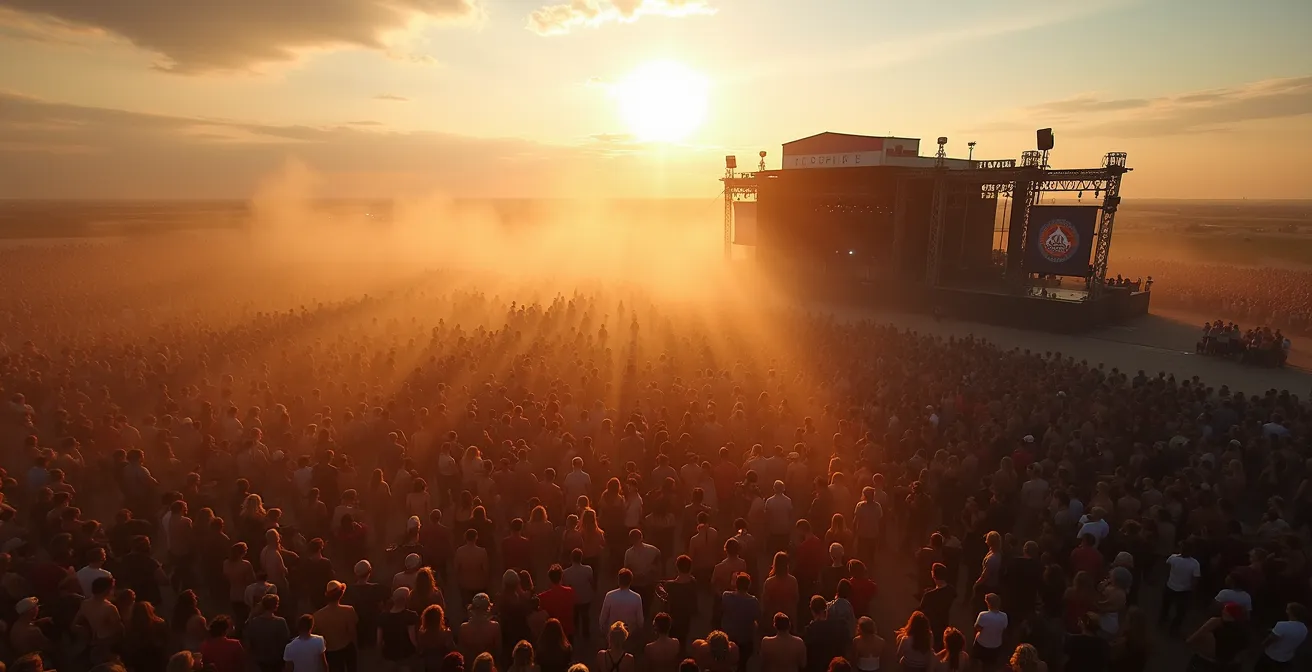
Contrary to popular belief, the unforgettable magic of festivals isn’t found *in spite of* the physical hardship—it’s forged *because of it*.
- Shared struggle acts as a social catalyst, short-circuiting individual self-awareness and fostering a powerful state of group unity known as “collective effervescence.”
- The psychological principle of “effort justification” makes us value these experiences more intensely *because* we endured discomfort to achieve them.
Recommendation: Frame your festival experience not as a simple party, but as a deliberate psychological reset—a necessary pilgrimage into chaos to achieve a unique form of human connection.
Trying to explain a multi-day camping festival to a skeptical friend often feels like a losing battle. They see the exorbitant ticket prices, the photos of mud-caked boots, the stories of porta-potty horrors, and the sheer physical exhaustion. Their conclusion is logical: “Why would you pay to suffer?” We offer the usual defenses: the incredible music, the sense of community, the escape from everyday life. But these answers feel thin, failing to capture the profound, almost spiritual, resonance of the experience.
But what if these explanations miss the point entirely? What if the discomfort isn’t a bug, but the central, non-negotiable feature? As a social anthropologist, I argue that the enduring power of festivals lies not in avoiding hardship, but in embracing it collectively. The heat, the crowds, the sensory overload, and the physical toll are not unfortunate side effects; they are the very ingredients that strip away our modern-day armor of individualism and plunge us into a state of profound shared humanity. This shared struggle is the mechanism that creates the magic.
This article delves into the psychology and neuroscience behind this phenomenon. We will explore how tens of thousands of brains can synchronize, why a VIP ticket might actually rob you of the best experience, and how the very things that seem like punishments are what forge the most powerful memories. We will equip you with the language to explain that you’re not just attending a concert—you’re participating in an ancient human ritual of collective effervescence.
To fully grasp this concept, we’ll examine the intricate dance between our brains, our bodies, and the crowd. The following sections break down the core components of the festival experience, from the neuroscience of a mass singalong to the practicalities of survival and recovery.
Summary: Decoding the Festival Experience
- What Happens to Your Brain When 50,000 People Sing the Same Chorus?
- How to Pack for a 3-Day Camping Festival Without Overpacking?
- VIP Experience vs. General Admission: Is the Private Toilet Worth $200 Extra?
- The Hydration Mistake That Sends 10% of Festival-Goers to the Medic Tent
- How to Cure the “Post-Festival Blues” and Reset Your Dopamine Levels?
- Why Laughing in a Crowded Theater Feels Better Than Laughing Alone?
- How to Budget for a Month-Long Cultural Immersion in Europe for Under $2,500?
- Why You Forget the Setlist Immediately After a Great Concert?
What Happens to Your Brain When 50,000 People Sing the Same Chorus?
That moment when a beloved chorus washes over a crowd and 50,000 voices merge into one is the heart of the festival experience. It feels transcendent, but the phenomenon is deeply rooted in neuroscience. This is not just a collection of individuals enjoying music simultaneously; it’s the formation of a temporary biological and psychological “superorganism.” Our brains, it turns out, are hardwired to sync up with those around us, and a festival provides the perfect, high-stimulus environment for this to occur on a massive scale.
This powerful sense of unity is what sociologist Émile Durkheim first termed “collective effervescence.” It’s the feeling of being part of something larger than oneself, where individual identity dissolves into the energy of the group. As Dr. Shira Gabriel, a leading researcher on the topic, explains, this is not a rare occurrence but a fundamental human need. She states in the journal Personality and Social Psychology Bulletin:
Collective effervescence – the sense of connection and meaning that comes from collective events – is not just useful for understanding rare, unusual events, but everyday gatherings predict wellbeing above and beyond other kinds of social connection.
– Dr. Shira Gabriel, Personality and Social Psychology Bulletin
Recent studies have shown this is a measurable, physical process. Research at the Max Planck Institute examining musicians and audiences discovered the existence of “hyper-brain modules,” where specific brain regions synchronize across multiple people during a shared experience. Through this neural synchrony, our breathing, heart rates, and even brainwave patterns begin to align. You aren’t just imagining you’re “on the same wavelength” as the people around you; on a neurological level, you actually are. This is the biological basis for the profound connection we feel in a crowd, a connection forged in the crucible of shared sound and emotion.
How to Pack for a 3-Day Camping Festival Without Overpacking?
The challenge of packing for a festival is a microcosm of the festival itself: a battle between the desire for comfort and the reality of constraint. Overpacking burdens you, while underpacking invites misery. The key isn’t to bring more things, but to bring the right things. A strategic, psychologically-informed approach transforms packing from a chore into a ritual of preparation for survival and connection. Instead of thinking “what do I need?”, think “what psychological functions must I support?”.
This means framing your gear not by category, but by purpose. You need tools for Autonomy (staying powered and clean), catalysts for Connection (ways to find and bond with your group), and aids for Sanctuary (creating moments of personal peace amidst the chaos). Packing becomes an act of anticipating your future self’s needs, both physical and mental. The gear below isn’t just a list; it’s a survival system.
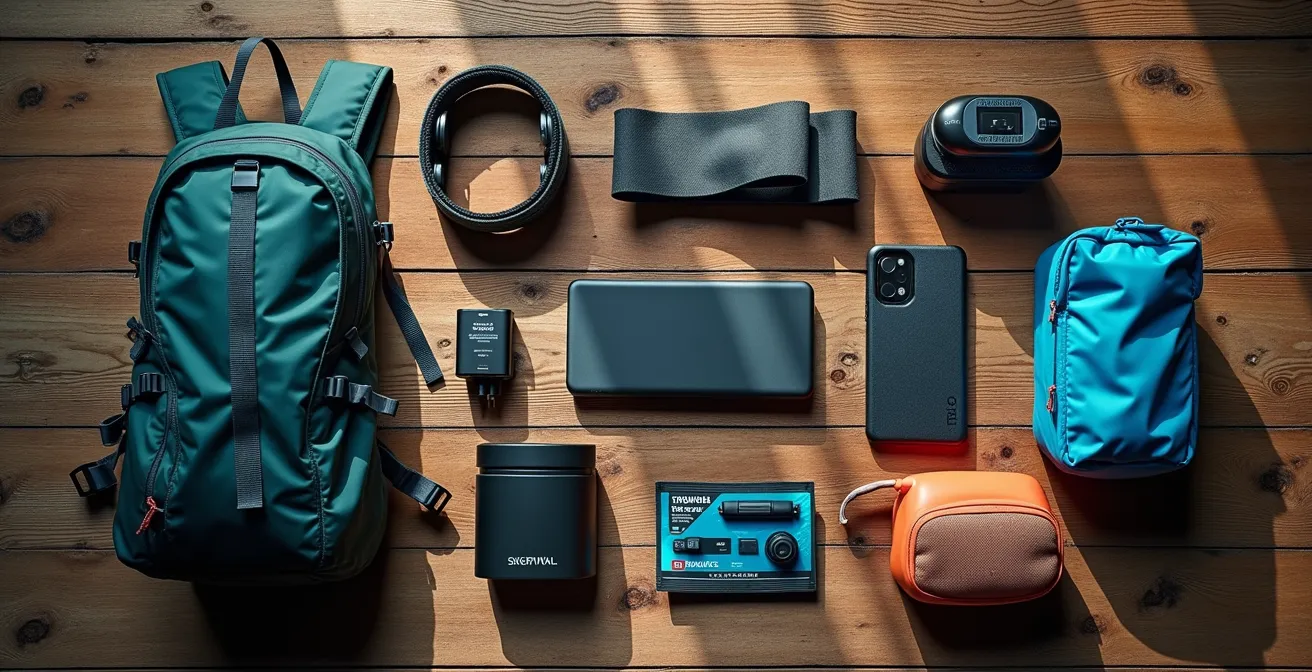
As the image suggests, this preparation is a form of modern survivalist ritual. Each item is chosen with intent, creating a sense of control and readiness that psychologically prepares you for the beautiful chaos to come. This organized approach ensures you have the bandwidth to engage with the experience, rather than constantly troubleshooting your own discomfort.
Your Psychological Needs-Based Packing Checklist
- Tools for Autonomy: Ensure self-sufficiency with a power bank (min. 20,000mAh), biodegradable wet wipes (100-pack), and a headlamp with a red-light mode to preserve night vision.
- Catalysts for Connection: Foster group cohesion with a distinctive camp flag or totem for easy meetups, shareable SPF 50+ sunscreen, and a deck of cards for downtime bonding.
- Aids for Sanctuary: Carve out personal space with high-fidelity earplugs (32dB reduction for sleep), a comfortable eye mask, and a portable camp chair to create a mental reset zone.
- Hydration & Recovery Systems: Prioritize bodily function with a 3L hydration pack, at least 12 servings of electrolyte packets, and a backup collapsible water bottle.
- Physical Reset Tools: Plan for post-exertion care with a small foam roller or massage ball for muscle recovery and melatonin to help regulate your sleep cycle post-festival.
VIP Experience vs. General Admission: Is the Private Toilet Worth $200 Extra?
The VIP ticket promises a festival experience stripped of its most infamous hardships: cleaner bathrooms, shorter lines, and exclusive viewing areas. From a purely rational standpoint, it seems like an obvious upgrade. Yet, many seasoned festival-goers argue that the General Admission (GA) experience, with all its grit and grime, is more “authentic” and ultimately, more rewarding. This isn’t just nostalgia; it’s a well-documented psychological principle known as effort justification.
Effort justification is a form of cognitive dissonance where we place greater value on outcomes that we had to work harder to achieve. Enduring long lines for water, navigating a dense crowd for a good spot, and sharing in the collective groan of a muddy field aren’t just inconveniences—they are investments. When the payoff comes—that perfect musical moment—our brain retroactively justifies the struggle, making the memory more potent and meaningful. Indeed, qualitative research on festival psychology shows that for many young attendees, enduring discomfort was a key component of their positive memories. The struggle becomes part of the triumphant narrative.
The VIP experience, by removing this struggle, can inadvertently dilute the psychological impact. While more comfortable, it isolates you from the very collective effervescence you came to experience. The shared hardship of GA is a powerful social glue. It transforms strangers into temporary comrades, bonded by a common goal. Choosing VIP isn’t just a financial decision; it’s a choice between comfort and a potentially more powerful, socially-bonded memory.
This table, based on concepts from academic analysis of festival experiences, breaks down the psychological trade-offs:
| Aspect | General Admission | VIP | Psychological Impact |
|---|---|---|---|
| Social Connection | Maximum crowd immersion | Separated viewing areas | GA enhances collective effervescence through shared hardship |
| Comfort Level | Basic facilities, long queues | Private toilets, shorter lines | VIP reduces stress but may diminish ‘earned’ enjoyment |
| Memory Formation | Strong episodic memories through challenge | Comfortable but potentially less memorable | Effort justification makes GA experiences more vivid |
| Identity Signaling | Signals ‘authentic’ fan status | May signal status seeking | GA participation becomes part of fan identity narrative |
| Recovery Time | Requires 2-3 days full recovery | 1-2 days recovery needed | Extended recovery reinforces experience significance |
The Hydration Mistake That Sends 10% of Festival-Goers to the Medic Tent
“Stay hydrated” is the most common piece of festival advice, yet medical tents are consistently filled with people suffering from hydration-related issues. The most dangerous mistake, however, is not a lack of water, but an imbalance of it. In the sensory-rich, physically demanding festival environment, our brain’s ability to interpret our body’s signals—a process called interoception—becomes severely dampened. We feel the music, the lights, and the crowd, but we stop accurately feeling our own thirst, fatigue, and electrolyte levels.
This leads to a critical error: after hours of dancing and sweating, we chug large amounts of plain water. While this seems correct, we’ve been sweating out not just water, but vital salts like sodium. By replacing only the water, we dilute the sodium concentration in our bloodstream, leading to a life-threatening condition called hyponatremia. It’s a cruel paradox where the attempt to solve one problem creates a much deadlier one.
The Marathon Runner Syndrome at a Music Festival
Dr. Lewis Nelson of NYU Langone Medical Center has reported that many festival-related medical emergencies are not caused by dehydration alone, but by a combination of heat, exertion, and improper rehydration. As detailed in a report on festival health risks, when attendees consume excessive amounts of water without replacing electrolytes, they induce hyponatremia. This condition, common in marathon runners, causes cells to swell with water, which is particularly dangerous in the brain, leading to cerebral edema, seizures, and potential organ failure. The key takeaway is that hydration is a balance of water *and* electrolytes, not just water alone.
The sensory overload of a festival directly contributes to this danger. The thumping bass, flashing lights, and sea of people create an external stimulus level so high that our internal “warning lights”—like the subtle signs of electrolyte imbalance—are completely ignored. We override our body’s wisdom in pursuit of the peak experience.

This is why a hydration strategy must be proactive, not reactive. It involves consistently sipping from a hydration pack that contains not just water, but an electrolyte solution. You cannot trust your body to tell you what it needs in an environment designed to make you forget your body exists.
How to Cure the “Post-Festival Blues” and Reset Your Dopamine Levels?
The return to normal life after a festival can feel jarring and profoundly empty. This “post-festival blues” is not just emotional; it’s a physiological response to the abrupt withdrawal of a constant stream of peak experiences. For three days, your brain was bathed in a cocktail of dopamine, oxytocin, and endorphins, fueled by novelty, social connection, and music. The sudden silence and routine of daily life can feel like a crash. Curing this requires more than just rest; it demands a structured “sensory tapering” protocol.
The goal is to gently guide your brain back to its normal baseline, rather than shocking it with an abrupt return to reality. This involves gradually decreasing the level of stimulation while consciously integrating and processing the experience. Instead of cutting off the festival cold turkey, you wean yourself off its intensity. This could involve:
- Days 1-2: Creating a “decompression playlist” that begins with your festival favorites and slowly transitions to more ambient, calming music over several hours of listening each day.
- Days 3-4: Maintaining social connection with less stimulation by scheduling one-on-one video calls with festival friends, rather than engaging in chaotic group chats.
- Days 5-7: Actively resetting your sensory baseline by replacing the visual chaos of the festival with the calming patterns of nature, taking 30-60 minute walks in green spaces.
- Week 2 Onward: Preventing a total crash by integrating “micro-doses” of collective experience back into your life, such as attending a small local concert or joining a group activity.
This process honors the significance of the experience. The powerful feelings of connection and happiness are real and lasting. As recent research highlights, these effects are not fleeting.
Collective effervescence experienced at live music events was directly linked to greater happiness even a week later, with effects lasting up to six months in longitudinal studies.
– Nicole Koefler, Esha Naidu, and Dr. Shira Gabriel, Personality and Social Psychology Bulletin, 2024
The post-festival blues, then, is the shadow cast by an intensely bright light. The key is not to fight the sadness, but to integrate the joy, carrying the embers of that collective effervescence back into the quiet of everyday life.
Why Laughing in a Crowded Theater Feels Better Than Laughing Alone?
The amplified joy of a shared laugh in a theater or comedy club is a more accessible, everyday example of the same mechanisms at play in a festival crowd. Laughter is inherently contagious, but the experience of laughing *together* is qualitatively different from laughing alone at a screen. This is due to a combination of emotional contagion and the powerful effect of neural synchrony, where our brains literally get in tune with those around us.
When we hear others laugh, our brain’s mirror neuron system activates, priming us to experience the same emotion. In a group setting, this creates a positive feedback loop: one person’s laugh triggers another’s, which in turn reinforces the first person’s amusement, and the emotion rapidly cascades through the crowd. The collective sound becomes a physical force, amplifying the individual emotional response far beyond what it would be in isolation. We are not just hearing a joke; we are participating in a shared ritual of joy.
This is more than just a psychological effect. As neuroscience research reveals that brain waves synchronize during shared emotional events, with specific frequencies showing peak alignment during group laughter. This synchronization is the physical manifestation of being “on the same page.” Even in virtual spaces, like live-streamed concerts during the COVID-19 pandemic, researchers observed synchronized emotional responses in comment sections, proving the power of shared, simultaneous experience. The physical co-presence in a theater or at a festival magnifies this effect exponentially, adding layers of non-verbal cues—body language, audible gasps, shared glances—that deepen the collective connection.
How to Budget for a Month-Long Cultural Immersion in Europe for Under $2,500?
While the title asks a practical question about budgeting for travel, let’s apply its underlying logic to the festival experience itself. The real question isn’t just “how much does it cost?” but “how do we allocate our resources—time, energy, and money—for the greatest possible *psychological return on investment*?” A traditional budget focuses on minimizing cost, but a psychological budget focuses on maximizing the creation of powerful, lasting memories.
On a trip or at a festival, our memories are not created equal. We quickly forget the specifics of a generic hotel room or a standard meal, but we vividly remember a unique, challenging, or deeply emotional experience. Therefore, a budget designed for memory-making should strategically de-prioritize spending on fleeting comforts and over-invest in the catalysts of strong episodic memories. This means spending less on things that isolate or merely sustain you (like a fancy campsite far from the action) and more on things that deepen your immersion and connection (like group activities or unique add-on experiences within the festival).
It’s about trading passive comfort for active engagement. This approach aligns perfectly with the principle of effort justification: the experiences we invest more of ourselves in—whether that’s energy navigating a crowd or a small amount of money for a shared art workshop—are the ones that stick with us. The goal is not to have the most comfortable trip, but the most memorable one.
The following table reimagines a standard budget through the lens of “Memory ROI,” a concept that can be applied to any immersive experience:
| Budget Category | Traditional Allocation | Psychological ROI Allocation | Memory Impact |
|---|---|---|---|
| Accommodation | 40-50% ($1000-1250) | 25-30% ($625-750) | Low recall after trip |
| Unique Experiences | 10-15% ($250-375) | 30-35% ($750-875) | High episodic memory formation |
| Food | 25-30% ($625-750) | 20% ($500) | Memorable only if culturally unique |
| Transportation | 15-20% ($375-500) | 15% ($375) | Journey memories if scenic |
| Social Activities | 5% ($125) | 10% ($250) | Strong social memory encoding |
Key Takeaways
- Discomfort is a feature, not a bug: Shared hardship is the catalyst for the “collective effervescence” that makes festivals profound.
- Your brain on music: During mass singalongs, your brainwaves literally synchronize with thousands of others, creating a temporary “superorganism.”
- Memory prioritizes feeling over facts: Your brain is wired to remember the intense emotional peak (episodic memory) rather than the factual details (the setlist).
Why You Forget the Setlist Immediately After a Great Concert?
It’s a familiar feeling: you’ve just witnessed a life-changing performance, your ears are ringing, and your heart is full. A friend asks, “What was the third song they played?” You draw a complete blank. This isn’t a sign of a bad memory; it’s a sign that your brain was functioning exactly as it should during a peak experience. Your brain made a strategic choice: it prioritized encoding the rich, emotional, holistic experience over recording a dry list of facts.
This is the crucial difference between episodic memory and semantic memory. Semantic memory is for facts, data, and concepts—like a song title or a setlist order. Episodic memory is for autobiographical events, rich with sensory detail, emotional context, and a sense of self. During a truly great concert, you are not a passive observer collecting data; you are an active participant in a flow state. This state is characterized by deep immersion, a distorted sense of time, and a feeling of effortless action.
Neuroscientifically, this makes perfect sense. As a research synthesis from Neuroscience of Consciousness points out, the brain operates differently during these moments:
During peak experience, the brain prioritizes encoding rich, holistic episodic memory over dry, semantic data. The brain tags core emotional moments with high significance while pruning less critical transitional data to save cognitive space.
– Research synthesis, Neuroscience of Consciousness, Oxford Academic
In this state of flow, your prefrontal cortex—the part of your brain responsible for analytical thought and self-monitoring—shows suppressed activity. You stop analyzing and simply *experience*. You remember the feeling of the bass in your chest, the look on your friend’s face during the encore, and the overwhelming emotion of the crowd singing as one. Your brain correctly identifies *that* as the important information to save, not the precise order of the songs.
So the next time a skeptical friend asks for proof of a festival’s worth, tell them the proof isn’t in a setlist you can’t remember. The proof is in the profound, difficult-to-articulate feeling of connection that lingers long after the music fades—an experience you had to earn through shared struggle, and one your brain deemed far more important to remember than any list of songs.