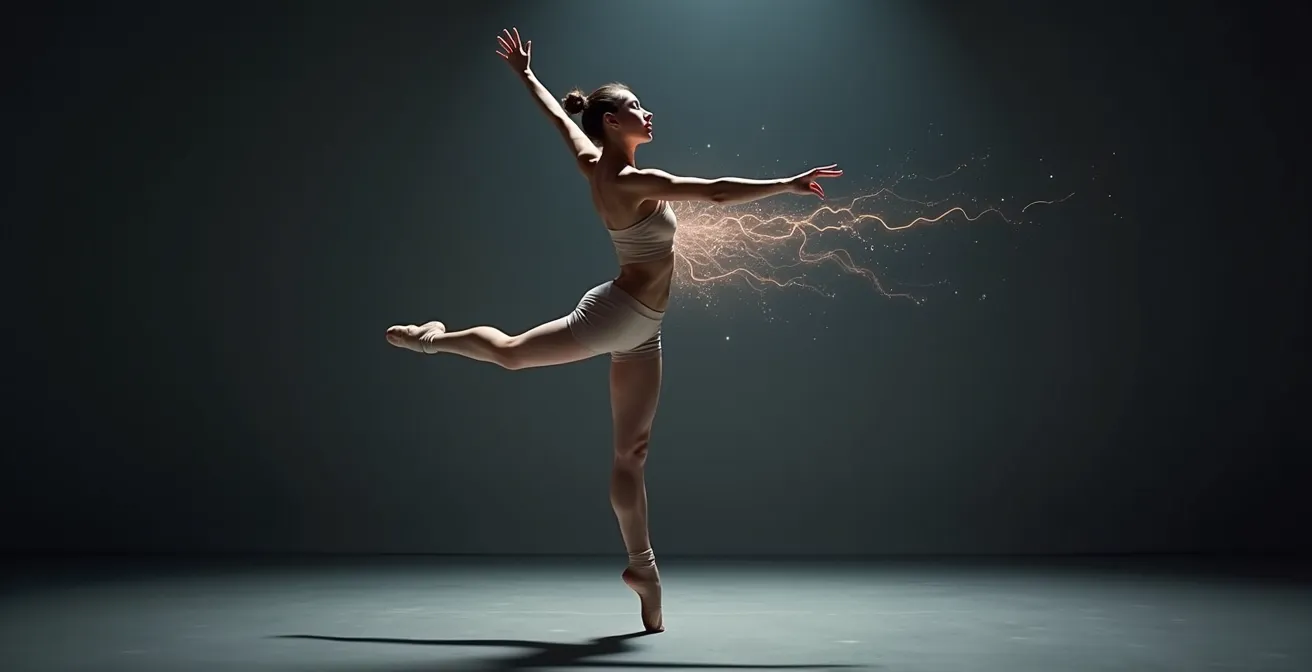
Contrary to popular belief, watching a performance is not a passive activity; it is an active neurological workout that hijacks your brain’s motor pathways for a ‘vicarious rehearsal’.
- Your brain’s “mirror neuron system” simulates the movements you see, firing the same neural circuits as if you were performing the action yourself.
- This simulation is so powerful it can help maintain muscle pathways, even during periods of inactivity, and enhances your brain’s creative and empathetic capacities.
Recommendation: Instead of just being entertained, consciously select diverse performances to strategically train different cognitive functions, turning cultural consumption into a form of neuro-enrichment.
Have you ever watched a ballet dancer execute a flawless leap and felt a phantom flutter in your own muscles? Or witnessed an acrobat’s near-fall and felt a jolt of adrenaline, your own body tensing as if to catch them? This is not mere empathy; it’s a profound biological phenomenon. For a sedentary person, this feeling can be a spark of inspiration, a connection to a physical expression that feels distant. But this connection is far from magical. It’s the tangible result of your brain’s intricate wiring.
Most people think of watching a performance as passive entertainment. The common advice is to simply “appreciate the art.” But what if the deepest appreciation comes from understanding the powerful neural hijacking happening inside your own skull? What if that feeling of vicarious movement is actually a form of subconscious training, a simulation so powerful it can prime your own body for action?
This article moves beyond the surface-level appreciation of performing arts. We will dissect the biological mechanisms that turn you from a simple spectator into an active participant at the neural level. We are not just watching; our brains are rehearsing, learning, and rewiring. This is the science of neuroaesthetics, where every observed movement becomes a conversation between the performer’s body and your own motor cortex.
To fully grasp how you can leverage this for your own cognitive and physical well-being, we will explore the underlying science, provide a framework for choosing performances, and reveal why embracing new challenges is the ultimate catalyst for this process. This guide unpacks the journey from passive viewing to active neural engagement.
Summary: Why Watching Professional Dancers Triggers Your Own Motor Cortex?
- How “Mirror Neurons” Allow You to Feel the Acrobat’s Fear?
- How to Pick 3 Shows That Give You a Full Overview of the Performing Arts?
- Classical Structure vs. Modern Freedom: Which Dance Style Resonates with Your Personality?
- The “Opera Is for Snobs” Myth That Keeps You from Affordable Culture
- What to Read Before a Performance to Understand the Context?
- Why You Lose 3-5% of Muscle Mass per Decade and How to Stop It?
- How Minimalist Sets Force Your Brain to Be More Creative?
- Why Starting a Hobby You Suck At Is Good for Your Ego?
How “Mirror Neurons” Allow You to Feel the Acrobat’s Fear?
The sensation of feeling an action you are only watching is not your imagination. It’s the work of a sophisticated neural network known as the mirror neuron system. These remarkable brain cells fire both when you perform an action and when you observe someone else performing that same action. In essence, your brain simulates the observed movement internally, creating a shared experience that bridges the gap between seeing and doing. This “motor simulation” is the biological foundation of kinesthetic empathy—the ability to feel movement in your own body simply by watching another.
This system isn’t just a simple echo. Its sensitivity is tuned by experience. For instance, research on mirror neuron activation reveals that ballet dancers’ brains show significantly more activity in motor-related areas when watching ballet compared to a style they haven’t trained in, like capoeira. This demonstrates that the more familiar your brain is with a motor pattern, the deeper the simulation. However, the fundamental system is active in everyone. When you watch an acrobat balance precariously, your brain isn’t just processing visual data; it’s running a simulation of what it would take for *you* to maintain that balance, activating the same circuits involved in stability and motor control.
This neural mechanism has profound implications. In a compelling study, UCL researchers observed that this internal simulation is so robust that an injured dancer could potentially maintain their skills by watching others perform. Their brain continues to run the “software” of the dance, a process of vicarious rehearsal that keeps neural pathways active. For the observer, this means every performance is an opportunity for your brain to rehearse complex motor sequences, even from the comfort of your seat.
How to Pick 3 Shows That Give You a Full Overview of the Performing Arts?
Simply watching any performance provides a baseline level of neural engagement. However, to transform passive viewing into a strategic “workout” for your brain, a curated approach is far more effective. Different performance styles challenge distinct cognitive networks. In fact, neuroscience research demonstrates that dance observation boosts connectivity across attention, control, visuospatial, and motor processing networks. By intentionally selecting a varied “diet” of shows, you can target and strengthen a wider range of these neural systems.
Rather than choosing randomly, consider a portfolio approach based on the cognitive demands of each art form. A balanced selection doesn’t just provide a cultural overview; it ensures a comprehensive neurological experience. This strategy moves beyond simple entertainment and into the realm of active, self-directed neuro-enrichment. Each performance becomes a specific tool for exercising a different part of your brain’s predictive and empathetic machinery.
Your Brain-Training Performance Checklist: A 3-Show Strategy
- Engage Pattern Recognition: Choose a highly structured performance like a classical ballet (e.g., Swan Lake). Your brain will work to recognize repeating motifs and predict the formal, rule-based movements, strengthening its pattern-matching and motor prediction circuits.
- Challenge Predictive Coding: Select an improvisational show, such as contemporary dance or a live jazz performance. The lack of a predictable structure forces your brain to constantly update its expectations, creating “prediction errors” that are crucial for learning and neural plasticity.
- Exercise Complex Empathy: Include a narrative-driven performance like theatrical dance or opera. Following a story through movement and music engages your “Theory of Mind” network, as your brain works to infer the characters’ intentions, emotions, and beliefs.
By following this framework, you move from being a passive consumer of culture to an active curator of your own cognitive development. Each ticket becomes an investment in your brain’s flexibility, creativity, and emotional intelligence.
Classical Structure vs. Modern Freedom: Which Dance Style Resonates with Your Personality?
The distinction between classical ballet’s rigid structure and contemporary dance’s expressive freedom is not merely aesthetic; it corresponds to different ways your brain processes information. Your preference for one over the other may reflect your brain’s own cognitive style. Classical ballet, with its precise, geometric lines and predictable vocabulary, heavily engages the brain’s pattern recognition and sequencing abilities, primarily involving the basal ganglia and cerebellum. It offers the cognitive satisfaction of seeing a complex, rule-based system executed to perfection.
In contrast, modern and contemporary dance thrive on unpredictability. They break classical rules, using gravity, floor work, and asymmetrical movements to surprise the observer. This style challenges your brain’s predictive coding mechanisms. Instead of confirming expectations, it generates constant “surprise signals,” forcing your brain to adapt and remain flexible. This can feel either exhilarating or chaotic, depending on your cognitive disposition. The internal simulation your brain runs is less about perfection and more about exploring the physical and emotional range of the human body.
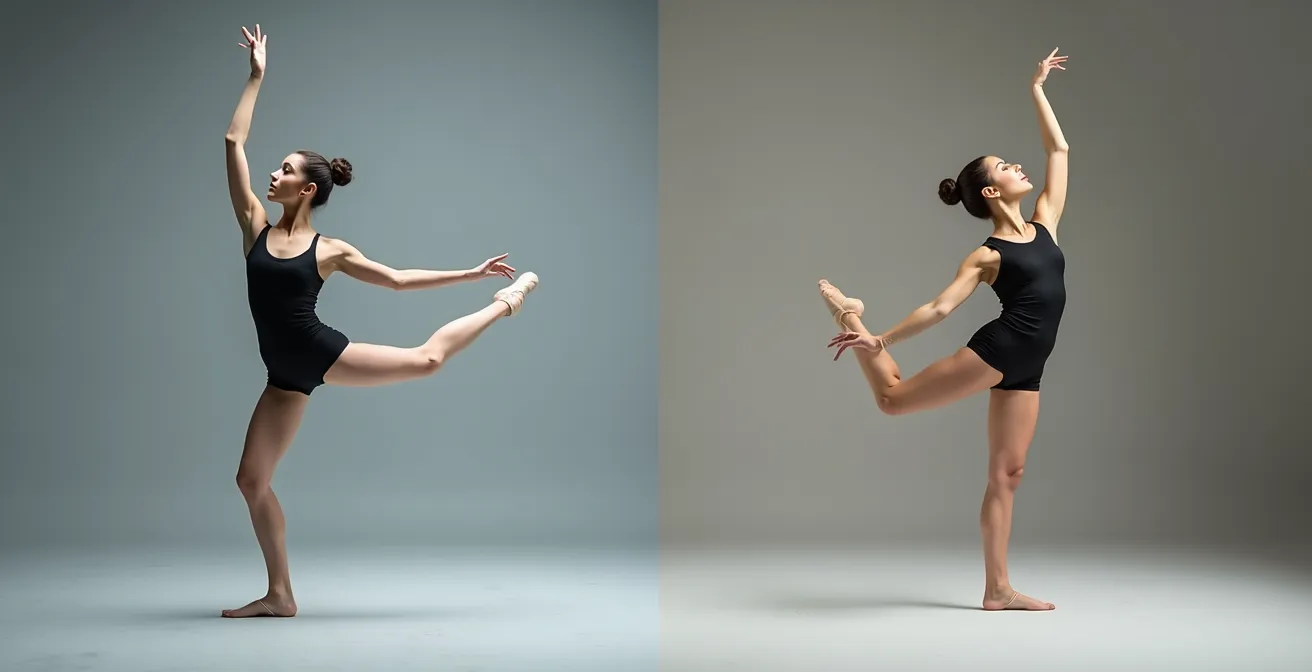
This difference in neural engagement is fundamental to the viewing experience. As Dr. Daniel Glaser from the UCL Institute of Cognitive Neuroscience explains, this simulation is deeply personal:
People’s brains appear to respond differently when they are watching a movement, such as a sport, if they can do the moves themselves. When we watch a sport, our brain performs an internal simulation of the actions, as if it were sending the same movement instructions to our own body.
– Dr. Daniel Glaser, UCL Institute of Cognitive Neuroscience
Whether you are drawn to the logical elegance of ballet or the novel freedom of contemporary dance, both provide a powerful workout. One hones your brain’s ability to process order and precision, while the other enhances its capacity for creativity and adaptation in the face of the unexpected.
The “Opera Is for Snobs” Myth That Keeps You from Affordable Culture
The perception of opera as an elitist, inaccessible art form is one of the most persistent cultural myths. This stereotype not only limits access to a rich tradition but also prevents people from experiencing what is, from a neurological standpoint, one of the most powerful forms of brain training available. Opera is not just music or theater; it is a multi-modal spectacle that forces your brain to process an immense amount of parallel information simultaneously.
When you watch an opera, your brain is not performing a single task but juggling several at once. Your auditory cortex processes complex orchestral music and the nuances of the human voice. Your language centers work to decipher lyrics (often with the help of surtitles). Your visual system tracks the movements of dozens of performers on a grand stage. Crucially, your mirror neuron system and motor cortex are engaged by the physicality of the singers, while your limbic system, the seat of emotion, responds to the dramatic narrative. Research identifies this as a unique form of “neuro-enrichment.”
This simultaneous activation of motor, emotional, auditory, and narrative-processing centers makes opera a uniquely potent cognitive workout. It trains the brain in task-switching and sensory integration, skills essential for navigating our complex, information-dense world. The idea that this is only for a select few is a cultural barrier, not a biological one. Many opera houses now offer affordable “rush” tickets, simulcasts in cinemas, and community outreach programs, making this powerful experience more accessible than ever. Viewing opera not as a status symbol but as a complex, enriching stimulus for your brain reframes it as a valuable and attainable cultural exercise.
What to Read Before a Performance to Understand the Context?
Walking into a performance “cold” allows for a pure, visceral reaction. However, providing your brain with context beforehand can dramatically deepen the experience, transforming it from a series of impressive movements into a meaningful conversation. The goal isn’t to spoil the plot but to prime your brain’s “Theory of Mind” network—the system responsible for understanding the intentions, beliefs, and emotions of others.
When you understand the choreographer’s core question or the historical context of a piece, you give your brain a framework. This “top-down” information influences how your “bottom-up” sensory processing unfolds. Instead of just seeing a leap, you might perceive it as an act of defiance, escape, or joy, because you’ve been primed to look for that narrative layer. As neuroscientists have noted, understanding the creator’s goal allows you to see the performance as a communicative act, not just a physical display. Your brain shifts from simply simulating movements to actively trying to decode the meaning behind them.
Before a performance, focus on these key areas:
- The Creator’s Intent: Look for interviews with the choreographer or director. What question were they trying to answer? What emotion did they want to explore? This primes your empathy circuits.
- The Musical Score: If possible, listen to key parts of the music. Understanding its structure and emotional tone gives you a roadmap for the performance’s dramatic arc.
- The Original Story or Theme: For narrative ballets or operas, reading a short synopsis of the story is essential. For abstract contemporary pieces, understanding the central theme or concept (e.g., “humanity’s relationship with technology”) provides a crucial anchor for your interpretation.
This small investment of time pays huge dividends. It equips your brain with the tools to engage with the performance on a much deeper, more satisfying level, enriching the motor simulation with a layer of intellectual and emotional understanding.
Why You Lose 3-5% of Muscle Mass per Decade and How to Stop It?
After the age of 30, adults who are physically inactive can lose between 3-5% of their muscle mass per decade. This age-related decline, known as sarcopenia, is a primary driver of frailty and loss of independence later in life. While the most direct countermeasure is physical exercise, neuroscience reveals a fascinating complementary strategy: the power of active observation. The neural link between watching movement and activating your own motor pathways is not just a curiosity; it’s a mechanism with tangible physiological potential.
When you watch a dancer, the “motor simulation” in your brain is more than just a fleeting thought. It generates real, measurable electrical signals. Studies on motor cortex stimulation show that passive action observation leads to enhanced motor corticospinal excitability. In simpler terms, the neural pathway from your brain to your muscles becomes more active, as if it’s preparing to command a movement. This “priming” effect helps keep those pathways toned and responsive, even when the muscles themselves are not contracting.

This phenomenon of vicarious rehearsal offers a powerful tool against the “use it or lose it” principle of muscle maintenance. For a sedentary person, or someone recovering from an injury, regularly watching complex, skilled movement can act as a form of neural maintenance. It won’t build muscle mass on its own, but it keeps the command-and-control centers in the brain firing, potentially slowing the degradation of neural pathways that contributes to muscle atrophy. It reinforces the idea that engaging with physical culture is not a frivolous pastime but a genuine contributor to long-term physical resilience.
How Minimalist Sets Force Your Brain to Be More Creative?
When you attend a performance with an elaborate, detailed set, your brain is given a rich world to passively absorb. A realistic drawing-room or a lush forest tells you exactly where you are. But when the stage is bare—save for a single chair or a stark geometric shape—a fascinating neurological process is triggered. This minimalism creates what neuroscientists call a “cognitive void,” and your brain is hardwired to fill it.
By removing explicit external cues, a minimalist set forces your brain to switch from passive perception to active world-building. Your imagination is compelled to construct the environment. Is that single chair a throne, a prison seat, or a simple piece of furniture? The ambiguity engages your creative and associative networks, as you draw upon your own memories and experiences to complete the scene. This act of co-creation is a more demanding—and ultimately more rewarding—cognitive exercise than simply processing a pre-packaged environment.
This principle is beautifully articulated in research on the neuroscience of dance, which notes the brain’s compelled creativity:
A minimalist set creates a ‘cognitive void’ that the brain is compelled to fill. By removing external cues, the stage forces your brain to switch from passive perception to active world-building, engaging the imagination and creative networks.
Furthermore, with fewer visual distractions, your attention is focused almost entirely on the human form. Every subtle gesture, muscle contraction, and shift in balance becomes magnified in importance. Your brain dedicates more resources to the motor simulation of the dancers’ bodies, leading to a more intense and detailed kinesthetic experience. A minimalist performance is therefore a dual workout: it strengthens your creative, world-building faculties while deepening the motor empathy at the core of the viewing experience.
Key Takeaways
- Observation is Active Training: Watching skilled movement is not passive; it’s a “vicarious rehearsal” that activates your brain’s motor cortex, strengthening neural pathways as if you were practicing yourself.
- Variety Maximizes Benefit: To get the most cognitive benefit, curate your viewing like a workout plan, choosing a mix of structured (ballet), improvisational (jazz), and narrative (opera) performances to train different neural networks.
- Failure Fuels Appreciation: The struggle of learning a new skill yourself—and failing—rewires your brain, strengthening the cerebellum and motor cortex, which in turn deepens your brain’s ability to simulate and appreciate the mastery you see in others.
Why Starting a Hobby You Suck At Is Good for Your Ego?
The inspiration sparked by watching a master performer can be powerful, but it’s often followed by a daunting thought: “I could never do that.” This is precisely why you should try. Starting a hobby you are genuinely bad at—whether it’s dance, pottery, or painting—is a profoundly beneficial act for your brain and, counterintuitively, for your ego. The process of being a novice, of struggling and failing, triggers essential neural mechanisms for growth.
From a biological standpoint, making errors is the single most important signal for learning. When you try a dance step and fail, your brain registers a “prediction error”—a mismatch between the intended action and the actual outcome. This signal forces the brain to adapt, strengthening connections in the motor cortex and, most critically, the cerebellum, which is vital for coordination and motor learning. This struggle is not a sign of incompetence; it is the very process of building new neural pathways.
The Dartmouth College fMRI Study: How Failure Enhances Observation
In a landmark study, researchers at Dartmouth College used fMRI scans to track novices as they learned complex dance sequences over several weeks. The scans revealed that the high error rates in the early stages of learning were directly correlated with increased activity and plasticity in the brain. More importantly, after a session of failing at the steps themselves, participants showed a significantly deeper and more nuanced activation in their motor cortex when they subsequently watched professionals perform. Their own physical struggle gave their brain a richer, more detailed “motor image” to compare with the observed mastery, making the vicarious rehearsal more potent.
This process is humbling. It detaches your ego from the need for immediate perfection and reorients it toward the value of the process itself. By embracing the struggle, you are not just learning a new skill; you are fundamentally upgrading your brain’s hardware for learning and, in doing so, unlocking a far deeper, more embodied appreciation for the mastery you witness in others.
The journey from a sedentary observer to someone whose brain is actively engaged and even physically primed by art is now clear. The next logical step is to move from passive appreciation to active participation, no matter how small the start. Begin by exploring local dance classes, workshops, or even online tutorials to experience firsthand the neural growth that comes from a challenge.