
Walking a city transforms you from a passive spectator into an active storyteller, embedding its narrative deep into your memory.
- Scientific research on embodied cognition proves physical engagement can improve memory retention by linking movement and sensory input.
- Actively navigating and experiencing the “sensory topography” of streets recharges your brain more effectively than the passive consumption of views from a screen or window.
Recommendation: Ditch the checklist-driven bus tour and plan your next urban exploration as a personal, story-driven journey on foot to truly understand a place.
You’re standing at a crossroads in a new city. To your left, a gleaming double-decker bus promises a whirlwind tour of ten major landmarks in two hours. To your right, a pair of worn cobblestone streets beckons you into the urban unknown. The choice seems to be between efficiency and immersion, between seeing the city and feeling it. For many travelers, the bus seems like the logical choice to ‘see it all’. But what if the goal isn’t to collect sights like items on a grocery list, but to understand the story the city is telling?
The conventional wisdom of travel often prioritizes coverage. We are told to see the monuments, snap the photos, and check the boxes. But this approach reduces a living, breathing metropolis to a series of static postcards viewed through a pane of glass. This article proposes a fundamental shift in perspective. It argues that the true soul of a city is not found in its grand monuments, but in the spaces between them. The key to unlocking this soul is not speed, but pace. The answer lies in an idea from cognitive science: embodied cognition.
This is the principle that our bodies are not just vessels for our brains, but active participants in how we think, feel, and remember. By choosing to walk, you engage in a form of narrative cartography—the act of reading the city with your body. Every step on an uneven paving stone, every scent from a local bakery, and every unexpected turn down a quiet alley becomes a sentence in a story you are co-authoring with the city itself. This journey is not about efficiency; it’s about a deeper, more permanent form of discovery.
This guide will navigate you through the “why” and “how” of this immersive approach. We will explore the science behind why you remember history better when you stand where it happened, the practicalities of preparing for a day of urban exploration, and the strategies for becoming the architect of your own unforgettable city walk. Prepare to leave the spectator’s seat and become the protagonist of your next travel adventure.
To help you navigate this new approach to urban travel, this article is structured to guide you from the foundational science of memory to the practical steps of planning your own immersive journey. Explore the sections that pique your interest or follow the path from start to finish to fundamentally change how you see your next destination.
Summary: Why Walking Unlocks a Deeper Urban Experience
- Why You Remember History Better When You Stand Where It Happened?
- How to Choose Shoes for a 20,000-Step Day on Cobblestones?
- Free Walking Tour vs. Private Guide: Is the Quality Difference Worth $150?
- The Tipping Etiquette for “Free” Tours That Confuses Travelers
- How to Map a Themed City Walk (e.g., Coffee or Ghosts) Using Google Maps?
- Netflix Binge vs. Nature Walk: Which Actually Recharges Your Brain?
- Climbing the Tower vs. Looking at It: Which Offer the Better Memory?
- How to Plan an Immersive Trip That Changes Your Perspective Forever?
Why You Remember History Better When You Stand Where It Happened?
The experience of standing on the exact spot where a historical event unfolded creates a memory that is far more vivid and lasting than reading about it in a book or seeing it from a bus. This isn’t just a romantic notion; it’s a scientifically supported phenomenon known as embodied cognition. Our brain doesn’t encode memories in a vacuum. It links facts and figures to sensory data—the chill of the wind, the texture of the stone underfoot, the echo of a narrow street. When you walk through a historical district, your physical movement and sensory engagement become part of the memory itself.
This concept is supported by compelling research. For example, a study on embodied learning strategies found that memory improved by 30% at medium-term intervals when participants used physical engagement to learn. The physical act of being in a space forces your brain to create a multi-layered mental map, connecting abstract historical knowledge to a concrete physical location. You cease to be a passive recipient of information and become an active participant in the story. The history is no longer just a date, but a tangible experience tied to a specific place you have physically occupied.
Case Study: The Paris Urban Memory Project
In a fascinating study, researchers analyzed over 66 hours of city walking tour videos from Paris, mapping 1,169 georeferenced locations. They demonstrated how the continuous stream of street-level sensory data—from the sound of a cafe to the sight of a hidden courtyard—directly enhances the formation of durable urban memories. This proves that the “inefficient” detours and sensory distractions of a walk are precisely what make the experience so memorable compared to a sterilized bus tour.
This principle of learning through physical action is further validated by educational psychology. As researchers Kang et al. explain in the Educational Psychology Review:
Retention test scores were significantly higher in groups learning from meaningful physical gesturing compared to abstract learning, as the brain links physical sensations to memory encoding.
– Kang et al., Educational Psychology Review, Embodied Cognition in Learning
When you walk, you are constantly making micro-gestures: turning your head to follow a sound, stopping to touch a wall, or shifting your balance on an old staircase. Each of these actions is a form of physical gesturing that anchors the moment in your mind. This deep, multi-sensory encoding is something a bus tour, by its very nature, cannot replicate.
How to Choose Shoes for a 20,000-Step Day on Cobblestones?
If your body is the tool for reading the city, then your shoes are its most critical component. The difference between a day of joyful discovery and a painful ordeal often comes down to what’s on your feet. Choosing the right footwear for a 20,000-step day, especially on unforgiving surfaces like cobblestones, is not about fashion; it’s about biomechanics and endurance. The ideal urban walking shoe must master a trifecta of support, cushioning, and grip, tailored to the unique challenges of the urban environment.
Forget your flimsy fashion sneakers or heavy-duty hiking boots. Urban exploration demands a hybrid. You need a sole with enough cushioning to absorb the repetitive impact of hard pavement but firm enough to provide stability on uneven ground. Too much softness can dampen proprioceptive feedback—your body’s sense of the ground—leading to instability, while too little causes premature fatigue and foot pain. Look for a balance: a supportive arch, a firm heel counter to prevent ankle rolling, and a flexible forefoot that allows for a natural stride.
This paragraph introduces the complex interaction between a shoe and the ground. To truly understand this, it is helpful to visualize the forces at play. The illustration below captures the critical moment of contact between a shoe’s sole and the city’s ancient texture.
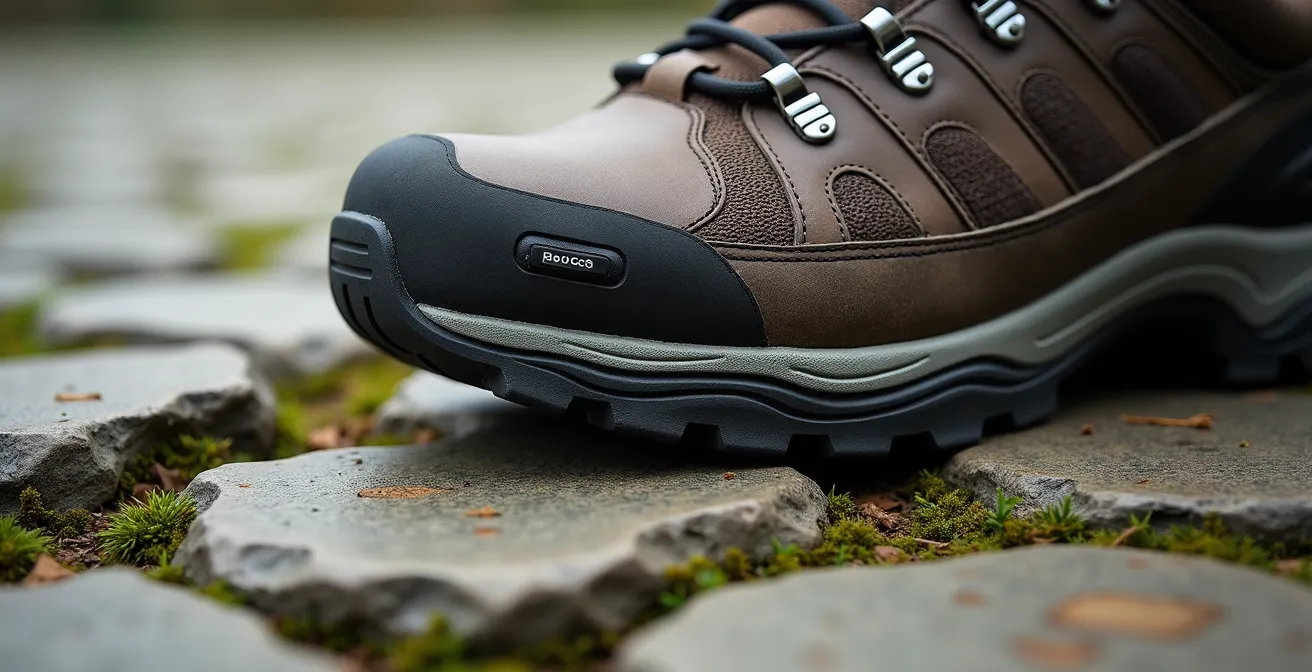
As this image highlights, the grip pattern is crucial. The sole must be able to adapt to a variety of surfaces, from slick marble floors in a museum to the irregular, often damp, cobblestones of a historic lane. A multi-directional tread pattern provides the best traction. Finally, consider breathability. A long day of walking generates heat and moisture, so a shoe with a breathable upper mesh will prevent blisters and discomfort, allowing you to focus on the city’s narrative, not on your feet.
Free Walking Tour vs. Private Guide: Is the Quality Difference Worth $150?
Once you’ve committed to exploring on foot, the next decision is whether to join a “free” walking tour or invest in a private guide. While both get you off the bus and onto the streets, they offer fundamentally different experiences in narrative delivery, flexibility, and depth. The choice isn’t just about budget; it’s about what kind of story you want to uncover. A free tour is a broadcast; a private tour is a dialogue.
Free walking tours are an excellent entry point into a city. They typically cover the main highlights, operate on a tips-based model, and attract a large, diverse group of travelers. The guide delivers a well-rehearsed, one-to-many narrative designed for broad appeal. This is a fantastic way to get your bearings and hear the city’s “greatest hits.” However, the large group size (often 15-30+ people) and fixed route mean there is little room for personalization, spontaneous detours, or in-depth answers to niche questions. You are part of an audience.
A private guide, while a significant investment, changes your role from audience member to co-creator. The experience is tailored entirely to your interests. Intrigued by architectural details, local ghost stories, or the best espresso? The route is built around you. With a small group, you can access narrow alleys and hidden courtyards that are impossible for a large tour to navigate. The narrative becomes an interactive conversation, allowing you to dive deep into topics and ask follow-up questions. This comparison is detailed in the table below, based on recent tourism industry analysis.
| Aspect | Free Walking Tour | Private Guide |
|---|---|---|
| Group Size | 15-30+ people | 1-6 people |
| Narrative Style | Broadcast (one-to-many) | Interactive dialogue |
| Route Flexibility | Fixed popular route | Customizable to interests |
| Hidden Spots Access | Limited to crowd-friendly areas | Can explore narrow alleys and quiet spots |
| Average Duration | 2-3 hours | 3-6 hours flexible |
| Actual Cost (with tip) | €10-20 per person | €150-250 total |
Ultimately, the “worth” of a private guide depends on your travel goals. If you are seeking an efficient and social overview, a free tour offers incredible value. But if your goal is to engage in a deep, personal dialogue with the city and have a transformative experience, the customized narrative and exclusive access offered by a private guide can be well worth the investment. It’s the difference between watching a documentary and having a conversation with the director.
The Tipping Etiquette for “Free” Tours That Confuses Travelers
The term “free walking tour” is one of the most brilliant and confusing marketing concepts in modern tourism. While it implies no upfront cost, the model is entirely dependent on tips. Understanding the economics behind these tours is key to navigating the tipping etiquette with confidence and fairness. The guide is not a volunteer; they are a professional performer whose income relies on the quality of their storytelling, and they often have to pay to lead the tour.
Here’s the hidden reality: many guides are not directly employed by the tour company. Instead, they operate as freelancers who pay a fee to the company for each person who shows up for their tour. This is a crucial piece of information that changes the perception of tipping. It is not just a bonus for good service; it is the guide’s primary source of revenue. According to industry analysis from traveler communities, guides often pay a marketing fee of €3-3.50 per participant to their company before they have earned a single cent. This means if 20 people show up, the guide is already €60-€70 in debt for that tour.
So, what is an appropriate amount to tip? The unspoken consensus in most major European and American cities is between €10 and €20 per person for a standard 2-3 hour tour. A tip of €5 might be considered the bare minimum to cover the guide’s fee, while €15 is often cited as a fair price for a good tour. A tip of €20 or more is a way to acknowledge an exceptional performance—a guide who was not just informative but truly transformative in their storytelling. Think of the tip not as a donation, but as a “narrative commission.” You are paying for the quality of the story, the personality of the narrator, and the unique perspective they provided.
This model, while confusing at first, empowers the traveler. You get to assess the value of the experience and pay what you believe it was worth. It also incentivizes guides to be exceptionally engaging and knowledgeable. By understanding that your tip is their salary, not just a bonus, you can participate in this unique ecosystem fairly and reward the hard work that goes into making the city’s history come alive.
How to Map a Themed City Walk (e.g., Coffee or Ghosts) Using Google Maps?
The ultimate act of narrative cartography is to become your own guide. Instead of following a pre-determined route, you can create a personalized, themed walk that transforms the city into a living museum curated to your specific interests. Whether you’re hunting for the best coffee shops, tracing the footsteps of a historical figure, or exploring local ghost legends, digital tools like Google Maps can become your powerful co-author. It’s about turning a map from a static document into a dynamic storyboard.
The key is to move beyond simple point-to-point navigation and use layers to build a narrative. Start with a “narrative thesis”—a central question or theme for your walk. For a “ghost walk,” it might be “Exploring the city’s forgotten tragedies.” For a “coffee walk,” it could be “Tracing the evolution of the third-wave coffee scene.” This thesis will guide your research and point selection. Use online blogs, historical archives, and local guides to identify 5-7 key “plot points” for your story.
This overhead view of a map being planned captures the intentional, creative spirit of designing your own journey. It’s an act of deliberate discovery, not passive consumption.

Once you have your points, Google Maps’ “My Maps” feature is invaluable. Create a new map and begin adding your locations as pins. But don’t just drop pins—use the platform’s features to build your narrative. Give each pin a title that fits the story (e.g., “The site of the old roastery” instead of just “Coffee Shop X”). Use the description box to add notes, historical context, or even link to relevant articles or videos. This turns each point on the map into a chapter of your story. The following checklist provides a structured method for this creative process.
Your Action Plan: The Narrative Arc Mapping Method
- Create Custom Layers: Designate layers for “Primary Plot Points” (main stops), “Subplots” (interesting nearby details), and “Character Encounters” (planned interactions with locals).
- Structure as a Story: Mark your first key location as the “Inciting Incident,” build interest with “Rising Action” stops, choose the most unique spot as the “Climax,” and find a reflective ending point for the “Resolution.”
- Use Color Coding: Assign colors to different types of locations. For example, red for must-see spots, yellow for optional detours, and blue for planned rest stops or cafes.
- Add Multimedia: Enrich your map by adding historical photos, links to YouTube videos about a location, or personal notes and observations to each pin.
- Set Walking Time Estimates: Use Google’s walking directions to get a baseline time, but always include a 5-10 minute buffer at each stop for spontaneous discoveries and sensory absorption.
Netflix Binge vs. Nature Walk: Which Actually Recharges Your Brain?
After a long day of travel, the temptation to collapse in your hotel room and binge-watch a show is powerful. It feels like a way to “turn off” your brain and recharge. However, cognitive science suggests this form of passive entertainment is far less restorative than an active urban walk. The key difference lies in the concepts of “directed attention” and “soft fascination.”
Binge-watching, scrolling through social media, or even navigating a busy airport requires directed attention. This is your brain’s capacity for intense focus, which is a finite resource. When it gets depleted, you feel mentally fatigued and irritable. While a Netflix binge might feel like rest, it often still demands directed attention to follow plots and process fast-paced visual information, preventing your brain from truly recovering. An urban walk, by contrast, engages a different cognitive mechanism known as “soft fascination.”
Soft fascination occurs when you are in an environment that is interesting enough to hold your attention effortlessly, without demanding intense focus. The rustle of leaves in a city park, the intricate pattern of a wrought-iron gate, the murmur of a foreign language—these details capture your interest gently, allowing your directed attention to rest and replenish. This active engagement with the world is fundamentally different from passive consumption. As expert researchers note:
Urban walking forces your brain to become the storyteller—actively scanning for details, creating connections, and building narrative from scratch. This active engagement is mental exercise, not passive rest.
– Castro-Alonso et al., Frontiers in Psychology – Embodied Learning Research
Study: Attention Restoration Theory in Action
A comprehensive study involving 1,046 participants explored how different activities affect cognitive recovery. The results, published in a leading psychology journal, confirmed that experiences involving ‘soft fascination’—like walking through a detailed urban or natural environment—had a significant positive effect on restoring directed-attention capacities. The study concluded that such activities are far more effective at combating mental fatigue than screen-based entertainment, which often continues to drain our cognitive reserves.
So, the next time you feel drained, resist the urge to reach for the remote. A slow, aimless walk through a nearby neighborhood isn’t just a way to see more of the city; it’s a scientifically-backed method for recharging your mental batteries, ensuring you’re ready for the next day of exploration.
Climbing the Tower vs. Looking at It: Which Offer the Better Memory?
Every city has its iconic viewpoint—a tower, a hill, a skyscraper. The traveler is often faced with a choice: take the elevator to the top for a quick, panoramic view, or put in the physical effort to climb the stairs. While both paths lead to the same vista, the memories they create are profoundly different. The effort you invest in an experience directly correlates with how deeply it is encoded in your memory. Climbing the tower makes you a protagonist in the story of the ascent; taking the elevator leaves you a mere spectator.
This is explained by the “effort justification” principle in psychology. Our brains are wired to place a higher value on outcomes that we had to work for. The struggle of the climb—the burning muscles, the shortness of breath, the changing light through the narrow windows—creates a rich narrative arc. Each landing becomes a chapter, building anticipation for the climax at the top. When you finally emerge into the open air, the view is not just a pretty picture; it is a reward, earned through physical exertion. The memory is encoded not just visually, but kinesthetically, through muscle memory and the sensation of effort.
Scientific research backs this up. Studies on memory formation show that experiences involving active, first-person participation are recalled with greater accuracy and emotional intensity. For instance, psychological research reveals that first-person motor imagery—imagining yourself performing an action—showed the highest memory efficiency gradient among 83 adults tested. Actually performing the action, like climbing, is even more powerful. You are not just seeing the view; you are remembering the journey to that view.
Research: The Protagonist vs. Spectator Memory Study
A study published on PubMed compared how memories were formed using different perspectives. Participants were asked to recall events they experienced as an active protagonist versus a passive spectator. The findings were clear: memories that involved physical effort and a first-person perspective were encoded more deeply and recalled with greater detail. The brain prioritizes experiences where ‘I did this’ over those where ‘I saw this’.
When you stand at the bottom of the tower, you are not just choosing between stairs and an elevator. You are choosing your role in the story. Do you want to be the hero who conquered the tower, with a rich, multi-sensory memory of the ascent? Or do you want to be the tourist who was simply transported to the top? The better memory is almost always the one you have to work for.
Key Takeaways
- Embodied Cognition is Key: Walking is not just movement; it’s a cognitive act. Physical and sensory engagement with a place enhances memory retention far more than passive viewing.
- Effort Justifies Memory: The physical effort invested in an experience, such as climbing a tower instead of taking an elevator, directly strengthens the value and vividness of the resulting memory.
- Active vs. Passive Recovery: A walk that engages “soft fascination” with urban details is more mentally restorative than passive screen time, which continues to deplete your directed attention.
How to Plan an Immersive Trip That Changes Your Perspective Forever?
Shifting from a bus-tour mindset to a walker’s perspective is more than a logistical choice; it’s a philosophical one. It’s about planning a trip not as a checklist of sights, but as an opportunity for genuine discovery and perspective change. An immersive trip is one where you return home with not just photos, but with new stories, a deeper understanding, and a subtly altered view of the world and your place in it. This requires intentional planning focused on fostering curiosity and serendipity.
The first step is to define a “narrative thesis” for your trip. Before you book a single hotel, ask yourself a central question. It could be broad, like “How does this ancient city grapple with modernity?” or specific, like “What does the local coffee culture reveal about the community?” This question acts as your compass, guiding your choices away from generic tourist traps and toward experiences that help you answer it. It transforms you from a consumer of experiences into a researcher on a personal quest.
This approach emphasizes the value of physical exploration, a core tenet of embodied learning. As Kourakli et al. state in their research on interactive learning:
Embodied learning emphasizes the importance of perception and movement – learners build awareness through physical exploration and practice, which helps them understand materials more easily and enhances knowledge retention.
– Kourakli et al., Interactive Technologies and Embodied Learning Study
Build your itinerary around this thesis. Instead of a packed schedule, build in “unstructured exploration time.” Dedicate entire afternoons to getting lost in a neighborhood that interests you, armed only with your curiosity and a general sense of direction. Pack tools for capturing not just images, but sensory data: a small notebook to jot down sounds, smells, and textures; an audio recorder on your phone for ambient soundscapes. These practices force you to slow down and pay attention on a granular level, building a rich, multi-sensory map of your experience.
A truly transformative trip concludes with synthesis. Set aside time at the end of each day, or after you return home, to process your notes and discoveries. This could take the form of a personal essay, a photo journal with detailed captions, or a multi-layered digital map of your journey. The act of creating something from your experience solidifies the perspective shift. It’s the final step in moving from being a tourist who simply saw a place, to a traveler who truly understood it.
Frequently Asked Questions About Free Walking Tours
What’s the expected tip amount for a free walking tour?
Most participants tip €10-20 per person for a 2-3 hour tour. In major European cities, €15 is often considered the average for a quality experience, while €20 or more rewards an exceptional guide whose storytelling truly enhances your visit.
How does tipping work as ‘narrative commission’?
Think of your tip as payment for the quality of the story. A guide who recites basic facts might warrant a tip of €5-10, just enough to cover their costs. A guide who provides transformative perspectives, engages the group, and makes the city’s history come alive merits a higher commission of €15-20 or more.
Are tips mandatory on ‘free’ tours?
While technically voluntary, tips are the guide’s primary source of income. Most guides must pay a per-person marketing fee to the tour company, so they rely on your tips to make a living. Not tipping means the guide may have actually paid for the privilege of guiding you.
By embracing the role of the urban walker, you choose depth over breadth, narrative over checklists, and memory over fleeting images. The next time you travel, consider leaving the bus behind and letting your own two feet write the story. Your most profound travel experiences are waiting for you in the quiet alleys and bustling squares that can only be reached by walking.