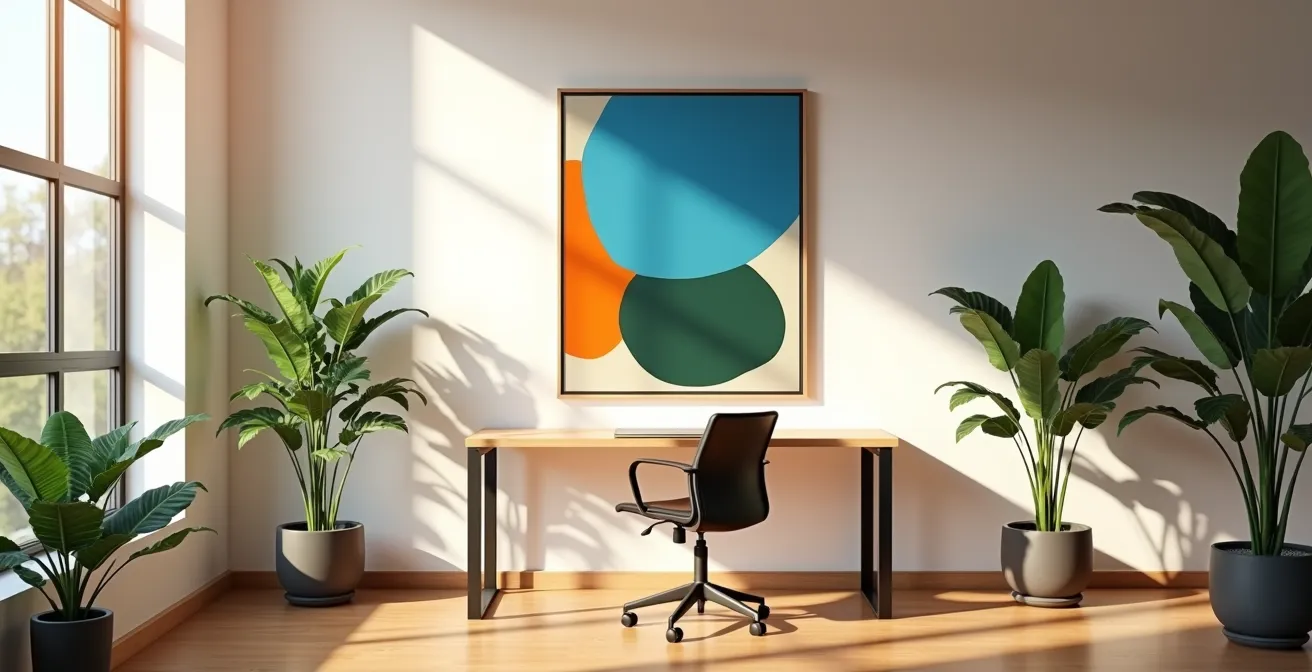
Boosting creativity isn’t about waiting for inspiration; it’s about building a sensory environment that manufactures it.
- Specific colors and sounds (like blue hues and pink noise) are scientifically proven to enhance focus and cognitive performance.
- Three-dimensional art like sculpture alters spatial perception more profoundly than 2D prints, creating a more dynamic mental state.
Recommendation: Stop decorating your workspace and start designing it as a cognitive toolkit to actively manage your focus and creativity.
As a freelancer or remote worker, you face a unique paradox: your freedom is your greatest asset, yet the isolation of your workspace can become a cage for creativity. When a creative block hits, the common advice is to “take a walk” or “change your scenery.” But what if the solution isn’t outside your office, but in how you architect the environment within it? Many believe that adding art is merely about decoration, a way to make a sterile space feel more personal. This view misses the point entirely.
The art in your workspace isn’t just a passive object; it is an active cognitive tool. The colors, shapes, and even the sounds you choose are direct inputs into your brain’s operating system, capable of either hindering or catalyzing your productivity. Forgetting this is like a musician ignoring the tuning of their instrument. The key isn’t simply *having* art, but understanding how to use it with intention.
This guide moves beyond the platitude of “art is good for morale.” We will delve into the sensory architecture of a high-performance creative space. You’ll learn to calibrate your visual and auditory stimuli to match specific cognitive demands, turning your workspace from a place you simply work *in*, to an instrument you work *with* to orchestrate focus, break through creative blocks, and engineer your flow state on demand.
This article explores the specific, science-backed strategies to transform your workspace into a catalyst for creativity. We will examine how to leverage color, sound, and form to build an environment that actively supports your deepest work.
Summary: How to Engineer a Workspace That Boosts Creative Output
- Which Abstract Art Colors Stimulate Focus vs. Relaxation?
- White Noise vs. Classical Music: Which Soundtrack Best Masks Distractions?
- The Sensory Overload Mistake That Kills Your Flow State
- How to Spend 10 Minutes with One Painting to Unlock New Ideas?
- How to Turn Your Smart TV into a Dynamic Art Gallery for Free?
- How to Build a “Flow State” Playlist Using Video Game Scores?
- Brutalism vs. Art Deco: Which Style Defines the Soul of the 20th Century?
- Why Sculpture Transforms a Room More Effectively Than Flat Art?
Which Abstract Art Colors Stimulate Focus vs. Relaxation?
The color of the art on your walls is not just an aesthetic choice; it is a direct command to your nervous system. Color psychology is often oversimplified, but its core principles are powerful tools for stimulus calibration. Certain hues act as cognitive catalysts for deep work, while others promote the relaxed state necessary for creative incubation. The key is to match the color to the task at hand, using your art as a functional backdrop for your mental state.
For tasks requiring intense concentration, such as writing, coding, or detailed analysis, blue is unparalleled. Its shorter wavelength has a calming effect on the brain, reducing mental noise and enhancing acuity. In fact, specific research has found that blue environments can boost productivity by up to 15%. An abstract piece dominated by shades of cobalt, navy, or cerulean can create a pocket of intellectual serenity. Green offers a similar benefit, promoting balance and reducing eye strain, making it ideal for long work sessions.
Conversely, when the goal is brainstorming or divergent thinking, you need to introduce energy. Accents of yellow or orange stimulate mental activity and encourage optimism. However, these colors must be used sparingly, as overuse can lead to anxiety. An abstract painting with a splash of vibrant yellow can be the visual jolt needed to spark a new idea without overwhelming your senses.
This table breaks down how to strategically deploy color in your workspace to achieve specific cognitive outcomes. By understanding these effects, you can curate a visual environment that works for you, not against you.
| Color | Focus Effect | Relaxation Effect | Best Use Case |
|---|---|---|---|
| Blue | Enhances concentration & mental agility | Calming, reduces stress | Areas requiring intense focus |
| Green | 25% boost in focus (APA study) | Promotes balance & harmony | Long work sessions, brainstorming |
| Yellow | Stimulates mental activity | Can increase anxiety if overused | Creative spaces (as accent) |
| Red | Increases urgency & energy | Can elevate stress levels | Deadline-driven tasks |
White Noise vs. Classical Music: Which Soundtrack Best Masks Distractions?
Just as visual stimuli can be calibrated, your auditory environment can be meticulously designed. The freelancer’s home office is often a battleground of unpredictable sounds—a neighbor’s lawnmower, a delivery at the door, the hum of household appliances. The common solution, music, can be a double-edged sword; lyrics and complex melodies often demand cognitive resources, becoming a distraction themselves. The real goal is to create a consistent, unobtrusive “sonic blanket” that masks interruptions without demanding attention.
This is where “colored” noise comes into play. While white noise—a mix of all audible frequencies—is well-known, it’s not the only option. Pink noise, which has more power in the lower frequency bands, is often perceived as more balanced and less harsh than white noise. It mimics natural sounds like rainfall or wind. A recent meta-analysis of 13 studies found a small but significant benefit of pink noise for improving task performance, particularly for individuals prone to distraction.
Classical music, specifically instrumental baroque pieces with a steady tempo of around 60 beats per minute, can also be effective. The music’s structured and mathematical nature provides a predictable pattern that the brain can easily background, unlike pop music with its variable structures and lyrical content. However, the choice between noise and music is deeply personal. The ultimate test is whether the sound fades into the background, allowing your focus to remain on your work. Experiment with different soundscapes—from the steady hiss of pink noise to the structured elegance of Vivaldi—to find the auditory texture that best insulates your flow state.
The Sensory Overload Mistake That Kills Your Flow State
In the quest to create a stimulating workspace, it’s easy to make a critical error: sensory overload. More is not always better. A room filled with vibrant art, complex music, and strong scents can create a cognitive traffic jam, overwhelming your brain’s processing capacity and shattering your focus. The goal is not maximum stimulation, but optimal stimulation. This delicate balance is the cornerstone of a high-performance creative environment.
How can you tell if you’ve crossed the line? The signs of sensory overload include a sudden difficulty concentrating on a single task, feeling agitated or overwhelmed by your surroundings, and a strong, almost primal urge to escape the space. You might find yourself rereading the same sentence repeatedly or feeling an inexplicable irritability. This is your brain telling you that it has too many inputs to manage effectively. It’s a state of mental friction where creative thinking becomes impossible.
Achieving optimal stimulation means finding your personal peak on what psychologists call the arousal-performance curve. Too little stimulation leads to boredom and lethargy; too much leads to anxiety and distraction. Your mission is to find the “just right” level of sensory input that keeps you alert and engaged without pulling you out of your flow state. This might mean having one powerful piece of abstract art instead of a cluttered gallery wall, or choosing a simple, steady soundscape like pink noise over a dynamic classical playlist on days when you feel particularly scattered. The art of workspace design lies in this constant, mindful calibration of your sensory diet.
How to Spend 10 Minutes with One Painting to Unlock New Ideas?
Art in your workspace should be more than a passive backdrop; it can be an active partner in your creative process. One of the most powerful and underutilized techniques for breaking a creative block is the practice of intentional contemplation. This involves setting aside a brief, focused period—as little as 10 minutes—to engage deeply with a single piece of art, not as a critic, but as a curious observer. The goal is to quiet the analytical mind and activate the brain’s associative, pattern-recognizing networks.
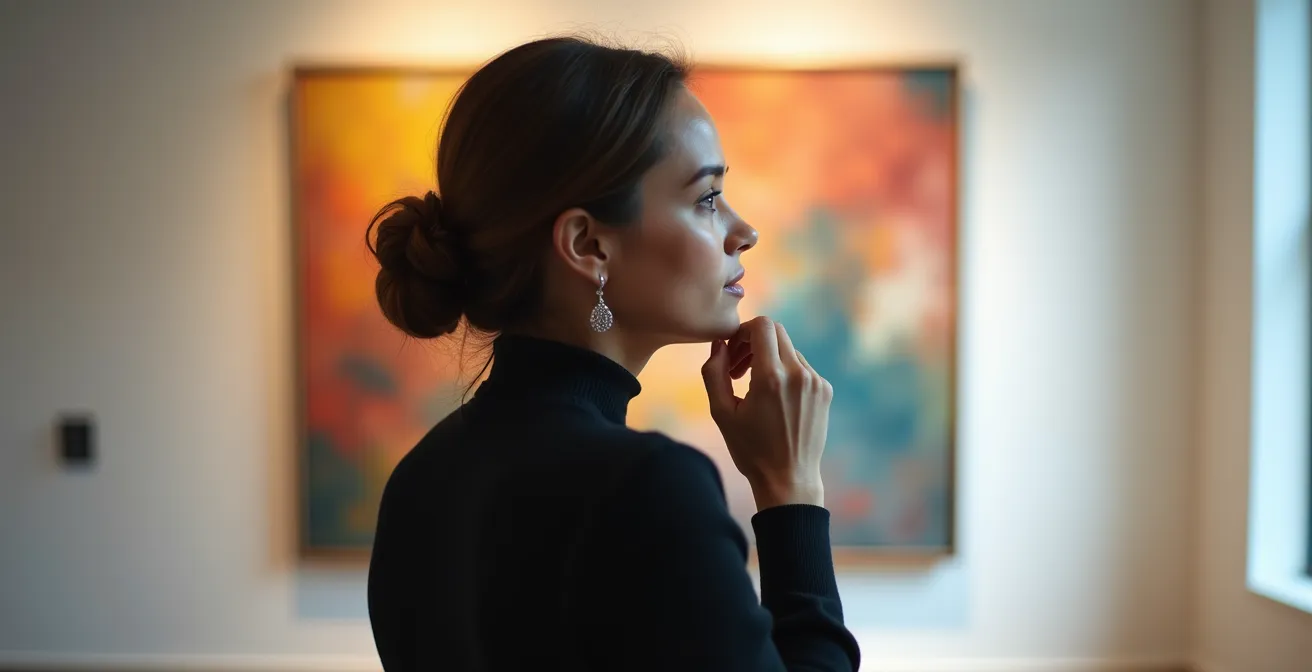
The practice is simple. Choose one painting or sculpture in your space. For 10 minutes, simply look at it. Let your eyes wander across the canvas. Notice the colors, the textures, the interplay of light and shadow, and the lines. Don’t try to “understand” or interpret it. Instead, ask open-ended questions: What emotions does this color evoke? If this shape had a sound, what would it be? What lies beyond the edge of the frame? This process disengages you from the specifics of your creative problem and immerses you in a world of pure form and color, allowing your subconscious to make new connections.
This is not an esoteric exercise; it has a measurable impact on performance. Research from the University of Exeter showed that when employees have input into the art in their workspace, they can be up to 32% more productive. This empowerment comes from the personal connection to the art, making it a more effective tool for contemplation. By actively using the art you’ve chosen, you transform it from a mere object into a cognitive catalyst, a portal to fresh perspectives and unforeseen solutions.
How to Turn Your Smart TV into a Dynamic Art Gallery for Free?
A static piece of art is powerful, but a dynamic, ever-changing visual landscape can prevent sensory habituation—the process by which your brain learns to ignore constant stimuli. A Smart TV, often a black, lifeless rectangle when off, can be transformed into a vibrant, digital art canvas. This approach allows you to curate a visual environment that evolves with your workday, providing energizing visuals in the morning and calming scenes in the afternoon, all without spending a dime.
The process is surprisingly simple and relies on leveraging free resources. Many of the world’s greatest museums, like the Rijksmuseum in Amsterdam and the Smithsonian, offer open-access APIs that provide high-resolution digital versions of their collections. You can download these masterpieces and create themed playlists. Generative art platforms like Electric Sheep offer another fascinating option, displaying ever-evolving, non-repeating abstract visuals created by a collective of computers and human artists.
Once you’ve collected your images, you can use free slideshow apps built into your TV’s operating system or a simple Google Photos album set to “slideshow” mode and cast to your screen. The key to making this effective is programmatic rotation. Schedule your display to change every 30-60 minutes. This subtle shift is just enough to refresh your visual field and prevent your brain from tuning out the art completely, ensuring it remains an active cognitive stimulant throughout the day.
Your 5-Step Digital Art Canvas Audit
- Identify potential ‘canvases’: List every screen in your workspace (Smart TV, spare monitor, tablet) that can display art.
- Inventory your content sources: Gather links to free, high-resolution art APIs (e.g., Rijksmuseum, Smithsonian) and generative art platforms.
- Align with your cognitive needs: Define which art styles or color palettes match your primary work tasks (e.g., focus-driven landscapes vs. creative abstracts).
- Evaluate for sensory fatigue: Plan a rotation schedule (e.g., every 30 minutes) and themes (e.g., morning energy, afternoon calm) to prevent habituation.
- Create a technical roadmap: Choose your slideshow app (e.g., Google Photos) and schedule the implementation to activate your dynamic gallery.
How to Build a “Flow State” Playlist Using Video Game Scores?
The perfect soundtrack for deep work often comes from an unexpected source: video games. Game composers are masters of sensory architecture, tasked with creating auditory environments that enhance focus and immersion for hours on end without becoming distracting. Their work is purpose-built to facilitate a flow state. Unlike film scores, which are designed to manipulate emotion in short bursts, video game music is crafted for sustained concentration, making it an ideal tool for productivity.
The key is to select music from the right genres of games.
- Puzzle Game Scores (e.g., *Fez*, *Monument Valley*): These soundtracks are typically minimalist, ambient, and atmospheric, designed to support complex problem-solving without intruding on thought processes.
- Strategy/City-Builder Scores (e.g., *Civilization*, *Cities: Skylines*): This music is grander and more structured but maintains a steady, non-intrusive tempo that is perfect for long-term planning and deep work sessions.
- Ambient Exploration Scores (e.g., *No Man’s Sky*, *Journey*): Ethereal and often without a strong melody, these scores are ideal for creative brainstorming and ideation, creating a sense of wonder and possibility.
To further enhance cognitive function, you can layer these playlists with specific frequencies. For instance, Huberman Lab research indicates binaural beats at 40 Hz can improve general cognition and focus. By playing a 40 Hz tone at a low volume underneath a video game score, you are creating a multi-layered auditory tool designed for peak mental performance. This level of intentional sound design transforms your headphones from a distraction-blocker into a focus-enhancer.
Brutalism vs. Art Deco: Which Style Defines the Soul of the 20th Century?
Beyond individual pieces, the overarching aesthetic style of your workspace embodies a work philosophy. Two dominant 20th-century styles, Brutalism and Art Deco, offer a fascinating dichotomy. Choosing between them is not merely a matter of taste; it’s a statement about the kind of work you aim to do. One promotes monastic concentration, the other inspires aspirational dynamism. Understanding their psychological underpinnings allows you to align your environment with your professional goals.
Brutalism, with its emphasis on raw concrete, exposed materials, and minimal ornamentation, is the architecture of uncompromising focus. Its visual language is one of honesty and function. A workspace inspired by Brutalism—featuring a concrete desk accessory, a minimalist metal lamp, or art prints of stark architectural forms—reduces visual distraction to an absolute minimum. It creates an environment that encourages deep, analytical work, free from frivolity. It is the ideal aesthetic for writers, programmers, and researchers who need to descend into a state of profound concentration.
Art Deco, by contrast, is the style of optimistic momentum. Born in the boom of the 1920s, it is characterized by lavish geometric details, strong vertical lines, and a sense of aspirational growth. An Art Deco-inspired workspace—with brass accents, a fan-shaped mirror, or prints featuring bold, symmetrical patterns—inspires progress and forward movement. It is a stimulating environment that fuels energy and creative innovation, making it perfectly suited for entrepreneurs, designers, and anyone in a role that thrives on agile thinking and collaborative brainstorming.
The choice between these styles is a choice between two modes of thinking. By curating your space with elements of one or the other, you are creating a powerful psychological prime for the type of cognitive state your work demands.
| Aspect | Brutalism | Art Deco | Work Philosophy Match |
|---|---|---|---|
| Core Philosophy | Uncompromising focus, raw honesty | Optimistic dynamism, aspirational growth | Deep Work vs. Agile Innovation |
| Visual Elements | Raw concrete, minimal ornamentation | Vertical lines, lavish geometric details | Monastic concentration vs. Creative stimulation |
| Psychological Effect | Reduces distraction, promotes depth | Inspires progress, forward momentum | Suited for analytical vs. creative tasks |
Key Takeaways
- Your workspace is not a passive container but an active cognitive tool you can design to manage focus and creativity.
- Specific visual (color) and auditory (colored noise, game scores) stimuli are scientifically proven to enhance different mental states.
- The goal is “optimal stimulation,” not maximum. Overloading your senses with too much art or sound will kill your flow state.
Why Sculpture Transforms a Room More Effectively Than Flat Art?
While paintings and prints engage the eye, a sculpture commands the space. Three-dimensional art transforms a room more profoundly than flat art because it manipulates a crucial element of our environment: spatial dynamics. A sculpture is not something you just look at; it’s something you experience in relation to your own body. It has presence. It forces you to move around it, viewing it from different angles, and in doing so, it changes your perception of the entire room.
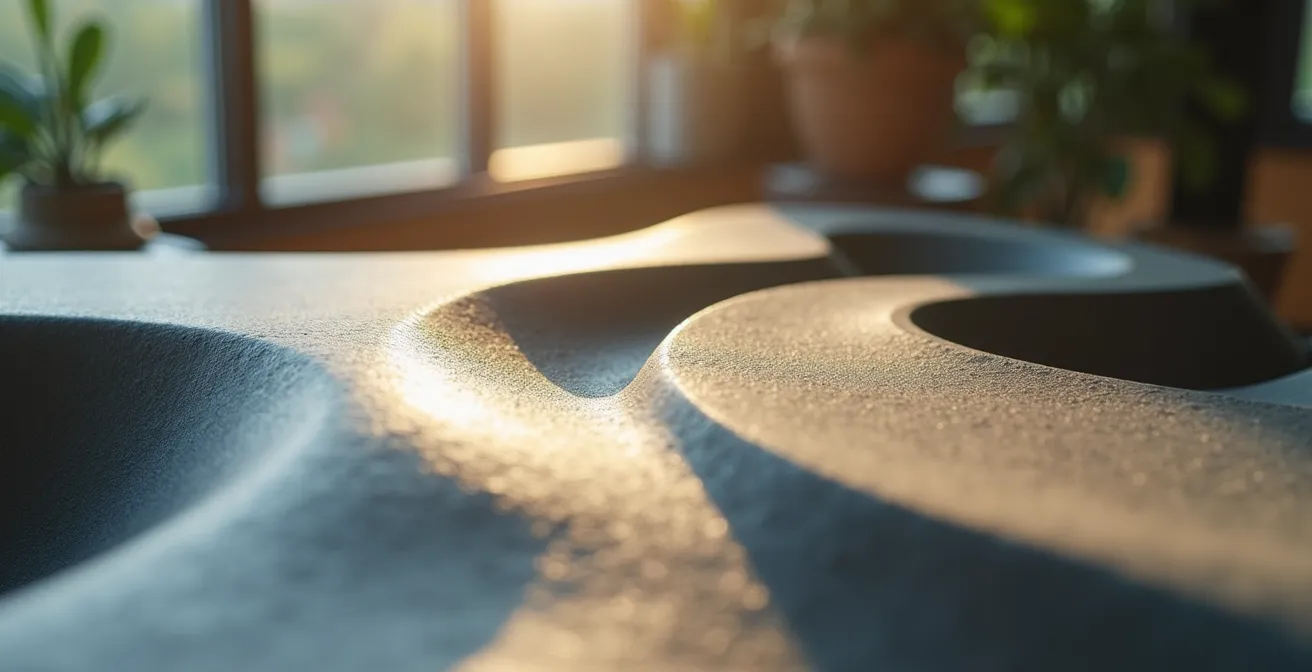
The power of sculpture lies in its interaction with light. Throughout the day, as the natural light in your workspace shifts, a sculpture comes alive. It casts evolving shadows, reveals new facets of its texture, and creates a dynamic, ever-changing point of interest. This subtle environmental flux is a powerful antidote to the sensory monotony that can lead to creative stagnation. A simple, organic form on your desk can provide a much-needed connection to the physical world, grounding you when you’re lost in digital tasks.
This principle of adding three-dimensional, naturalistic forms is echoed in the proven benefits of biophilic design. The presence of something as simple as a plant—a living sculpture—has a measurable effect on our cognitive function. By introducing 3D objects that interact with light and space, you create a richer, more complex sensory environment. This complexity engages the brain on a subconscious level, fostering a more agile and creative mental state than a purely two-dimensional world ever could.
By now, it’s clear that the objects in your workspace are far more than simple decorations. They are the levers and dials of your personal cognitive control panel. From the color of a print to the curve of a sculpture and the frequency of a sound, each element is a choice that can either build or break your creative momentum. Start seeing your workspace not as a collection of things, but as a holistic sensory system you can engineer for peak performance. Your next great idea might not come from a moment of inspiration, but from the intentional design of the space where you work.