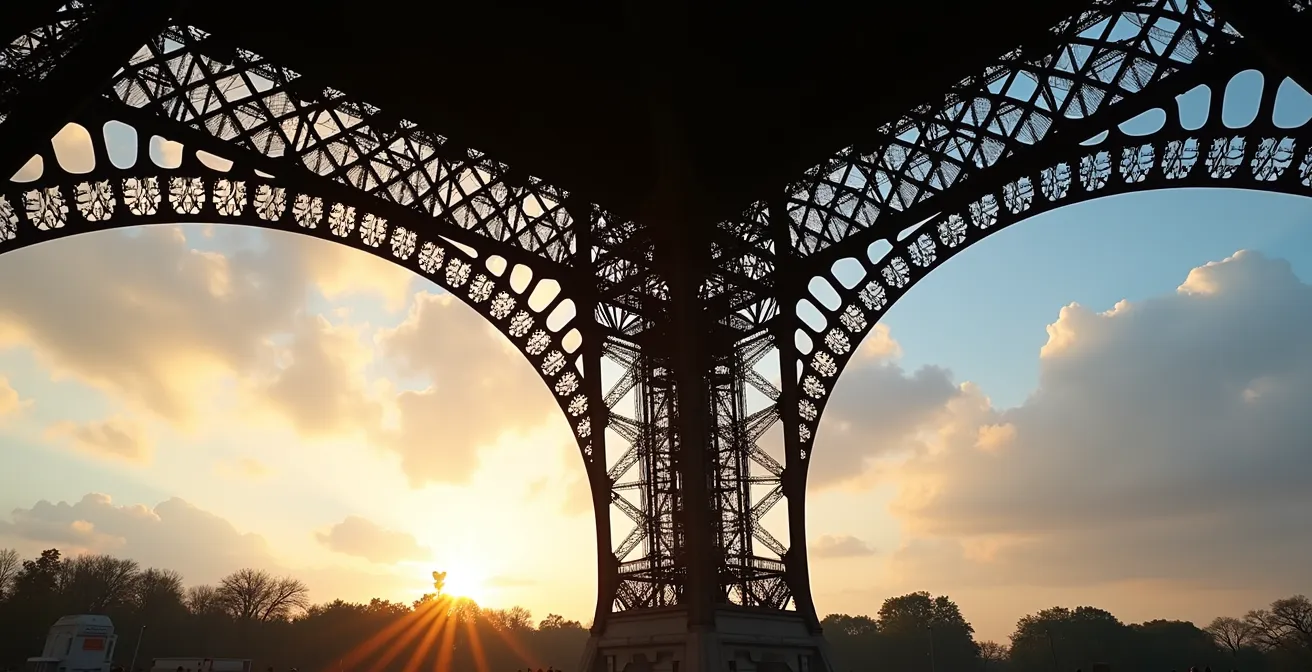
The letdown you feel at a famous landmark isn’t a sign of failure; it’s an invitation to a deeper, more authentic travel experience.
- Disappointment often stems from the gap between a curated social media fantasy and a living, breathing city.
- Engaging with the “grit”—the crowds, the planning, the imperfections—creates stronger memories than passively observing.
Recommendation: Shift your goal from seeking a perfect picture to actively participating in the real, unedited story of a place.
You’ve seen it in a thousand movies and a million photographs: the Eiffel Tower, glittering against the Parisian sky. You book the flight, cross an ocean, and stand before it for the first time. But instead of pure awe, you feel… something else. It seems smaller than you imagined, besieged by crowds and souvenir sellers. This flicker of disappointment is a near-universal experience for the modern traveler, a quiet letdown that happens at the Pyramids, the Colosseum, and the Statue of Liberty.
The common advice is to simply “lower your expectations” or avoid popular sites altogether. We’re told to manage the risk of disappointment by anticipating it. But this approach misses the point entirely. The issue isn’t the landmark itself; it’s the flawed expectation of a sterile, picture-perfect moment, an image curated by decades of media and polished Instagram feeds. We arrive expecting a private viewing and are shocked to find a real, messy, living city operating around it.
What if the true magic of travel isn’t found by avoiding this friction, but by embracing it? This guide proposes a different path. Instead of seeing crowds, dirt, and planning hassles as flaws, we can reframe them as part of the authentic story. The key is to shift from being a passive observer hunting for a fantasy to an active participant in reality. It’s about learning to read the texture of a place, not just look at its monuments.
This article will explore how to make this mental shift. We will deconstruct the psychology behind travel disappointment, offer concrete strategies for engaging more deeply with iconic sites, and show why the most memorable travel stories often come from the imperfect moments that happen between the perfect photos.
Summary: Why the Eiffel Tower Is Smaller—and a Better Experience—Than You Imagine
- Why Japanese Tourists Sometimes Need Hospitalization After Visiting Paris?
- How to Secure Tickets for the Alhambra 3 Months in Advance?
- Climbing the Tower vs. Looking at It: Which Offer the Better Memory?
- The Distraction Technique Pickpockets Use at Trevi Fountain
- Why Visiting Venice in November Is Wet but Worth It for the Solitude?
- When to Visit Popular Cities to Ensure Authentic Local Encounters?
- How to Experience the Colosseum Alone by Waking Up at 5 AM?
- Why Walking a City Reveals Stories That Buses Miss?
Why Japanese Tourists Sometimes Need Hospitalization After Visiting Paris?
The gap between expectation and reality can be so extreme it has a medically documented name: Paris Syndrome. This acute psychological condition primarily affects Japanese tourists who arrive in Paris expecting a romantic utopia straight from films and magazines. They envision a pristine city of high fashion, art, and quaint cafés. What they find is a bustling, noisy, and sometimes gritty metropolis with indifferent service and petty crime. This profound culture shock can trigger severe symptoms, including hallucinations, anxiety, and feelings of persecution.
While thankfully rare, the Japanese embassy in Paris still handles around 20 cases per year requiring psychological support or repatriation. Dr. Hiroaki Ota, the psychiatrist who first identified the syndrome, noted it stems from the violent collision of a hyper-idealized image with an unvarnished reality. It’s the ultimate proof that unrealistic expectations don’t just lead to disappointment; they can cause genuine distress. This phenomenon serves as a crucial lesson for all travelers: our preconceived notions are the most fragile baggage we carry.
The antidote isn’t to stop dreaming, but to build a more resilient travel mindset. It requires acknowledging that every great city has layers of both beauty and grit. Learning to appreciate this complexity is the first step toward a more meaningful journey. This is the core of the ‘Grit is the Pearl’ mindset.
Your Action Plan: The ‘Grit is the Pearl’ Mindset
- Set a clear purpose beyond glamour: Focus on experiencing a new environment, not just capturing perfect moments.
- Plan for reflection: Embrace both positive and negative aspects as meaningful growth opportunities, not just checklist items.
- Reframe “negatives”: See a crowded metro or graffiti not as flaws in a fantasy, but as signs of a living, authentic city.
- Appreciate the full journey: Shift from seeking a nonexistent perfection to valuing the entire, imperfect experience.
- View contrasts as genuine exploration: Understand that New York’s soaring skyscrapers and dirty subways are two sides of the same authentic coin.
How to Secure Tickets for the Alhambra 3 Months in Advance?
Sometimes, the friction of travel isn’t psychological but logistical. Nothing shatters the dream of wandering through a historic marvel faster than a “Sold Out” sign. The Alhambra in Granada is a prime example. Its breathtaking Nasrid Palaces have a strictly limited capacity, and tickets often vanish the moment they’re released. According to the official Spain tourism website, tickets are made available up to three months in advance and are fiercely competitive.
This is where proactive engagement with reality pays off. Waiting until the week of your visit is a recipe for disappointment. The “perfect” plan requires booking exactly on time. However, a more resilient traveler knows there are other ways to experience the magic of a place. The key is to research alternatives, turning a potential dead end into a new opportunity. Instead of giving up, you can look for guided tours, which often have pre-reserved ticket blocks, or consider the Granada Card for bundled access.
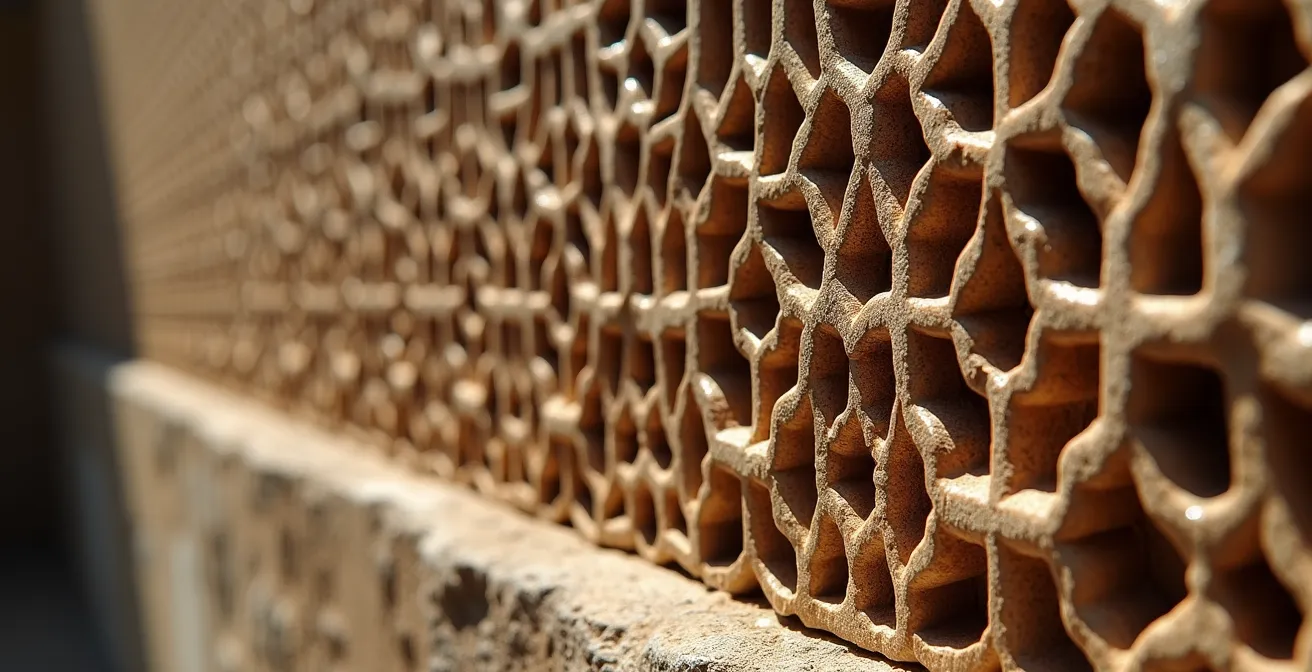
As this image of the palace’s detailed carvings shows, the beauty of the Alhambra is in its layers. Even if you can’t secure a ticket for the main palaces, you can still find wonder. The experience doesn’t have to be an all-or-nothing proposition. Exploring the gardens or visiting at night offers a completely different, and often more intimate, perspective. This flexibility transforms a planning failure into a unique adventure.
The following table, based on an in-depth analysis of ticketing options, breaks down the alternatives when primary tickets are gone. It’s a practical guide to turning disappointment into a new plan.
| Option | Cost | What’s Included | Best For |
|---|---|---|---|
| Granada Card | ~40€ | Alhambra + 10-15 other monuments | Multi-day visitors wanting comprehensive access |
| Guided Tour | Variable | Nasrid Palaces, Alcazaba, Generalife with expert guide | First-time visitors wanting deeper insights |
| Night Visit | Less than day ticket | Nasrid Palaces OR Generalife Gardens at night | Alternative experience when day tickets unavailable |
| Gardens Only | Reduced price | Main landscaped areas, no Nasrid Palaces | Budget travelers or return visitors |
Climbing the Tower vs. Looking at It: Which Offer the Better Memory?
The Eiffel Tower experience perfectly illustrates the difference between passive observation and participatory experience. Most visitors queue for hours for an elevator, ascend in a crowded box, spend a few minutes on a packed viewing deck taking photos, and descend. They have *seen* Paris from the tower. But have they truly *experienced* the tower itself?
Consider the alternative: climbing its stairs. It’s a physical act of engagement. You feel the wind through the iron lattice, hear the city’s hum grow distant as you ascend, and see the intricate details of Gustave Eiffel’s engineering up close. You are not just a passenger; you are a participant in the structure’s scale and design. The breaks on the first and second floors become earned moments of rest and reflection, not just stops on a tour.
Case Study: The Sensory Experience of the Eiffel Tower Climb
Tour companies that pioneered guided climbs of the Eiffel Tower report a profound difference in visitor feedback. Climbers don’t just talk about the view; they talk about the feeling of accomplishment and the unique perspective from within the tower’s skeleton. The journey involves 704 steps to the second floor, with the first floor featuring a transparent glass floor 57 meters above the ground, adding a thrilling sensory dimension. This physical and visual journey creates a far more durable memory. Even Gustave Eiffel himself preferred to climb the 1,700+ steps to the top when escorting dignitaries, understanding that the climb was integral to the experience.
This isn’t about bragging rights. It’s about creating a richer memory through sensory engagement. The physical effort, the changing perspective, the feeling of the ironwork—these elements forge a connection that a passive elevator ride cannot replicate. The memory becomes “the time I climbed the Eiffel Tower,” not just “the time I saw it.” You leave with a story, not just a snapshot.
The Distraction Technique Pickpockets Use at Trevi Fountain
Nowhere is the collision of beauty and grit more apparent than at a crowded landmark like Rome’s Trevi Fountain. While you’re lost in the Baroque splendor, someone else is studying your behavior. Petty crime thrives on the very awe that brings you to these places. Pickpockets are masters of exploiting a traveler’s distracted state, and their methods are a lesson in applied psychology.
Their primary tool is not stealth, but distraction. A common tactic involves one person “accidentally” spilling something on you or dropping a handful of items at your feet. Your natural instinct is to help or react. In that split second of diverted attention, an accomplice relieves you of your wallet or phone. Another method is the “false petition,” where someone shoves a clipboard in your face, using it as a screen to block your view of their other hand as it explores your pockets or bag. They aren’t just thieves; they are choreographers of chaos.
The solution isn’t paranoia, but situational awareness. It’s about expanding your focus from the monument to the environment around it. Notice the flow of the crowd. Be wary of anyone who intentionally invades your personal space. A key technique is to establish a baseline of normal behavior for the area and then look for anomalies—people moving against the crowd, lingering without purpose, or working in unnatural-looking groups. By understanding their script, you can refuse to play your part.
This vigilance isn’t about seeing everyone as a threat. It’s another form of engagement—reading the human landscape with the same attention you give the stone one. It keeps you grounded in the present reality of the place, making you a less attractive target and a more observant traveler.
Why Visiting Venice in November Is Wet but Worth It for the Solitude?
Venice in the summer is a postcard of glorious sunshine, but it’s also a reality of shoulder-to-shoulder crowds, sweltering heat, and long queues. The city can feel less like a historic marvel and more like a theme park. But what happens when you visit in the off-season? Venice in November is often wet, misty, and cool. For many, this sounds like a flawed experience. For the engaged traveler, it’s an opportunity.
The rain and fog of November wash the city clean of crowds. The Piazza San Marco, a sea of people in July, can be hauntingly empty at dawn. The absence of tourist hordes allows the city’s true character to emerge. You can hear the echo of your own footsteps in narrow alleyways, the lapping of water against ancient foundations, and the murmur of Italian from inside a warm café. The mist acts as a natural diffuser, softening the light and wrapping the architecture in a mysterious, melancholic beauty.
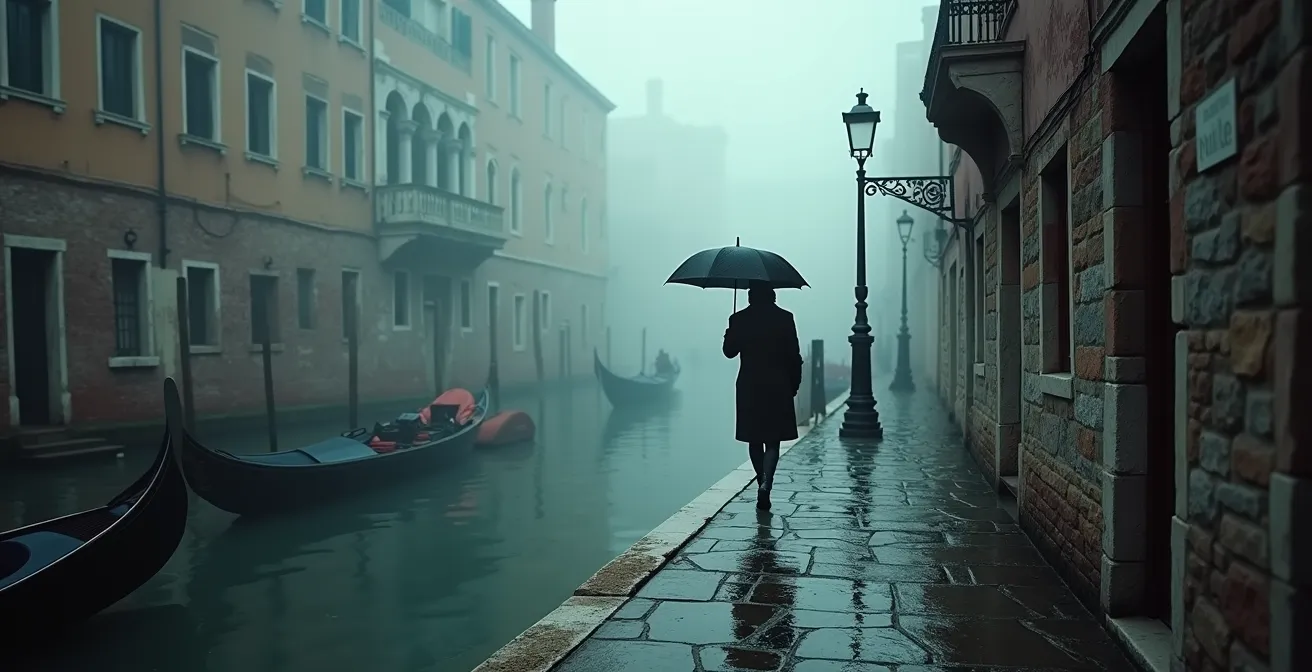
This is the reward for embracing what others see as imperfect conditions. The solitude allows for a deeper, more personal connection to the city. The reflections on wet cobblestones create double images, turning every streetlamp into a work of art. You trade the guarantee of good weather for the possibility of genuine atmosphere. It’s a choice to experience the city’s quiet soul rather than its loud, performative summer self.
This off-season approach requires a mindset shift. You aren’t there to check off a list of sights in perfect weather. You are there to feel the mood of a place in its most authentic state. A rainy day in Venice isn’t a ruined day; it’s simply a different kind of beautiful day, one that offers a more contemplative and memorable experience.
When to Visit Popular Cities to Ensure Authentic Local Encounters?
The single greatest complaint about over-touristed cities is the feeling of being in a bubble, disconnected from local life. So, how do you break out? The answer lies in understanding the concept of “third places.” Coined by sociologist Ray Oldenburg, these are the anchors of community life that are neither home (the first place) nor work (the second place). They are the neighborhood cafés, local libraries, public parks, and markets where people gather, interact, and build social bonds.
In a city like Paris or Rome, tourists naturally gravitate to the famous monuments. Local life, however, unfolds elsewhere. The key to authentic encounters is to intentionally seek out these third places. Instead of having coffee on the main plaza, walk three blocks into a residential neighborhood and find the café where locals are reading the paper. Instead of another museum, spend an afternoon in a public garden watching families and friends interact. This strategy allows you to observe—and sometimes participate in—the un-staged rhythm of daily life.
Case Study: The Third Place Strategy in Practice
Travel psychologists have noted that visitors who actively incorporate “third places” into their itineraries report significantly higher satisfaction and a greater sense of connection. For example, a tourist in Barcelona might spend a morning at the Mercat de Santa Caterina on a weekday, observing locals shop for groceries, rather than just the tourist-focused Boqueria. In Florence, this could mean visiting a neighborhood library to see its architecture and feel its quiet, civic energy. These small detours from the beaten path provide a window into the city’s true identity and guard against the disappointment that comes from a purely touristic experience.
This approach requires curiosity and a willingness to wander without a specific goal. It’s about prioritizing genuine connection over a checklist of sights. As clinical psychologist and travel expert Javier Labourt notes, the problem often starts with a flawed premise: “the traveller is saying, this trip or this city will be this way, or will be perfect… perfection does not exist.” By seeking out real places instead of perfect moments, we find something far more valuable.
How to Experience the Colosseum Alone by Waking Up at 5 AM?
The advice to “wake up early to beat the crowds” is a classic travel tip, but it’s incomplete. The real question is: once you have that solitude, what do you do with it? Standing alone in front of the Colosseum at dawn is a rare gift. The goal shouldn’t be just to get an empty photo, but to use the silence to connect with the monument’s immense history in a way that’s impossible in the midday chaos.
This requires a conscious script for your experience. Instead of a quick look, give yourself a structured 30 minutes of sensory engagement. Start by simply observing. For the first ten minutes, stand still and watch the soft morning light filter through the ancient arches, noticing the textures of the stone and the sheer scale of the structure without distraction. Let your eyes adjust and absorb the grandeur.
Next, close your eyes. For another ten minutes, try to imagine the sounds. The roar of 50,000 spectators, the clash of gladiators, the pronouncements of an emperor. The silence of the dawn provides the perfect canvas for this auditory time travel. You’re no longer just looking at a ruin; you’re placing yourself inside a living arena. Finally, for the last ten minutes, focus on the details. Walk closer and read the building’s 2,000-year history in its stones—the decay from time, the patches from restoration, the marks of centuries. You’re reading the building’s biography.
This deliberate, multi-sensory approach transforms an early morning into a profound, almost meditative experience. You are not just seeing the Colosseum before everyone else; you are communing with it. The emptiness isn’t the prize; it’s the opportunity.
Key Takeaways
- Travel disappointment is often a gap between a curated fantasy and the complex reality of a living city.
- The most memorable experiences come from active participation (climbing, walking, engaging) rather than passive observation.
- Reframing “negatives” like crowds, logistical hurdles, or bad weather as part of the authentic story leads to a richer journey.
Why Walking a City Reveals Stories That Buses Miss?
The tour bus offers a comfortable, efficient way to see a city’s highlights. From behind a glass window, you get a narrated slideshow of famous buildings. But this convenience comes at a cost: disconnection. You are insulated from the city’s sounds, smells, and textures. You see the landmarks, but you miss the story. Walking, by contrast, is an act of total immersion. It’s the difference between watching a movie about a place and actually being in it.
At walking speed, the city reveals its secrets. You can spot the faint “ghost signs” of old advertisements painted on brick walls, notice the subtle shifts in architecture from one block to the next, and follow the “desire lines”—unofficial dirt paths in parks that show where locals *actually* walk. This is the urban palimpsest, the layers of history written onto the cityscape, visible only to those moving slowly enough to read them. A bus tour sticks to the main arteries, but a walker can investigate a curious alley, step into a hidden courtyard, or have a spontaneous chat with a shopkeeper.
This isn’t just about seeing more; it’s about experiencing differently. You feel the change in temperature as you move from a sunny plaza into a shady lane. You hear the mix of languages, traffic, and music. You are part of the street life, not just an observer of it. This deep, sensory connection is what creates a lasting sense of place.
This table, adapted from an analysis of urban exploration, clearly shows what is gained by choosing your feet over a seat.
| Discovery Element | Walking | Bus Tour |
|---|---|---|
| Urban Palimpsests (layered history) | Can spot ghost signs, bricked windows, architectural transitions | Too fast to notice details |
| Desire Lines | Can follow unofficial paths showing where locals actually go | Limited to vehicle routes |
| Sensory Experience | Full engagement: sounds, smells, textures, temperature | Visual only through windows |
| Spontaneous Discoveries | Can investigate interesting alleys, shops, hidden courtyards | Fixed route only |
| Local Interactions | Natural encounters with shopkeepers, residents | Isolated from street life |
Ultimately, a more rewarding travel experience doesn’t require a bigger budget or a more exotic destination. It requires a simple but profound shift in mindset. Start applying these strategies on your next trip to move beyond the surface-level postcard and discover the rich, complex, and unforgettable reality that lies beneath.