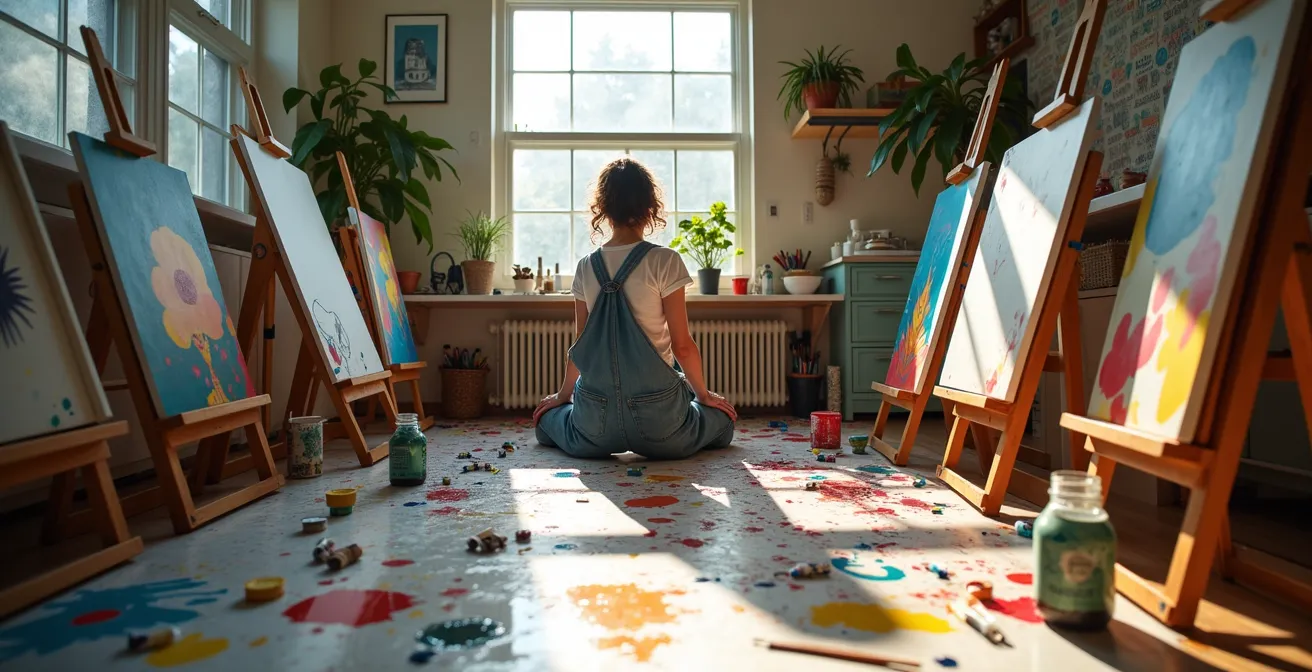
Contrary to what your perfectionist brain tells you, the goal of a new hobby isn’t to get good at it. The real value lies in the struggle. This article explains the neuroscience behind why being a clumsy, awkward beginner is a powerful tool to break cognitive rigidity, actively build new neural pathways, and forge a more resilient ego—one that thrives on effort, not just flawless performance.
You’ve mastered your career. Your home is a model of efficiency. You pride yourself on competence. So why does the thought of picking up a guitar or a paintbrush fill you with a unique kind of dread? For the perfectionist, the awkward, clumsy phase of being a beginner isn’t just uncomfortable—it feels like a direct threat to your identity. The fear of looking foolish, of failing publicly or privately, can be paralyzing.
Most advice will tell you to “embrace the process” or “learn humility.” While true, this doesn’t address the core issue. Your brain, wired for high performance, sees incompetence as a system error that needs to be avoided at all costs. It triggers a threat response, making the very act of learning feel like a failure before you’ve even started.
But what if the fumbling, the frustration, and the “bad” first attempts weren’t a bug, but a feature? What if being terrible at something was the most effective, science-backed way to build a truly unbreakable ego? This isn’t about feeling good despite your mistakes. It’s about understanding that the mistakes themselves are the mechanism for growth. They are the reps and sets for your brain’s resilience workout.
This guide will deconstruct that fear. We will explore the practical steps to start, the neurological reasons struggle is beneficial, how to create a space for imperfection, and why sharing your “bad” art is more powerful than hosting a perfect dinner party. It’s time to stop protecting your ego and start training it.
To navigate this journey from fear to freedom, this article is structured to guide you step-by-step. Discover the sections below to understand how you can turn novice struggles into your greatest strength.
Summary: Why Embracing Awkward Hobbies Is a Superpower
- How to Start Oil Painting for Under $50 Without Buying Junk?
- YouTube Tutorials vs. In-Person Classes: Which Accelerates Learning Faster?
- The “Valley of Despair” in Learning Guitar and How to Cross It?
- How to Carve Out a Hobby Station in a 500 sq ft Apartment?
- When Is the Best Time to Practice a New Skill for Memory Consolidation?
- What to Prepare Before Your First Meetup to Avoid Awkward Silence?
- How to Start a “Fine Art” Collection with a Budget of $1,000?
- Why Hands-On Workshops Build Stronger Bonds Than Dinner Parties?
How to Start Oil Painting for Under $50 Without Buying Junk?
The first hurdle for any perfectionist is the starting line, often cluttered with the fear of “doing it wrong” from the very first purchase. The impulse is to research exhaustively, buy the “best” gear, and then feel too intimidated by the investment to make a mess. Let’s dismantle that. Your goal isn’t to become a master painter overnight; it’s to give your brain a new problem to solve. And you can do that on a tiny budget. It’s a popular choice, as recent data shows that 30% of U.S. adults engage in painting or drawing.
Forget the 64-piece paint sets and premium linen canvases. Limitation is your greatest tool for creativity and cognitive effort. By starting with a minimal kit, you force your brain to work harder and learn more deeply. For example, using a limited “Zorn palette” (just three primary colors plus white) forces you to grapple with color theory from day one, rather than passively selecting a pre-mixed tube of “forest green.” This isn’t a shortcut; it’s a more challenging, and therefore more beneficial, path for brain-training.
The key is to assemble a “good enough for now” kit that is low-cost and high-function. Think canvas paper instead of stretched canvas, a couple of synthetic brushes instead of a full set of badger hair, and a repurposed ceramic plate as a palette. The psychological freedom that comes from knowing your supplies cost less than a fancy dinner is immense. It gives you permission to “waste” paint, to create “ugly” art, and to focus entirely on the physical sensation of brush on paper. This is where the real learning happens, far from the pressure of a pristine, expensive canvas.
Your first step is not to create a masterpiece, but to create a mess. That’s the win. By deliberately choosing budget materials, you are telling your ego that this activity is a no-stakes playground. You are lowering the barrier to entry so low that the only thing left to do is to begin.
YouTube Tutorials vs. In-Person Classes: Which Accelerates Learning Faster?
Once you have your materials, the next question is how to learn. Today’s world offers two dominant paths: the solitary, self-paced world of online tutorials or the structured, social environment of an in-person class. For the perfectionist, the lure of YouTube is strong—it’s private, you can pause and rewind, and no one sees your mistakes. It’s no surprise that 53% of Americans learn hobbies from online videos. But is it the most effective way to rewire your brain?
The answer lies in understanding how each method impacts your brain’s learning systems. Online tutorials are fantastic for building procedural memory—the “how-to” muscle memory of performing a task. The repetition of watching, pausing, and mimicking an action strengthens specific neural pathways. It’s a controlled environment, perfect for getting comfortable with the basic mechanics of a skill.
This image contrasts the focused, personal space of online learning with the dynamic, collaborative energy of a physical classroom, highlighting two distinct paths to skill acquisition.
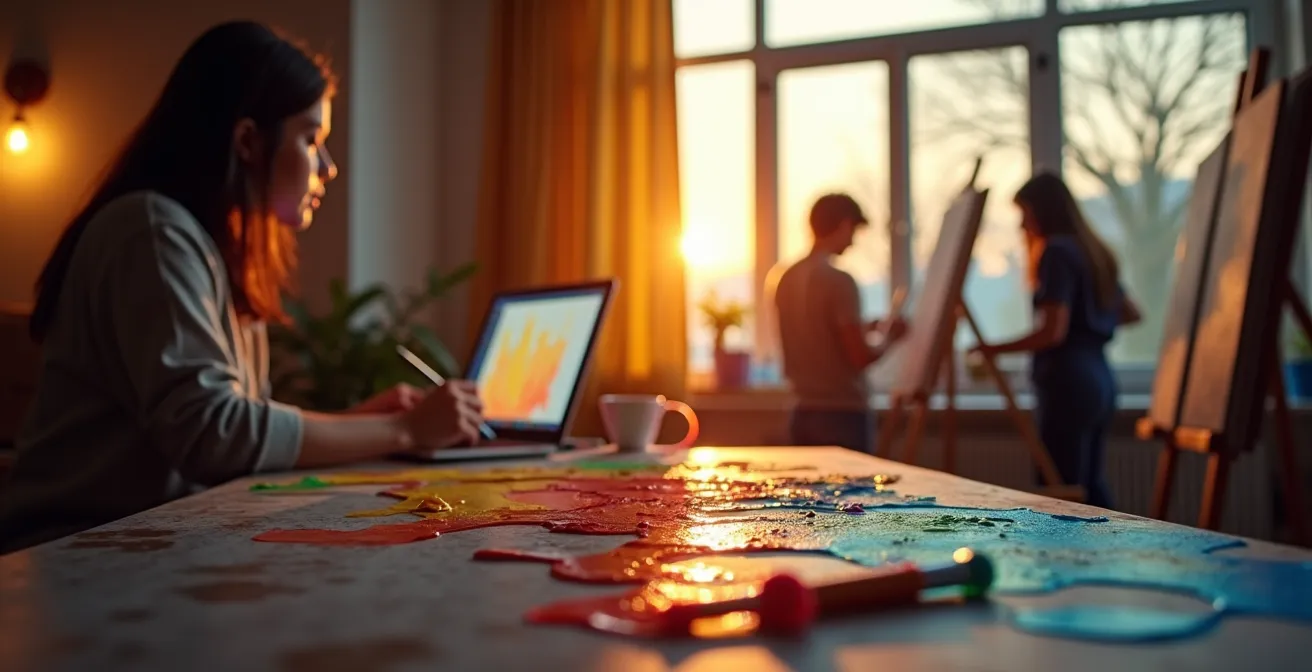
However, in-person classes activate a different, equally powerful set of neurological tools. Being in a room with others engages your mirror neurons, which fire both when you perform an action and when you watch someone else perform it. This accelerates understanding by allowing you to learn from others’ movements, mistakes, and successes. The live feedback from an instructor also creates a crucial, immediate loop that corrects errors before they become ingrained habits. This combination of observation and interaction fosters a deeper conceptual understanding that goes beyond simple mimicry.
Ultimately, neither method is universally “better.” They simply train different aspects of your brain. As the following table shows, the optimal approach often involves a hybrid model, leveraging the strengths of both to create a comprehensive learning experience.
This comparison, informed by principles of neuroplasticity, breaks down how different learning environments serve distinct cognitive functions. An analysis of brain-rewiring techniques supports the idea that varied stimuli are key to robust neural growth.
| Learning Method | Best For | Neuroplasticity Effect | Cost Range |
|---|---|---|---|
| YouTube Tutorials | Procedural memory & repetition | Strengthens specific neural pathways through self-directed practice | Free – $10/month premium |
| In-Person Classes | Conceptual understanding & social learning | Activates mirror neurons and behavioral synchrony | $50-200/month |
| Hybrid Approach | Comprehensive skill development | Combines myelination benefits with feedback loops | $25-100/month |
The “Valley of Despair” in Learning Guitar and How to Cross It?
Every learner, especially the perfectionist, will inevitably face it. You’ve learned a few chords, your initial progress was exciting, but now you’ve hit a wall. Your fingers feel clumsy, the F-chord buzzes no matter what you do, and every song sounds like a mess. This is the “Valley of Despair”—the treacherous plateau where initial enthusiasm dies and the path to mastery seems impossibly steep. It’s the moment your brain screams, “Abort! We are not good at this!” It’s no wonder that research from Preply reveals that 48% of Americans give up learning a new skill within a few weeks.
This is the single most critical moment in your journey. Your perfectionist ego, which thrives on competence, interprets this struggle as a verdict: you’ve failed. But as a coach, I’m telling you this is where the real work begins. The “Valley of Despair” is not a sign of failure; it’s a sign that your brain is being fundamentally challenged. It’s a biological signal that you are on the verge of creating new, robust neural highways. As Dr. Michael Sebastian, an expert on skill acquisition, bluntly puts it:
You’re going to screw up. You’re going to look dumb. That’s the price of getting better.
– Dr Michael Sebastian, Why You Can’t Learn Anything New – Medium
Crossing this valley requires a shift from a “performance” mindset to a “training” mindset. You’re not there to play a beautiful song; you’re there to build myelin. Myelination is the process where your brain wraps insulating layers around your neurons, making nerve impulses travel faster and more efficiently. This is the physical manifestation of “practice makes perfect.” Every clumsy attempt, every buzzing note, is a signal to your brain to add another layer of myelin to that pathway. The struggle *is* the construction process. Knowing this transforms frustration into a feeling of productivity. You’re not failing; you’re literally building a better brain.
Your Action Plan: Myelination Hacks to Cross the Valley
- Practice interleaved learning: Mix difficult new chords with easy familiar ones in each session. This forces your brain to switch gears, strengthening recall.
- Use mental rehearsal: Spend 5 minutes away from the instrument visualizing your finger positions. This primes the neural pathways before physical practice.
- Implement micro-sessions: Multiple 10-minute practices are neurologically superior to one long, frustrating session for building new pathways.
- Add ‘wakeful rest’: After practicing, sit with your eyes closed for 10 minutes. This quiet period has been shown to be crucial for memory consolidation.
- Track small wins: Document one tiny improvement each session—a cleaner note, a faster change. This provides the dopamine hits your brain needs to stay motivated.
How to Carve Out a Hobby Station in a 500 sq ft Apartment?
Your environment is a powerful trigger for your mindset. For a perfectionist, a cluttered, makeshift hobby space can feel chaotic and demotivating, adding another layer of friction to the learning process. If your painting supplies are shoved in a box under the bed, the effort required to get started can be enough to make you give up. The solution isn’t a bigger apartment; it’s a dedicated, thoughtfully designed “neuroplasticity nook”—a space that signals to your brain, “This is where we learn and grow.”
In a small space, this requires creativity. Forget the dedicated “art room”; think multi-functional and mobile. A rolling cart is a perfectionist’s dream. It can be neatly organized with all your supplies and rolled out when you’re ready to practice, instantly transforming a corner of your living room into a studio. When you’re done, it rolls away, containing the “mess” and restoring order. Similarly, a wall-mounted, fold-down desk can create an instant workspace that disappears when not in use, preserving your precious square footage.
But the most powerful element of this space is how you use it to reframe your relationship with failure. Instead of hiding your imperfect attempts, put them on display. A powerful strategy is to hang your very first “terrible” painting next to your most recent one. This creates a visual timeline of your progress. It’s a constant, physical reminder that effort leads to improvement, directly combatting the perfectionist’s feeling of being “stuck.” This isn’t a “wall of shame”; it’s a “wall of growth,” and it’s for your eyes only.
Creating ritual zones within this small space is also key. Have a specific container for “in-progress” work and another for clean supplies. This small act of organization reduces the mental load of starting and stopping, making it easier to jump into those short, effective micro-sessions. Your tiny hobby station becomes more than just a place for your stuff; it becomes a ritualized space that cues your brain for deliberate practice and trains your ego to see the beauty in the journey, not just the destination.
When Is the Best Time to Practice a New Skill for Memory Consolidation?
You’ve carved out the space and you’re navigating the struggle, but when is the most effective time to practice? The “hustle culture” narrative might suggest late nights or early mornings, but the real answer has less to do with willpower and more to do with your brain’s natural cycles. The timing of your practice can have a significant impact on memory consolidation—the process of converting fragile, short-term memories into stable, long-term ones.
The science is clear: one of the most critical phases for memory consolidation happens while you sleep. As Dr. Andrew Budson, a neurology expert at Harvard Medical School, explains:
There is now a tremendous body of evidence that memories are consolidated during sleep. Memory consolidation is the process of short-term memories turning into long-term memories.
– Dr. Andrew Budson, Harvard Medical School – Neuroplasticity and Cognitive Fitness
This insight is a game-changer for any learner. It means that a practice session just before bed can be exceptionally powerful. During sleep, your brain replays the neural patterns of your recent activities, strengthening the connections you just worked to build. Practicing that tricky guitar chord or paint-blending technique in the evening essentially hands your sleeping brain a “to-do list,” telling it which new pathways to prioritize for myelination and reinforcement. It’s like getting in an extra, passive practice session while you rest.
This abstract visual represents the flow of time and its relationship to learning, with the transition from morning light to evening tones suggesting the optimal windows for practice and memory consolidation.

This doesn’t mean morning practice is useless. A session in the morning can prime your brain for the day, and learning is effective at any time. However, for a perfectionist struggling with a new skill, knowing that an evening session followed by a good night’s sleep is a neurologically supercharged combination can be incredibly motivating. It reframes the goal: you’re not just “trying to get it right” before bed; you’re strategically planting a seed for your brain to cultivate overnight. This turns practice from a performance into a preparation for automatic, background processing.
What to Prepare Before Your First Meetup to Avoid Awkward Silence?
You’ve joined a writing group, a pottery class, or a coding bootcamp. Now comes a fear more potent than a blank page: the fear of introducing yourself to a group of strangers who might be better than you. The perfectionist’s nightmare is the awkward silence after saying, “Hi, I’m new, and I have no idea what I’m doing.” The instinct is to stay quiet, observe, and hope no one notices you. This is a missed opportunity. That shared space of vulnerability is precisely where the strongest connections are forged.
The secret to avoiding awkward silence is not to pretend you’re an expert. It’s to lead with your incompetence. I call this the “Vulnerability Gambit.” Instead of preparing a polished elevator pitch about your aspirations, prepare your funniest failure story from the past week of practice. Starting a conversation with, “This week I tried to knit a scarf and ended up with something that looks like a net for a very small fish,” does two things: it shatters the tension with laughter and it gives everyone else in the room permission to be imperfect, too.
Shift your focus from outcome questions (“What did you make?”) to process questions (“What frustrated you the most this week?”). This invites genuine conversation about the shared struggle, which is far more interesting than a show-and-tell of finished products. A powerful move is to bring a “terrible first attempt” with you. Placing your lopsided pot or messy painting on the table is a bold declaration: “I am here to learn, not to perform.” It’s an act of leadership that sets a tone of psychological safety for the entire group.
Ask metacognitive questions that invite deeper reflection, like, “How has learning this skill changed how you approach other challenges in your life?” or “What’s one thing you believed about painting that turned out to be completely wrong?” These questions bypass small talk and get to the heart of the growth mindset. You’re not just sharing a hobby; you’re sharing the journey of transformation. By preparing to be open about your struggles, you become the person who makes the room comfortable, not the person hiding in the corner.
Key Takeaways
- Embracing incompetence is a neurological strategy, not a sign of failure. The struggle itself builds a more resilient brain.
- Start small and cheap. Low-stakes materials give you the psychological freedom to make mistakes, which is where real learning occurs.
- The “Valley of Despair” is a biological signal of growth. Crossing it by focusing on myelination turns frustration into a productive workout for your brain.
How to Start a “Fine Art” Collection with a Budget of $1,000?
As you immerse yourself in a new creative hobby, you might find yourself appreciating the final product of others’ work in a new light. But the idea of collecting “fine art” can seem even more intimidating than creating it, especially for a perfectionist on a budget. The gallery world feels exclusive, and the $1,000 price tag feels like it demands a “perfect” choice. But what if you applied the same “process over product” mindset to collecting?
Forget the polished, finished masterpieces from established artists. The most meaningful and accessible way to start a collection is to focus on process-oriented art. This means seeking out the sketches, studies, color tests, and even the “failed” canvases of emerging artists. These pieces are often significantly more affordable, but more importantly, they are a window into the creative struggle. They are the physical artifacts of the “Valley of Despair.”
Case Study: The Process-Oriented Collecting Strategy
During the pandemic, as more people engaged in fine arts, a new trend in collecting emerged. Instead of buying polished final pieces, new collectors began focusing on the developmental work of emerging artists. By acquiring sketches, material studies, and pieces showing visible corrections and struggle, they found they could build a thematically rich collection for under $1,000. This approach not only supports artists on their journey but also creates a collection that tells a story of growth and resilience, mirroring the collector’s own creative endeavors.
By collecting these artifacts of effort, you are doing more than just buying a picture. You are investing in another person’s growth journey. You are curating a collection that celebrates the beauty of the attempt. A charcoal study for a large oil painting, with its erased lines and smudges, tells a more compelling story about resilience than the final, perfect product ever could. It becomes a daily reminder in your own home that the path to competence is messy.
This strategy transforms collecting from a high-stakes financial decision into an extension of your own growth mindset. Your $1,000 budget, instead of being a limitation, becomes a powerful lens, forcing you to look for value not in prestige, but in authenticity and effort. Your art collection becomes a testament to the idea that the journey—with all its imperfections—is the most valuable part of any creative act.
Why Hands-On Workshops Build Stronger Bonds Than Dinner Parties?
The perfectionist often excels at traditional social gatherings. Hosting a flawless dinner party, engaging in witty conversation—these are performances with known rules. But they often create a sense of pressure to maintain a polished facade. A hands-on workshop—whether it’s pottery, printmaking, or woodworking—flips this dynamic on its head. It replaces performance with shared vulnerability, and in doing so, builds connections that are neurologically stronger.
The magic ingredient is “behavioral synchrony.” When a group of people are engaged in a shared, focused, hands-on task, their movements, heart rates, and even brainwaves begin to align. This is not just a metaphor; it’s a measurable neurobiological phenomenon. This synchrony triggers the release of oxytocin, often called the “bonding hormone,” which promotes feelings of trust, empathy, and social connection. You’re not just working alongside someone; your brains and bodies are literally getting in sync.
This is why the bonds formed while struggling together over a wobbly pot or a misaligned print feel so much more substantial than the small talk exchanged over a cheese plate. A dinner party is a stage for our competent, curated selves. A workshop is a lab for our fumbling, learning selves. In a workshop, everyone is a beginner. The CEO and the intern are equally clumsy with a lump of clay. This shared beginner’s mindset dissolves hierarchies and creates a space of genuine equality and mutual support.
The Neuroscience of Shared Struggle
Research from the Society of Behavioral Medicine highlights that engaging in shared hobbies is a powerful way to reduce stress and increase happiness. Creative workshops are particularly effective because they foster behavioral synchrony. As participants mirror each other’s physical movements and emotional states (like frustration or delight), their brains release oxytocin. This neurochemical bond, forged through shared struggle and a collective beginner’s mindset, is demonstrably stronger and more lasting than connections built on purely verbal interaction in traditional social settings.
Your ego, which resists being seen as incompetent in your professional life, can relax in this environment because incompetence is the baseline for everyone. This shared vulnerability is the ultimate social glue. You don’t just leave with a poorly made mug; you leave with a genuine connection, built not on a foundation of shared perfection, but on the much stronger ground of shared, messy, human effort.
The journey of learning a new skill you are terrible at is not a detour from your competent life; it is an essential upgrade. It’s a targeted intervention to dismantle the rigid walls of perfectionism and build a more flexible, resilient, and authentic sense of self. Begin today by choosing your playground, embracing the mess, and allowing yourself the profound freedom of being a beginner.