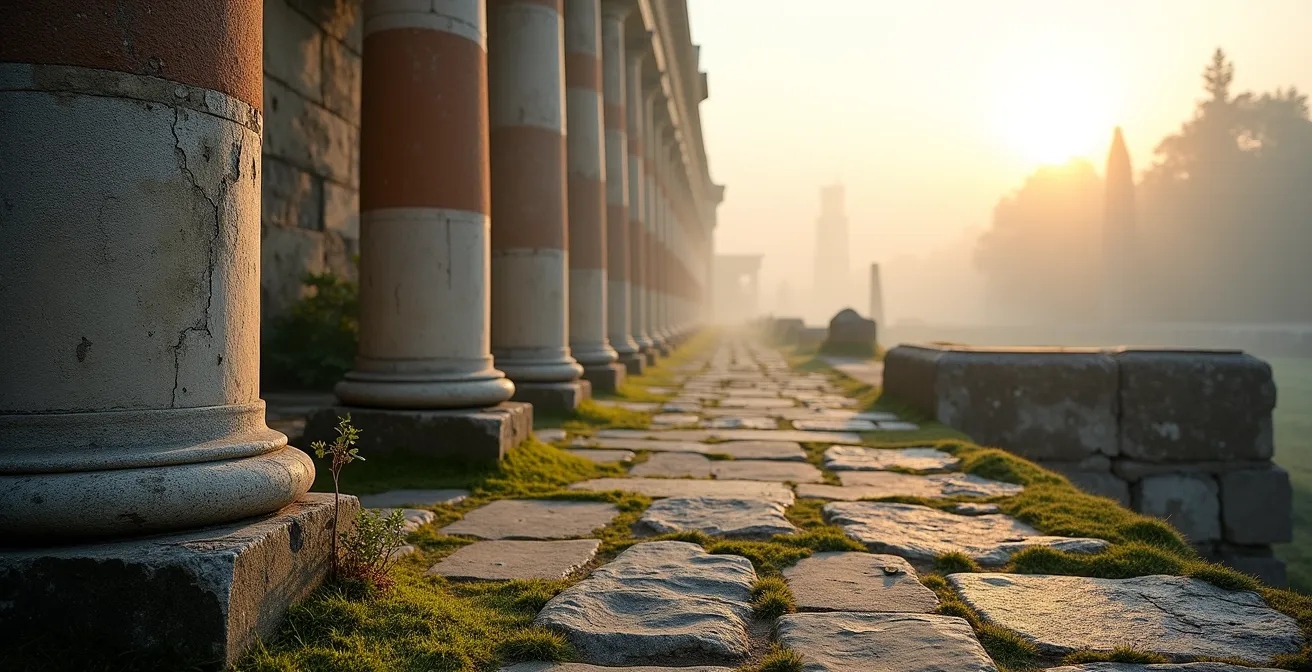
The “aliveness” of a ruin isn’t in the stones, but in how our minds engage with their story.
- A powerful historical experience happens when a site provides just enough clues for our imagination to fill the gaps.
- Perfectly restored sites can feel sterile because they leave no room for this “cognitive co-authorship.”
Recommendation: To truly connect with the past, shift from being a passive tourist to an active investigator, using archaeological clues to mentally reconstruct the world that was.
You stand before the sun-bleached skeleton of an ancient temple. Sometimes, a profound shudder runs through you—a sense of vertigo, of voices whispering just beyond hearing. The place feels electric, alive. Other times, you stand before a similar pile of weathered rock and feel… nothing. It’s just a collection of stones, a backdrop for a photograph, its soul long since departed. This is a common experience for the thoughtful traveler, a frustration that goes beyond simple historical interest or aesthetic appreciation.
Most will tell you this feeling is about contemplating the grandeur of empires or the passage of time. They speak of the scale of the Colosseum or the mystique of Stonehenge. While true, this only scratches the surface. It doesn’t explain why one crumbling wall can feel more resonant than an entire, perfectly reconstructed fortress. It misses the fundamental mechanism at play, the spark that ignites our historical imagination.
What if the key isn’t what the ruin *shows* you, but what it *asks* of you? The secret lies in a process of cognitive co-authorship. An “alive” ruin is not a complete story, but an invitation. It provides just enough architectural, sensory, and emotional clues for your mind to step in and help rebuild its world. A “dead” ruin is one that is either too complete, leaving no room for imagination, or too obliterated, offering no handholds for the mind to begin its work.
This guide explores how to cultivate that connection. We will uncover the psychological triggers that cause that historical vertigo, learn the practical steps to find solitude in crowded places, and understand the crucial difference between authentic decay and sterile restoration. By the end, you won’t just see ruins; you’ll learn to read them, feel them, and participate in their ongoing story.
To navigate this journey from passive observer to active participant, this article breaks down the essential elements for connecting with the past. The following sections offer a roadmap to understanding the deep, emotional resonance of ancient places.
Summary: A Traveler’s Guide to Why Ancient Ruins Feel Alive
- Why You Might Feel Dizzy or Emotional When Seeing the Parthenon?
- How to Experience the Colosseum Alone by Waking Up at 5 AM?
- Reconstructed Sites vs. Untouched Ruins: Which Is More Authentic?
- The Graffiti Mistake That Can Land You in a Foreign Jail for 5 Years
- When Is the “Golden Hour” for Stone Monuments to Capture Texture?
- The Trespassing Fine That Can Cost You $500 While Exploring Ruins
- How to Mentally Reconstruct a Ruin Using Archaeological Clues?
- Why Ancient Engineering Often Outlasts Modern Concrete?
Why You Might Feel Dizzy or Emotional When Seeing the Parthenon?
That sudden wave of dizziness or a profound, unbidden sadness when gazing upon the Parthenon is a phenomenon many travelers report. This isn’t just an appreciation for architecture; it’s a form of historical vertigo. Your mind is grappling with the sheer weight of “deep time.” The weathered marble isn’t just a surface; it’s a physical record of millennia. Each groove, stain, and fracture is a testament to seasons, conflicts, and countless human lives that have passed before it.
This intense emotional response is a confrontation with both permanence and decay. In her work, cultural critic Susan Stewart offers a powerful insight into this feeling:
The immediate emotional impact of looking at a ruin is a reminder of our own deaths, since, unlike a heap of rubble, a ruin bears some traces of what it once was before its fall.
– Susan Stewart, The Ruins Lesson: Meaning and Material in Western Culture
The ruin forces a dual awareness: you see the magnificent structure that *was*, and you see the crumbling reality that *is*. Your mind flickers between these two states, and in that oscillation, you feel the vastness of time and your own fleeting place within it. The experience becomes deeply personal, a meditation on mortality triggered by stone and sunlight.
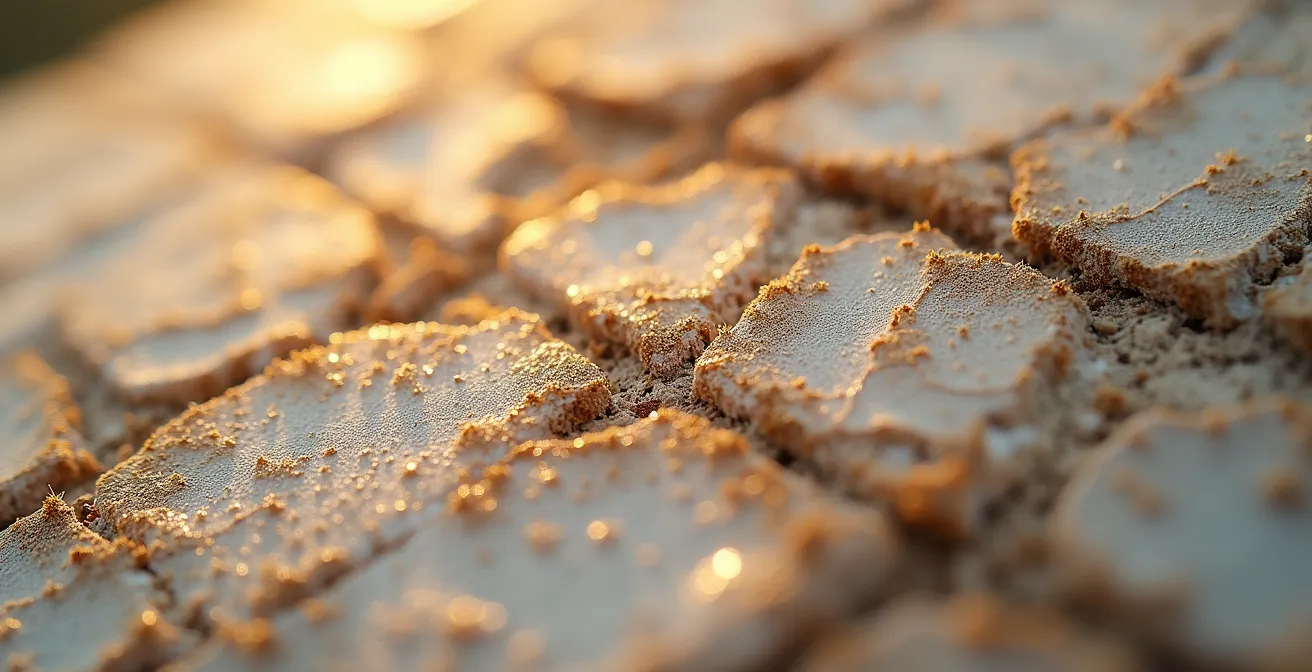
As this image shows, the texture of ancient stone is a landscape in itself. The almost crystalline structure of the marble, scarred with the marks of tools wielded by hands over two thousand years ago, draws you in. It’s this sensory resonance—the tangible connection to the past through sight and imagined touch—that short-circuits our modern sense of time and induces that powerful, dizzying feeling of connection.
How to Experience the Colosseum Alone by Waking Up at 5 AM?
The greatest barrier to connecting with an ancient site is often the modern world itself: the sea of selfie sticks, the chatter of tour groups, the relentless shuffle of feet. To experience the Colosseum as a place of ghosts and echoes rather than a crowded tourist attraction requires a deliberate strategy. The most effective method is simple, yet demanding: you must arrive before the world wakes up.
Imagine standing inside the great amphitheater as the first light of dawn spills over its broken arches. The air is cool and still. The only sounds are the wind whistling through the corridors and the distant cry of a bird. In this silence, the space begins to speak. You are no longer just a visitor; you are an audience to history itself. One traveler, describing their early-morning tour of the Acropolis, noted it was “100% worth it if you hate crowds,” transforming a potentially spoiled experience into a deeply personal one.
Achieving this connection is about more than just beating the queues. It’s a ritual designed to reset your senses and prime your imagination. By arriving in the pre-dawn quiet, you give your brain the auditory and visual space it needs to begin its work of reconstruction.
- Arrive at the site entrance before the official opening time to be first in line.
- Before entering, close your eyes for sixty seconds to clear away the mental clutter of your journey there.
- Walk a path with intention, such as following the route of the gladiators from the underground tunnels to the arena floor.
- Focus on the authentic soundscape: listen for the echo of your own footsteps and imagine them as the sandals of a senator or the bare feet of a slave.
- Allow your mind to fill the auditory void, transforming the whisper of the wind into the roar of a crowd.
–
This early-morning pilgrimage isn’t about seeing the ruin in a different light, but about giving yourself the chance to truly *hear* it. In the quiet solitude, the barrier between past and present becomes permeable, and for a fleeting moment, you can feel utterly, profoundly alone with history.
Reconstructed Sites vs. Untouched Ruins: Which Is More Authentic?
A traveler often faces a choice: visit the carefully preserved, crumbling stones of an untouched ruin, or the perfectly rebuilt walls of a reconstructed site? Common sense suggests the reconstruction is more “authentic” because it shows us exactly what the structure looked like. Yet, for those seeking a deep connection, the opposite is often true. This is the authenticity paradox: the imperfect, decaying ruin frequently feels more real than the flawless replica.
An untouched ruin is a “temple of reverie,” as philosopher Robert Ginsberg described it. It doesn’t give you answers; it asks you questions. Who walked these halls? What was that broken archway? Why did this wall fall? Your mind is compelled to engage, to sift through the clues and become a co-author of the past. A reconstruction, by contrast, presents a finished story. It is educational but can feel sterile, leaving little room for wonder. It silences the whispers of time with the loud, clear voice of modern interpretation.
The key difference lies in the evidence of time itself. The patina, the weathering, the slow encroachment of nature on an old stone—these are not flaws. They are the very language of the ruin, telling a story of survival, decay, and eventual return to the earth. A brand-new wall, no matter how accurately built, lacks this essential narrative layer.
This table, based on philosophical and aesthetic analysis, breaks down the different ways these two types of sites engage our senses and imagination.
| Aspect | Untouched Ruins | Reconstructed Sites |
|---|---|---|
| Emotional Response | Romantic, melancholic, authentic connection to time | Educational but potentially sterile |
| Imagination Engagement | High – mind fills gaps, co-authors the past | Low – everything is presented |
| Evidence of Time | Visible patina, weathering tells story | Too perfect, lacks wear of centuries |
| Visitor Experience | Discovery and mystery | Information and clarity |
Ultimately, the “more authentic” site is the one that best facilitates a personal connection. While a reconstruction provides historical data, an untouched ruin offers an emotional and imaginative experience. It trusts you, the visitor, to complete the picture, making your journey a unique and unrepeatable act of discovery.
The Graffiti Mistake That Can Land You in a Foreign Jail for 5 Years
There is a powerful human impulse to leave a mark, to say “I was here.” In the context of an ancient ruin, however, this impulse becomes an act of profound disrespect. Carving your initials into a 2,000-year-old wall is not a continuation of history; it is an erasure of it. It is a modern shout that drowns out the historical whispers everyone else is trying to hear. It violates the unwritten contract of cognitive co-authorship, where each visitor is meant to be a respectful reader of the past, not a vandal who defaces the book for all who come after.
The legal consequences are becoming increasingly severe as nations fight to protect their heritage. Tourists have faced hefty fines, immediate deportation, and even lengthy prison sentences for acts of vandalism. In countries like Italy or Egypt, defacing a monument is not a minor offense; it is a serious crime against the nation’s cultural identity, with penalties that can include up to five years in prison and tens of thousands of dollars in fines. Authorities are no longer tolerant of the excuse of ignorance.
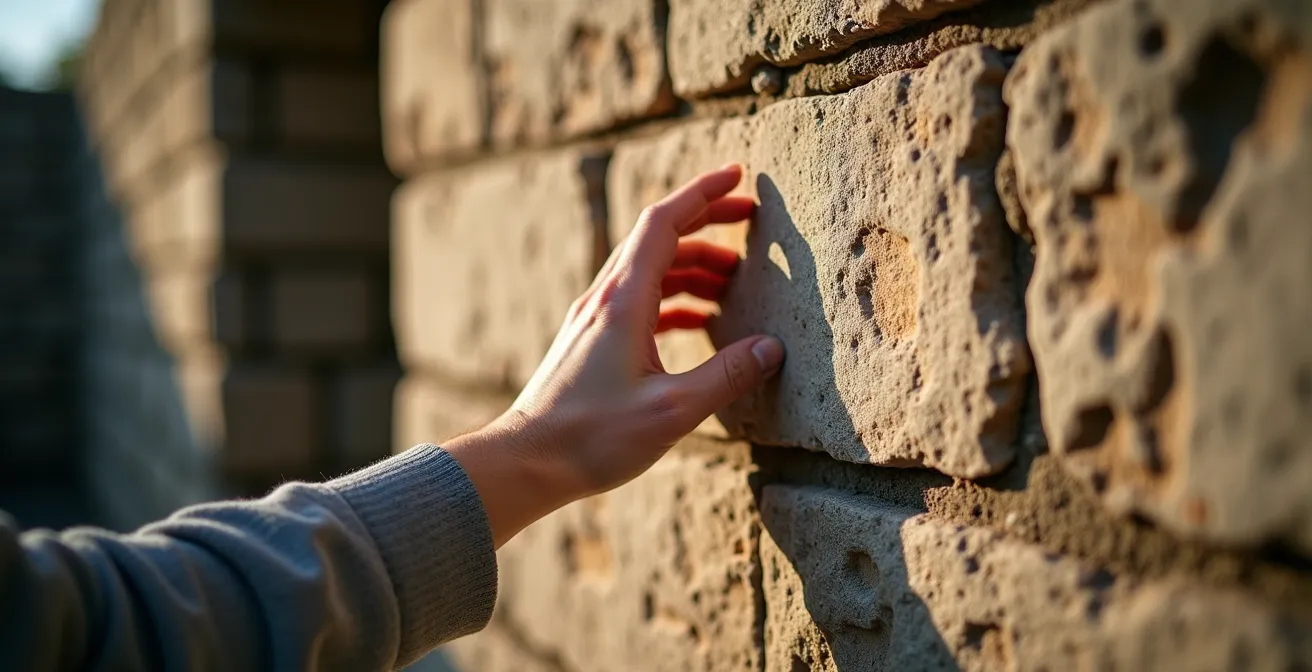
The desire to connect is understandable, but the method is misguided. A true connection is one of reverence and restraint, as symbolized by the hand hovering near, but not touching, the ancient stone. It is a gesture of listening, not of speaking. Fortunately, there are many ways to leave your “mark” that are both personally meaningful and ethically sound.
Your Action Plan: Ethical Ways to “Leave Your Mark”
- Photography as Connection: Use your camera not just to document, but to interpret. Capture the play of light, the texture of stone, or a unique angle that reflects your personal experience with the site.
- Journaling the Experience: Create detailed journal entries. Write down not just what you see, but what you feel, what you imagine, and the questions the ruin raises in you. This is your personal, indelible record.
- Support Conservation: The most positive mark you can leave is one of preservation. Make a donation to the site’s official conservation fund or, if available, participate in recognized volunteer programs.
- Virtual Graffiti: Use augmented reality (AR) apps that allow you to leave a digital message or drawing superimposed on the site, visible only to other users of the app, without damaging the physical structure.
- Geo-tagged Sharing: Share your photos and thoughts on social media with a specific geo-tag. This creates a digital layer of experience and memory, a modern, non-destructive version of saying “I was here.”
When Is the “Golden Hour” for Stone Monuments to Capture Texture?
Any photographer knows the “golden hour”—the first hour after sunrise and the last hour before sunset—as a time of magical light. For a traveler seeking to connect with ancient stone, this period is not just for beautiful pictures; it is a time of revelation. During the harsh light of midday, a monument can appear flat and lifeless, its details bleached out by the overhead sun. But during the golden hour, the sun’s low, angular rays transform it.
This warm, slanted light rakes across the surface, casting long, soft shadows that reveal every subtle texture. The faint marks of a Roman chisel, the delicate patterns of lichen, the gentle erosion from centuries of wind and rain—all of it becomes vividly three-dimensional. The stone ceases to be a monolithic block and becomes a canvas of history, its story told in a language of light and shadow. This enhanced sensory resonance allows for a much deeper, more intimate connection with the material past.
The ancient temple complex of Bagan in Myanmar is a perfect example. Travelers who experience it at sunrise describe a truly transcendent moment. As noted in one account, “The most memorable time to see Bagan is at sunrise or sunset, when the ancient peaks of this sprawling temple complex are illuminated by a soft glow.” The red-brick temples, built between the 11th and 13th centuries, seem to ignite from within, their ancient texture and form celebrated by the fleeting, perfect light.
This moment connects directly to the essence of a ruin. As philosopher Elizabeth Scarbrough observes, “Ruins are ephemerality writ large.” The golden hour is itself an ephemeral event—a brief window where the light is perfect before it fades into day or night. Experiencing a ruin during this transient moment is a powerful reminder of the impermanence of all things: the light, the structure, and ourselves. It aligns the rhythm of the day with the grander rhythm of history.
The Trespassing Fine That Can Cost You $500 While Exploring Ruins
The desire for an authentic experience often leads travelers to stray from the designated path. The lure of a closed-off section, a crumbling staircase, or a distant, solitary tower is strong. It promises a private moment with history, away from the crowds and the ropes. However, this impulse can lead to serious consequences, both for the site and for the traveler. A simple act of trespassing can result in fines of $500 or more, immediate expulsion from the site, and a ruined trip.
These restrictions are not arbitrary. They exist for two critical reasons: preservation and safety. Many archaeological sites are incredibly fragile. The cumulative effect of foot traffic can cause irreparable erosion and structural damage. Tourism statistics show that major sites like those of the Inca civilization draw over a million tourists annually, a constant pressure that necessitates strict controls. Furthermore, unmaintained areas can be genuinely dangerous, with unstable footing, hidden drops, and the risk of falling masonry.
Ignoring a “Do Not Enter” sign is not a bold act of exploration; it’s a statement that your personal curiosity is more important than the long-term survival of the site and the safety of yourself and others. The good news is that the desire for a deeper, more adventurous experience can be satisfied through legitimate channels that are often far more rewarding.
Your Action Plan: Legal Alternatives for Adventurous Exploration
- Book “Behind-the-Scenes” Tours: Many major sites offer special access tours led by archaeologists or senior conservation staff. These often take you into areas closed to the general public, providing expert insight you’d never get on your own.
- Join an Archaeological Volunteer Program: For a truly hands-on experience, consider volunteering with an organization like the Archaeological Institute of America. You can actively participate in a dig, learning excavation and preservation techniques.
- Explore with Virtual Reality: Museums and sites are increasingly using VR to allow visitors to “explore” inaccessible areas, such as the delicate interiors of a sealed tomb or a digital reconstruction of a collapsed structure.
- Attend Special Access Events: Keep an eye on the official websites of heritage organizations. They often host members-only or ticketed events during evenings, off-seasons, or for special archaeological announcements, granting exclusive access.
- Connect with Local Archaeological Societies: Before you travel, reach out to local historical or archaeological societies in the region. They may have their own tours or be able to provide access to lesser-known, but equally fascinating, sites.
How to Mentally Reconstruct a Ruin Using Archaeological Clues?
The most profound way to make a ruin feel “alive” is to actively engage in its reconstruction—not with bricks and mortar, but with your mind. This process of archaeological empathy is the heart of cognitive co-authorship. It involves using the physical clues left behind to rebuild a sensory and human picture of the past. Your brain is naturally wired for this; psychological research shows that when we encounter such spaces, our mirror neurons fire, and our minds automatically work to fill in the gaps.
As one analysis on cognitive archaeology explains, this process makes us “co-authors of the past.” Instead of passively receiving information, you become an active detective. The ruin is no longer a static object but a set of clues waiting to be interpreted. This active engagement quiets the ‘default mode network’ of your brain—the part responsible for self-referential chatter—and induces a state of awe and mindfulness. You are fully present, immersed in the task of solving the puzzle of the past.
To begin, you must learn what to look for. Shift your focus from the grand overview to the small details. These are the anchor points for your imagination, the starting threads from which you can weave a larger tapestry. The next time you are at a site, use this checklist to guide your investigation.
- Look for Mason’s Marks: Small symbols carved into stones were the signatures of the craftsmen or quarries. Different marks in different areas can indicate various construction phases or work crews.
- Observe Fallen Columns: Note the direction in which columns have fallen. Did they all fall the same way? This can be a clue to the cause of destruction, such as an earthquake from a specific direction.
- Identify Different Stones: A change from limestone foundations to marble walls, or the use of a different colored brick, can reveal additions, repairs, or different periods of wealth and construction.
- Find Empty Bases: A lone, empty stone pedestal in a courtyard or temple was not decoration. It once held a statue. Try to imagine its scale and subject based on the context.
- Test the Acoustics: In a theater or enclosed space, clap your hands. Listen to the echo. The architects designed this soundscape intentionally. Imagine it filled with voices, music, or speeches.
By training your eye to see these details, you transform from a tourist into an interpreter. Each clue you uncover adds another layer to your mental model, and slowly, the ghostly image of the world that was begins to take shape around you, built by the power of your own informed imagination.
Key Takeaways
- The feeling of a ruin’s “aliveness” is an active mental process of “cognitive co-authorship,” not a passive observation.
- True authenticity often lies in imperfect, untouched ruins that spark our imagination, rather than in perfectly sterile reconstructions.
- Respecting ancient sites by avoiding graffiti and trespassing is crucial for preserving the shared imaginative space for all visitors.
Why Ancient Engineering Often Outlasts Modern Concrete?
As we stand in awe of these ancient structures, a final question emerges: why are they still here? How can a Roman aqueduct or a Greek temple survive for two millennia, while modern concrete buildings often show signs of decay within a few decades? The answer lies in a profound, and often unintentional, genius of ancient engineering. These builders were not just constructing for a lifetime, but for eternity.
The sheer timeline is staggering. Archaeological evidence demonstrates that prehistoric monuments like Stonehenge, dating back to at least 2,500 BC, still command their landscape after more than 4,500 years. The longevity of these structures comes from two key principles: superior material science and a design philosophy that worked *with* nature, not against it.
The most famous example is Roman concrete. For centuries, historians marveled at how structures like the Pantheon have endured. Recent discoveries have revealed the secret: the Romans used a mix of volcanic ash, lime, and water that resulted in a unique chemical composition. Crucially, they used a “hot mixing” technique with quicklime, which left behind small, reactive lime clasts. When tiny cracks form in the concrete over time, rainwater seeps in and reacts with these clasts, forming new calcite crystals that effectively heal the cracks. The material was designed, perhaps accidentally, to be self-repairing.
Furthermore, ancient builders often employed brilliant, non-rigid construction techniques. In earthquake-prone regions, Incan builders in Peru cut massive stones to fit together so perfectly, without mortar, that they could shift during a tremor and then settle back into place. This flexibility allowed their walls to absorb and dissipate seismic energy, whereas a rigid modern wall would simply crack and fail. They built structures that could dance with the earth.
Our journey through these ruins is, in the end, a journey into ourselves. The awe we feel is a recognition of a deep continuity and a profound respect for the minds and hands that built for the ages. The next time you stand before a ruin, don’t just look—listen, feel, and reconstruct. Your journey into the past begins not when you buy the ticket, but when you choose to become a co-author of its story.