Finding the next great artist isn’t about luck; it’s about understanding the hidden supply chain of the regional art world.
- Regional galleries act as vital R&D labs, giving you an “informational edge” that is impossible in efficient, global markets.
- Your small purchase fuels a local economic engine, directly supporting the artist, the gallery, the framer, and other local craftspeople.
Recommendation: Stop chasing trends and start building relationships. The greatest value—both cultural and financial—lies in the art ecosystem right outside your door.
The dream of every art lover is to walk into a small, unassuming gallery and discover a genius before the rest of the world catches on. We imagine unearthing a masterpiece for a few hundred dollars that will one day hang in a major museum. Most advice on this topic is frustratingly generic: “visit local art fairs” or “follow artists on Instagram.” This approach treats discovery as a game of chance, a lottery ticket bought with your time and attention.
But what if the hunt for unpolished gems wasn’t about luck at all? What if it was a strategic activity, guided by understanding the hidden mechanics of the local art world? The truth is that small, regional galleries are not just showrooms; they are the essential research and development labs of the entire art industry. They operate within a complex, interconnected system—an art ecosystem supply chain—where they take the risks that larger institutions in New York or London cannot afford to.
This article peels back the curtain on that system. We will move beyond the platitudes to reveal the tangible economic impact of your support, provide concrete methods for finding spaces that don’t even appear on maps, and offer a framework for spotting undervalued talent. By the end, you won’t just be a consumer of local art; you’ll be a savvy, strategic participant in its creation and growth.
To navigate this landscape effectively, it is essential to understand its various components, from the economic foundations that support artists to the subtle cues that signal an artist’s rising value. This guide is structured to walk you through each layer of the regional art ecosystem.
Summary: Why Regional Art Is the Smart Collector’s Best Kept Secret
- How Buying a $300 Painting Supports a Local Ecosystem More Than a Museum Ticket?
- How to Find “By Appointment” Galleries That Aren’t on Google Maps?
- Investing in Your Neighbor vs. Blue Chip Art: Which Brings More Joy?
- The Tourist Trap Galleries That Sell Mass-Produced Art as “Local”
- How to Talk to an Artist at an Opening Without Sounding Awkward?
- How to Spot Undervalued Artists Before They Hit the Mainstream Galleries?
- How to Turn a Pottery Class into a Low-Pressure Networking Event?
- Why Fine Art Can Outperform the Stock Market During Inflation?
How Buying a $300 Painting Supports a Local Ecosystem More Than a Museum Ticket?
It’s easy to assume that a museum membership or a ticket to a blockbuster exhibition is the best way to support the arts. While important, that money often flows into large endowments or operational budgets, with very little trickling down to living, working artists in your community. A $300 purchase at a local gallery, however, is a direct and powerful injection of capital into the art ecosystem supply chain. This single transaction creates a ripple effect that a museum ticket simply cannot match.
When you buy a piece, the gallery typically takes a 40-50% commission. This isn’t just profit; it pays for local rent, utilities, and the salaries of staff who are dedicated to championing emerging talent. The remaining 50-60% goes directly to the artist. That money allows them to buy materials from local art supply stores, pay for studio space, and hire local framers. This dynamic is a key reason why high-net-worth collectors are increasingly focusing their spending on new talent; the Art Basel and UBS Survey of Global Collecting 2025 found that 52% of their expenditure went to works by new and emerging artists.
Case Study: The Jack Hanley Gallery Effect
Jack Hanley Gallery provides a perfect example of this ecosystem impact. Starting in Austin in 1987, Hanley took chances on unknown artists like photographer Thomas Ruff and conceptual artist Zoe Leonard. These small galleries provide the crucial initial funding and exposure that enable artists to experiment and develop their voice long before they are noticed by major institutions like the Whitney Museum, where Leonard later had a major survey.
This “multiplier effect” means every dollar you spend generates between $1.50 and $2.00 in local economic activity. Unlike the passive donation of a museum ticket, buying a painting is an active investment in the creative infrastructure of your own city.
Your Action Plan: Track Your $300 Impact
- Calculate the gallery’s cut: Acknowledge that 40-50% of your purchase directly pays for local rent, utilities, and staff salaries in your community.
- Follow the artist’s portion: Realize the artist’s 50-60% flows directly into local art supply stores, framers, and studio rentals, supporting other small businesses.
- Track secondary impacts: Consider the framer who employs local craftspeople or the art supply store that supports dozens of other emerging artists.
- Compare to museum revenue: Contrast this with a typical museum ticket, where less than 10% may go to direct operations and almost none to living local artists.
- Document the multiplier effect: Understand that your purchase is not a single transaction but an investment that stimulates $1.50-$2.00 in broader local economic activity.
How to Find “By Appointment” Galleries That Aren’t on Google Maps?
The most exciting art is often found in places that defy easy discovery. Mainstream galleries are important, but the true cutting edge is frequently hidden in artist-run spaces, private dealer homes, and “by appointment” venues that don’t have a sign on the door or a listing on Google Maps. Finding them requires you to think like an investigator, following the supply chain of the art world itself. Instead of looking for the final product (the gallery), you need to trace the suppliers and services that support it.
This means looking for the ancillary businesses that artists and galleries rely on. A high-end frame shop’s Instagram account is a goldmine; look at who they tag in their posts to see which gallerists and private dealers are their clients. The personal websites of faculty at local university MFA programs often list their gallery affiliations, revealing under-the-radar venues. Even art printers and fabricators can inadvertently reveal private dealer spaces through their client work.
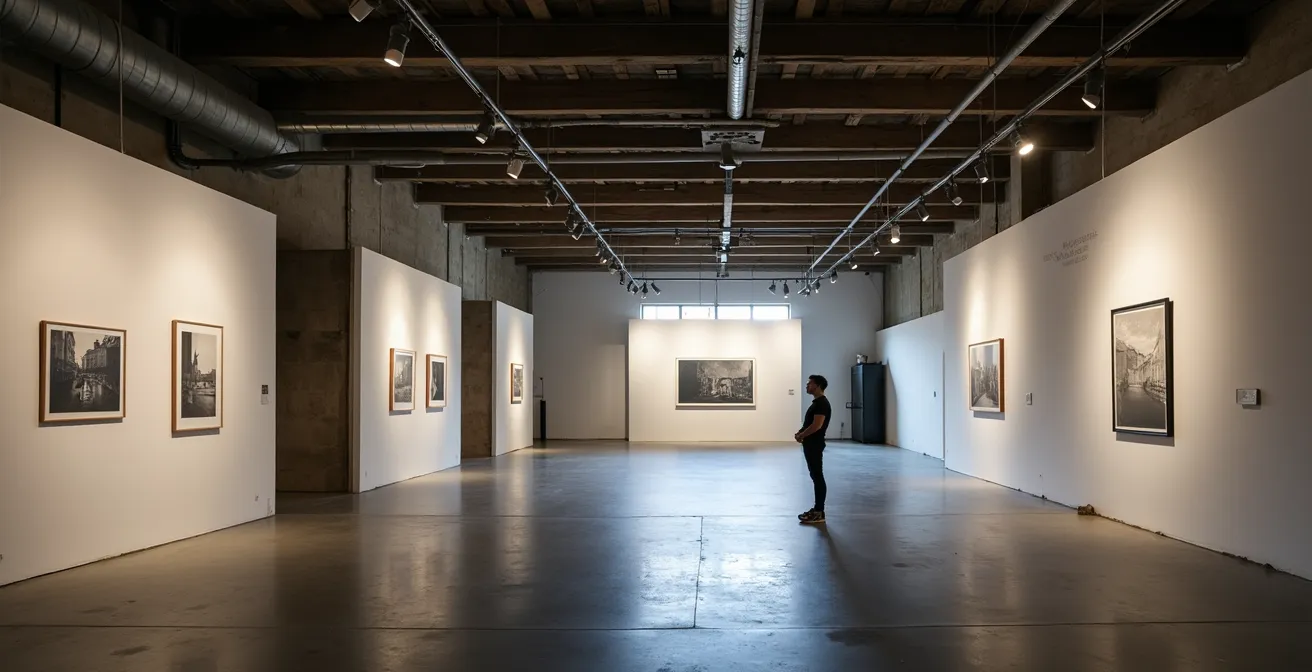
As you can see in this type of raw, intimate space, the focus is entirely on the art, free from commercial pressure. Open Studios events are another key opportunity. When you visit an artist’s workspace, look closely at their CV posted on the wall. It will list past and upcoming exhibitions, often including the small, artist-run spaces that gave them their start. The most direct method? Simply ask artists you meet at openings: “Where else are the interesting places to see art in this city?” They are your best guides to the scene’s hidden gems.
Your Field Guide: The Supply Chain Method for Finding Hidden Galleries
- Scan the Framers: Search Instagram for high-end frame shops and art installation services in your area—check their tagged posts and followers for gallery clients.
- Consult the Academics: Look up faculty at local university MFA programs. Their personal websites and CVs often list affiliations with smaller, more experimental galleries.
- Examine the CVs: Attend Open Studios events and carefully examine the artist CVs often posted on walls. Note the names of galleries from past and upcoming exhibitions.
- Follow the Fabricators: Track local art printers and specialty fabricators on social media. Their client work can reveal private dealer spaces and artist projects.
- Ask the Source: Directly and politely ask artists at openings: “Besides this one, what are the most interesting spaces to see art in this city right now?”
Investing in Your Neighbor vs. Blue Chip Art: Which Brings More Joy?
Blue-chip art—works by established, auction-house-approved names like Warhol or Picasso—offers a certain kind of security. It’s a known quantity, a stable asset. But it’s an investment devoid of personal connection. You are buying a historical artifact, not participating in a living story. Investing in a local, emerging artist is an entirely different proposition. It’s an investment in your neighbor, in a tangible person whose career you can watch grow, and in a story you become a part of.
The joy comes from the relationship. You can meet the artist, visit their studio, and understand the intent behind the work directly from the source. This connection transforms a decorative object into a meaningful touchstone. You’re not just a buyer; you’re a patron, a crucial early supporter. This desire for authentic connection is a growing trend; data from Artsy’s Market Recap reveals that 66% of high-net-worth collectors bought works by artists they had newly discovered in 2024, a significant jump from 43% in 2022. They are seeking the thrill of discovery and the satisfaction of direct impact.
Small galleries are the facilitators of this joy. They are what one art dealer, Melendez, described in an Artnet News analysis as the “probiotics of the system.” As he notes, they are essential for the health of the entire art world.
Without smaller galleries, there’s no healthy art world. They’re the probiotics of the system—risky, messy, and essential.
– Art dealer Melendez, Artnet News
By investing in an emerging artist, you are nurturing these “cultural probiotics.” You are taking a stake in the messy, risky, but vital process of cultural creation. The return on investment isn’t just measured in potential financial appreciation, but in the immense personal satisfaction of knowing you helped make it happen. That’s a dividend blue-chip art can never pay.
The Tourist Trap Galleries That Sell Mass-Produced Art as “Local”
In any area with a healthy flow of visitors, a specific type of gallery emerges: the tourist trap. These spaces masquerade as champions of local culture, but their primary business is selling mass-produced, decorative objects that have more in common with souvenirs than fine art. Falling for one of these can be a costly and disappointing mistake for a budding collector. Learning to differentiate an authentic local gallery from a tourist trap is a fundamental skill.
The signs are often clear if you know what to look for. Tourist traps feature a “warehouse” style of curation, with paintings stacked ten-deep and no room to breathe. The descriptions are generic (‘beautiful sunset,’ ‘local inspiration’) and there is little to no information available about the individual artists. The staff often can’t speak to an artist’s specific process or intent. In contrast, an authentic gallery has a clear curatorial vision. Exhibitions are themed, pieces have space, and the gallerist can tell you the story behind every single work and artist.
Price transparency is another major red flag. In a tourist trap, prices are often negotiable, suggesting they are arbitrarily inflated. An authentic gallery has a clear pricing structure and will gladly provide you with an artist’s CV, which documents their exhibition history, education, and career progression. Ultimately, it comes down to specificity versus generality. An authentic gallery is about specific artists with unique visions; a tourist trap is about selling a generic idea of “local art.”
The following table breaks down the key indicators to help you distinguish a genuine artistic hub from a commercial imitation, based on an analysis of what defines the best galleries for emerging artists.
| Indicator | Authentic Local Gallery | Tourist Trap |
|---|---|---|
| Artist Presence | Personal website, Instagram showing studio process, local press mentions | No individual artist info beyond gallery walls |
| Curation Style | Themed exhibitions with breathing room between pieces | Warehouse-style display, paintings stacked 10-deep |
| Story Specificity | Gallerist knows artist’s intent and process for each piece | Generic descriptions (‘beautiful sunset’, ‘local inspiration’) |
| Price Transparency | Clear pricing structure, artist CV available | Negotiable prices, no artist background info |
| Inventory Turnover | New exhibitions every 4-6 weeks | Same pieces displayed for months |
How to Talk to an Artist at an Opening Without Sounding Awkward?
For many aspiring collectors, the most intimidating part of the art world isn’t the price tags; it’s the social dynamics of a gallery opening. Approaching an artist can feel fraught with pressure. What do you say? How do you avoid sounding ignorant or, worse, insincere? The secret is to shift your focus away from judgment (“I like this”) and toward curiosity (“How did you make this?”). Artists spend countless hours with their materials and processes; it’s a topic they can speak about with passion and authority.
Instead of a generic compliment, ask a specific, process-focused question. “I’m fascinated by your use of layered glazes in this piece. What was the most challenging part of achieving that transparency?” This shows you’ve looked closely and are genuinely interested. Another great approach is to make connections between different works in the show: “I noticed this particular shade of blue appears in both that large painting and the smaller sculpture. Is there a deliberate link between them?” This demonstrates a higher level of engagement.
Don’t be afraid to embrace the “curious novice” stance. Saying “I’m just starting to learn about contemporary art, and I was hoping you could tell me a little about what inspired this series” is an honest and disarming opener. This can lead to more authentic conversations. As emerging ceramic artist Jackie Rines notes, the most meaningful connections often happen in informal, artist-run spaces where conversations flow naturally. She even suggests a “skill swap” approach, where you might offer your professional skills, like photography or writing, in exchange for artistic insights, building a relationship that goes beyond small talk.
Your Conversation Starter Kit: The Process-Focused Guide
- Start with Process: “I’m fascinated by your use of [specific technique/texture/color]. What was the most challenging part of achieving that effect?”
- Make Connections: “I noticed this theme/color appears in both that painting and this sculpture. Is there a deliberate link I should be seeing?”
- Embrace the Novice Role: “I’m new to collecting. Could you tell me a little bit about what inspired this body of work?”
- Ask About the Journey: “Your previous work was focused on [old medium/style]. What prompted the transition to this new direction?”
- Inquire About Influences: “This is such a unique approach. Are there any unexpected sources—like music, film, or science—that influenced this series?”
How to Spot Undervalued Artists Before They Hit the Mainstream Galleries?
Identifying an artist with long-term potential before they have a major gallery show is the holy grail for collectors. It’s a skill that blends research, intuition, and paying attention to signals the mainstream market often overlooks. While the big auction houses are now seeing a flood of new talent— 1,343 artists made their debuts at major auctions in 2024 with a huge sell-through rate—the key is to spot them years before they reach that stage.
One of the strongest early indicators is the “coherent vision pivot.” Many young artists experiment with various styles and mediums. The moment an artist moves from scattered experiments to a focused, obsessive exploration of a singular theme or technique is often the inflection point where their work begins to gain serious value. It shows maturity and a clear artistic voice.
Another set of signals comes from “minor league” validation. Look for artists who are winning small but prestigious awards, like city arts council grants or funded residencies. These are often awarded by panels of respected curators and established artists who are the first to recognize emerging talent. Also, track “institutional breadcrumbs”: an artist’s inclusion in a group show at a regional museum, even if it’s a small role, is a huge vote of confidence that often precedes a solo exhibition and greater market attention. Finally, follow the galleries themselves. Certain small galleries, like Someday in New York or SEPTIEME in Paris, have a proven track record of spotting future stars. When they sign a new artist, the savvy collector pays attention.
Checklist: Early Indicators of Rising Artist Value
- Cross-Disciplinary Validation: Has the artist designed album covers for notable indie bands, collaborated with theater designers, or had their work featured in other creative fields?
- “Minor League” Awards: Are they winning City Arts Council grants, funded residencies (e.g., at MacDowell, Skowhegan), or regional “Best in Show” prizes?
- The Coherent Vision Pivot: Has the artist moved from scattered, experimental work to a focused, deep exploration of a singular theme, medium, or style?
- Gallery Trajectories: Is the artist showing with a small gallery known for having a great “eye” and a track record of sending artists to larger, more established venues?
- Institutional Breadcrumbs: Are they being included in group shows at respected non-profit spaces or regional museums, even before getting a solo show?
How to Turn a Pottery Class into a Low-Pressure Networking Event?
Galleries are not the only place to discover talent. Some of the most valuable connections are made in less formal, participatory settings. An evening pottery class, a life drawing session, or a printmaking workshop can be a surprisingly effective, low-pressure networking event—if you approach it with the right strategy. The key is to “network sideways” rather than “networking up.”
Instead of focusing all your attention on the instructor, who is likely bombarded with questions, focus on your peers. Your fellow students are also passionate about art. They are future collectors, aspiring artists, or simply fellow enthusiasts. Propose a post-class coffee to “compare notes.” These informal conversations can be incredibly fruitful. Position yourself as an information hub by asking everyone about other artists they’re following or upcoming studio sales they know about. This is how you build a collecting cohort and a shared pool of knowledge.
Another powerful strategy is offering a “skill swap.” If you’re a photographer, offer to take professional-looking photos of a classmate’s final pieces for their Instagram. If you’re a writer, offer to help them with their artist statement. This creates a reciprocal relationship built on mutual support, not a one-sided transaction. This spirit of community is the lifeblood of artist-run initiatives like TERN Gallery in Nassau. Opened in 2023, the gallery focuses on emerging Caribbean artists and combines exhibitions with educational programs, creating a natural environment where collectors, students, and artists can interact informally and build the relationships that sustain the entire ecosystem.
Your Playbook: The ‘Network Sideways’ Strategy for Art Classes
- Focus on Peers: Instead of only talking to the instructor, connect with fellow students. Propose a post-class coffee to ‘compare notes’ on the class and the local art scene.
- Become an Information Hub: Actively ask your classmates about other artists they admire, galleries they visit, and upcoming studio sales or openings they plan to attend.
- Offer Skill Swaps: Leverage your professional skills. Offer to photograph a promising classmate’s work for their portfolio or help them edit their artist statement.
- Create a Community Channel: Start a class group chat or social media group to share opportunities, events, and discoveries. This builds a lasting cohort of collectors and artists.
- Organize Studio Visits: After the class ends, suggest informal studio visits among interested classmates. This is a fantastic way to see more work and build your collecting eye together.
Key Takeaways
- Investing in local art isn’t charity; it’s a strategic injection into a local economic engine with a significant multiplier effect.
- The best art is often found by investigating the “supply chain”—framers, printers, and academics—not just by visiting obvious galleries.
- True collecting joy comes from the personal connection and patronage of a living artist’s career, a dividend blue-chip art cannot offer.
Why Fine Art Can Outperform the Stock Market During Inflation?
For many, the idea of art as a serious financial asset seems frivolous compared to the cold, hard data of the stock market. However, during periods of inflation, tangible assets like fine art can offer unique advantages. Unlike a stock, which can go to zero, a piece of art has an intrinsic value as a physical object. But its real potential to outperform lies in the very “inefficiency” of the art market itself, especially at the regional level.
The stock market is a model of efficiency. Information is disseminated instantly and universally, and prices reflect all available knowledge at a moment’s notice. The regional art market is the polar opposite. Information is slow, localized, and often based on personal relationships. This inefficiency is not a flaw; it’s an opportunity. It allows a knowledgeable local collector to gain what a market analyst from the Global Art Market Report 2024-2025 calls an “informational edge.”
The art market’s inefficiency allows for true value investing, where you can gain an ‘informational edge’ that’s impossible in public markets.
– Market analyst, Global Art Market Report 2024-2025
This “informational edge” is your deep knowledge of the local scene, your relationships with artists, and your ability to spot the “coherent vision pivot” we discussed earlier. You know things the global market doesn’t. You can acquire a piece based on its artistic merit and growth potential long before its value is recognized by a wider audience. As inflation erodes the value of currency, the tangible, culturally significant value of your carefully chosen artwork can hold steady or even appreciate significantly, providing a hedge that is simply structured differently from financial instruments.
This table illustrates the fundamental differences that create opportunities for savvy collectors in the art market.
| Factor | Stock Market | Regional Art Market |
|---|---|---|
| Information Speed | Instant, universal | Slow, localized, personal knowledge-based |
| Price Discovery | Highly efficient, transparent | Inefficient, opaque, relationship-driven |
| Minimum Value | Can go to zero | Intrinsic value as physical object |
| Inflation Hedge | Variable, depends on sector | Tangible asset with cultural significance |
| Entry Barriers | Low (apps, fractional shares) | Moderate (knowledge, relationships needed) |
Now that you are equipped with the strategies to discover, evaluate, and connect with the art world around you, the final step is to put this knowledge into practice. To truly master this subject, it’s essential to never forget the foundational principles of how your support fuels the entire creative system.