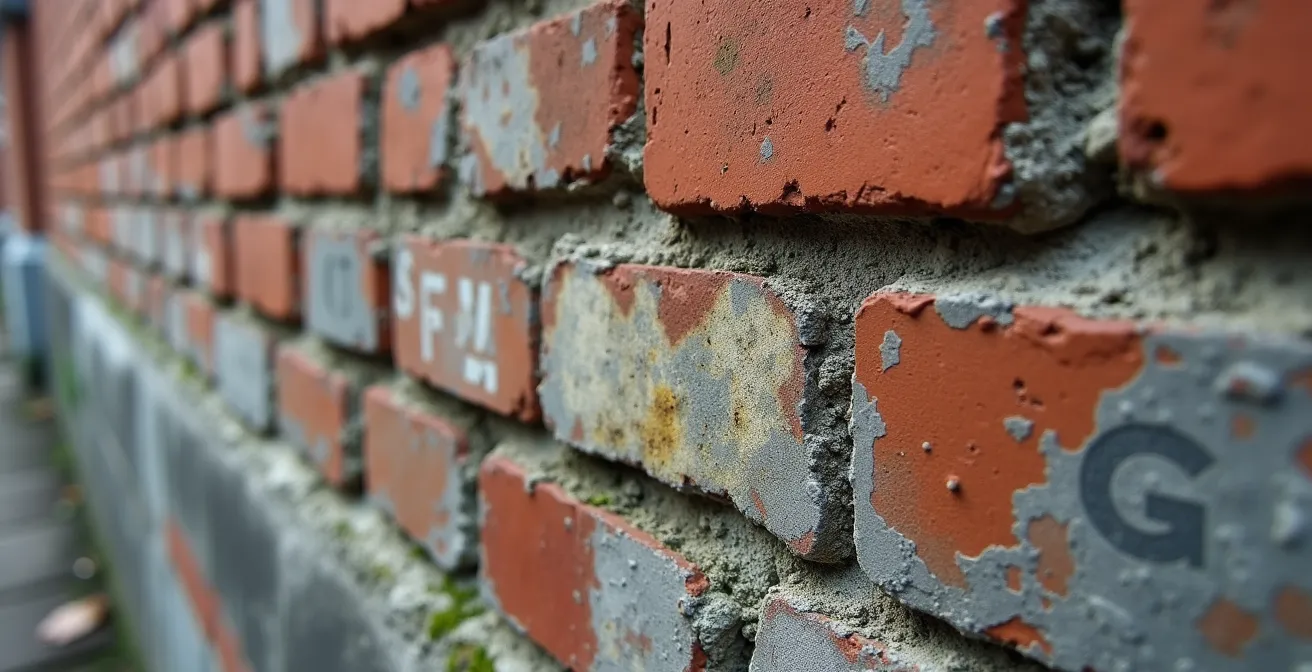
The soul of a city isn’t found in a guidebook’s list of dates; it’s read in the architectural palimpsest of its streets—a living history written in stone, glass, and light.
- Architectural details, like window styles, are not just decorative; they are socio-economic records of their time.
- Light is an analytical tool; the “blue hour” and “golden hour” reveal textures and forms that tell a building’s age and story.
Recommendation: Instead of just looking at buildings, start practicing “vertical reading”—examining them from basement to rooftop to uncover the layers of their unique biography.
An urban explorer stands before a weathered brick wall, a guidebook in their backpack, untouched. The book speaks of kings and construction dates, of official histories polished for tourists. But the wall tells a different, more intimate story. It speaks in the language of faded paint, patched holes where signs once hung, and the ghost outline of a long-demolished neighboring roof. This is the fundamental difference between visiting a city and truly understanding it. Guidebooks give you the approved narrative; learning to read buildings gives you the unabridged truth.
Most advice for urban explorers circles around familiar refrains: “look up” or “notice the different styles.” While not incorrect, this is like learning the alphabet without learning how to form words. The real skill lies not in identifying a building as “Art Deco,” but in understanding the ambition and glamour that its geometric brasswork was meant to project. It’s about recognizing that the story of a structure is a living document, an architectural palimpsest constantly being written, erased, and rewritten. It’s a text composed of material forensics, social ambition, and the narrative power of light itself.
But what if the key to unlocking these stories wasn’t about memorizing architectural terms, but about learning to see? What if you could decipher the history of a neighborhood just by the way sunset light rakes across a stone facade, or by the shift in window sizes from one house to the next? This is the promise of architectural reading. It is a method of observation that transforms you from a passive tourist into an active historian, an interpreter of the built environment’s silent, powerful language.
This guide will equip you with that very language. We will explore how to use light as a forensic tool, decode the ideological battles fought between styles, understand the ethics of exploring forgotten places, and see how even the smallest details, like a windowpane, can reveal volumes about a society’s past and present.
This article provides a framework for reading the urban landscape, from its grandest gestures to its most subtle scars. The following sections break down the essential techniques for becoming a fluent reader of the city.
Summary: Decoding the Urban Narrative
- How to Shoot Architecture During “Blue Hour” for Professional Results?
- Brutalism vs. Art Deco: Which Style Defines the Soul of the 20th Century?
- The Trespassing Fine That Can Cost You $500 While Exploring Ruins
- How to Identify Victorian vs. Edwardian Houses by Looking at the Windows?
- Why Modern Glass Towers Are Erasing Neighborhood Identity Faster Than Ever?
- Why Finding a Name on a Census Record Triggers a Dopamine Response?
- Why the Light at Sunset Reveals Masonry Details Invisible at Noon?
- Why Walking a City Reveals Stories That Buses Miss?
How to Shoot Architecture During “Blue Hour” for Professional Results?
For the architectural reader, light is not merely illumination; it is a narrator. The “blue hour”—that fleeting period of twilight after sunset or before sunrise—offers a unique voice. During this time, the absence of harsh direct sunlight creates a soft, diffused glow that simplifies forms and emphasizes silhouettes. It’s a moment when the building’s relationship to the sky becomes the primary story. The residual light from the sun, scattered by the atmosphere, bathes surfaces in a cool, even tone, ideal for capturing the pure geometry of a structure without the distraction of shadows.
This period is incredibly brief and variable; what might last for 15 minutes in the UAE can extend for hours in northern latitudes during summer. This ephemeral quality is what makes it so valuable. It forces the observer to be patient and deliberate. Rather than snapping a quick photo, you are waiting for the building to reveal a specific mood. As architectural photographer Rory Gardiner notes, this light is transformative.
I love ‘the blue hour.’ As the sun goes down, the sky wraps everything in a flat, bluish light. It seems very surreal, but it is a real phenomenon.
– Rory Gardiner, Architizer Journal interview on architectural photography
Professionally, shooting during this time requires a tripod to accommodate longer exposure times. This stability allows you to capture the rich, saturated blues of the sky while interior and street lights begin to emerge, creating a dramatic contrast between the cool exterior and the warm interior. It’s a technique that doesn’t just document a building; it portrays it as a beacon, a shelter against the coming night, telling a story of human presence and activity within the larger, cooling urban shell.
Brutalism vs. Art Deco: Which Style Defines the Soul of the 20th Century?
To walk through a city is to walk through a battlefield of ideologies. Nowhere is this more apparent than in the stark contrast between Brutalism and Art Deco. This isn’t just a matter of aesthetics—of raw concrete versus polished ornamentation—but a clash of visions for society. Art Deco, born in the roaring twenties, is the architecture of optimism, glamour, and technological progress. Its zigzag motifs, sunbursts, and lavish materials spoke of a confident future and a belief in human ingenuity.
Brutalism, emerging from the ashes of World War II, offered a radically different philosophy. It was an architecture of raw, unadorned honesty. Its proponents championed béton brut (raw concrete) as a material that was strong, democratic, and unapologetic. It was intended to serve the public good through social housing, universities, and government buildings, prioritizing function and structural integrity over what it saw as bourgeois decoration. To read these buildings is to read two opposing chapters of the 20th-century psyche: one of exuberant hope, the other of stern, stoic reconstruction.
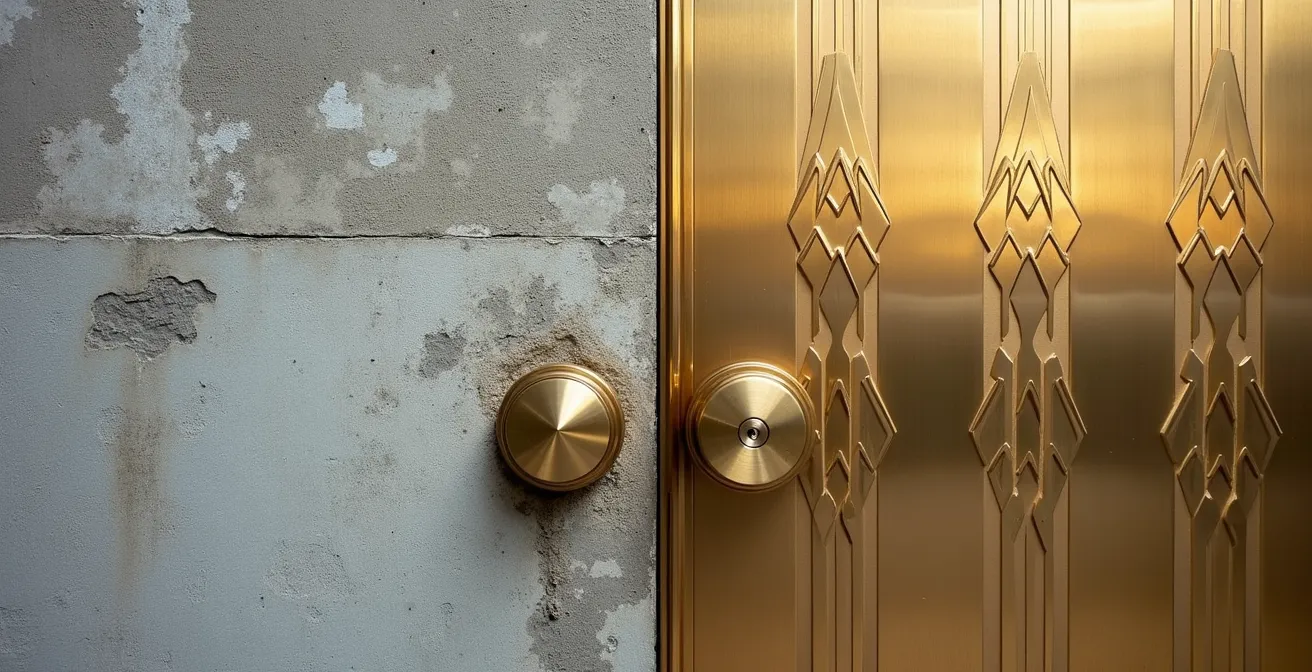
The visual dialogue between these styles is striking. Where Art Deco reaches for the sky with vertical lines and sleek forms, Brutalism often hunkers down, expressing weight and permanence. Yet, today, it is the Brutalist structures that are most at risk. They are often misunderstood, seen as cold and imposing rather than as the powerful social statements they were intended to be. The SOS Brutalism initiative has documented over 175 significant buildings threatened with demolition or insensitive alteration. Losing them means erasing a crucial, albeit difficult, part of our collective urban story.
The Trespassing Fine That Can Cost You $500 While Exploring Ruins
The pull of an abandoned building is undeniable. It’s a desire to step outside the prescribed boundaries of the city and into a space where time has stopped. This act of “trespassing” is central to the ethos of urban exploration (Urbex). As the website Urbex Hub explains, it’s about more than just seeing something forbidden; it’s a way to “reclaim a bit of personal agency.” In a world of curated experiences, accessing a place you’re ‘not supposed to’ can feel liberating. However, this freedom comes with a profound responsibility, and the line between exploration and vandalism is absolute.
While headlines may focus on fines or legal risks, the true urban explorer is governed by a strict code of ethics, not by fear of punishment. The philosophy is simple: you are a visitor in a fragile space, a witness to a story in its final chapters. Your role is to document, not to disturb. This means never forcing entry, never taking souvenirs, and never leaving anything behind but footprints. The goal is to preserve the state of decay, as that decay is the very story you came to read. It’s a practice of respectful intrusion.
This ethical framework is what separates the explorer from the vandal. It transforms a potentially illegal act into a form of grassroots historical preservation. By photographing these forgotten places, explorers create the only remaining record of buildings that are often destined for demolition. They are, in effect, the building’s final archivists. Adhering to this code is not just good practice; it is the moral foundation of the entire discipline.
Essential Urban Explorer’s Ethics Checklist: Points to Verify
- Take only photographs: Never remove artifacts or souvenirs from sites. The goal is documentation, not collection.
- Leave only footprints: Avoid disturbing or damaging structures, and leave the site exactly as you found it.
- No breaking and entering: Only enter through existing openings. If a site is sealed, you do not enter.
- Document and preserve: Recognize that your photography serves as the building’s last witness and historical record.
- Respect the history: Research the site beforehand to understand its significance and the stories it holds.
How to Identify Victorian vs. Edwardian Houses by Looking at the Windows?
Nowhere is a building’s story written more clearly than in its windows. They are the eyes of the facade, and by learning to read their language, you can date a house and understand the social aspirations of its original owners. Take, for instance, the transition from the Victorian to the Edwardian era in Britain. This shift represents a profound change in social attitudes, and it’s perfectly legible in the fenestration.
Victorian homes (1837-1901) were often defined by a sense of formality and privacy. This is reflected in their tall, vertically oriented sash windows. For much of this period, the infamous “Window Tax,” which was only abolished in 1851, discouraged large or numerous windows. Consequently, many earlier Victorian houses have smaller windows, set back from the street, creating a clear separation between the public and private realms. They are often decorated with ornate stone lintels and intricate brickwork, showcasing wealth while maintaining a reserved posture.
The Edwardian era (1901-1910) ushered in a new sense of confidence and a desire for light and air. The middle class was growing, and they wanted to show it. This is when the wide bay window became a quintessential feature. It projected outwards, physically breaking the flat plane of the facade to embrace the street and bring more light inside. This architectural move symbolized a new social openness and a display of prosperity. The windows themselves often featured smaller panes of glass in the upper sections, sometimes with stained glass, adding a touch of Art Nouveau-inspired decoration.
The following table, based on common architectural distinctions, breaks down these differences. Observing them allows you to see how economic policy and social values are directly translated into a home’s design, as demonstrated by an analysis of residential architectural features.
| Feature | Victorian (1837-1901) | Edwardian (1901-1910) |
|---|---|---|
| Window Size | Smaller, vertical emphasis | Larger, horizontal emphasis |
| Style | Tall sash windows | Wide bay windows |
| Privacy | Formal separation from street | Projection toward public space |
| Decorative Elements | Ornate lintels for wealthy homes | Simpler, cleaner lines |
| Social Function | Maintain interior privacy | Display middle-class confidence |
Why Modern Glass Towers Are Erasing Neighborhood Identity Faster Than Ever?
If Victorian windows tell a story of privacy and Edwardian bays a story of confidence, what story do the ubiquitous modern glass towers tell? For many architectural critics, the answer is unsettling: they tell no story at all. Or rather, they only reflect the stories of the buildings around them, distorting them in their shimmering, placeless facades. These towers, often celebrated as symbols of progress and corporate power, contribute to a growing sense of anonymity in our cityscapes.
Older architectural styles, whether Brutalism with its raw concrete or Art Deco with its decorative flair, have a distinct material narrative. Their surfaces hold texture, absorb light, and show age. They are of a specific place and time. A modern glass tower, however, is often an exercise in dematerialization. Its identity is not in its own substance, but in its reflections. As one critic noted, they are vertical “non-places,” creating an interchangeable global skyline where a tower in London could just as easily be in Dubai or Shanghai.
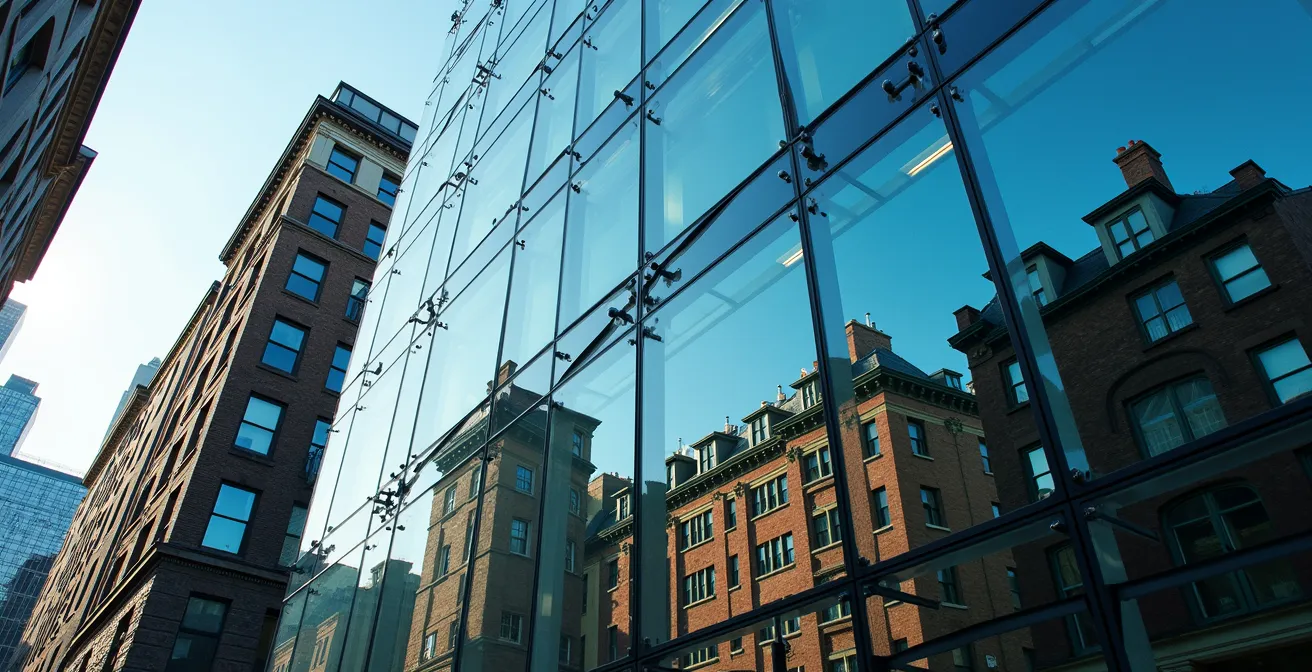
This process actively erases neighborhood identity. The tower doesn’t integrate into the existing urban fabric; it mirrors a fragmented, warped version of it. The rich texture of a historic brick facade or the intricate details of a stone cornice are reduced to a fleeting, abstract pattern on a curtain of glass. The effect is one of dislocation. The tower becomes a void in the urban narrative, a blank page in the city’s book. While technologically impressive, this architecture often fails the fundamental test of a building: to contribute its own unique chapter to the story of its place.
Why Finding a Name on a Census Record Triggers a Dopamine Response?
The title of this section is a metaphor. While genealogists feel a thrill finding a name on a census record, the architectural reader finds a similar rush in uncovering the “census” of the building itself. This is not a paper document but a physical record of use and habitation etched directly into the structure. Learning to read this “building census” is one ofthe most rewarding skills an urban explorer can develop. It’s a form of material forensics that brings a static object to life.
Think of the worn stone steps leading into an old public library. The deep, smooth depression in the center of each tread is a data point. It represents a century of footfalls, a physical graph of human traffic. It tells a more powerful story of the building’s role in the community than any plaque on the wall. Similarly, the layers of paint visible in a chipped doorway are a ‘census’ of changing tastes and ownership, with a 1970s avocado green peeking out from under a 1990s beige. Each layer is an entry in the building’s biography.
This method requires a shift in perception. You must look for the evidence of human interaction: the smooth patina on a brass door handle, the patched holes in a factory floor where machines were once bolted, or the faint outline of a sign long removed. These are the names on the building’s census. They are traces of the lives lived and the work done within its walls. Cross-referencing these physical clues with archival research—like old city directories or Sanborn fire insurance maps—can connect a physical scar to a specific business or family, creating that “dopamine response” of a mystery solved.
Why the Light at Sunset Reveals Masonry Details Invisible at Noon?
Just as the blue hour transforms a building’s silhouette, the “golden hour”—the period shortly before sunset—acts as a high-powered scanner for its surface. The secret is “raking light.” When the sun is low in the sky, light strikes the building’s facade at an acute angle, dragging long shadows across its surface. This effect dramatically exaggerates texture, revealing details in the masonry that are completely flattened and invisible under the high, direct sun of midday.
This is the moment when the craftsman’s hand becomes visible. The subtle trowel marks in old stucco, the texture of board-formed concrete, the precise tooling on a stone block—all of these details emerge from the flatness. It is during this time that the building’s material honesty is on full display. For a photographer or an architectural reader, this is a critical time for analysis. Professional architectural photographers often recommend shooting during the 30 minutes before sunset to get the best raking light for revealing these textures.
The season also plays a critical role in this dialogue between light and structure. As photographer Rory Gardiner points out, the low arc of the sun in autumn and winter provides excellent light for much of the day in the Northern Hemisphere. However, it also presents challenges. North-facing facades, which may be beautifully lit in the summer, can be plunged into permanent shadow during the winter, hiding their stories completely. Understanding the sun’s path throughout the day and year is as essential to reading a building as understanding its floor plan. Light is not passive; it is an active agent that reveals and conceals, and the expert reader knows how to be in the right place at the right time to hear what it has to say.
Key takeaways
- Light as a Tool: The time of day is not just for aesthetics; ‘blue hour’ defines form, while ‘golden hour’ raking light reveals surface texture and history.
- Styles as Ideologies: Architectural movements like Art Deco and Brutalism are physical manifestations of the social, political, and philosophical values of their time.
- Exploration as Preservation: Ethical urban exploration is a form of grassroots historiography, where documentation serves as a final record for buildings at risk of being erased.
Why Walking a City Reveals Stories That Buses Miss?
A city observed from a bus is a filmstrip of facades. A city experienced on foot is an immersive text, rich with footnotes and hidden chapters. Walking is the only mode of transport that allows for what urban explorers call “vertical reading” and the “palimpsest method.” A palimpsest is a manuscript page from which the text has been scraped or washed off so that the page can be reused, but where traces of the original writing remain. A city block is a living palimpsest, and walking is the only way to read its layered history.
This method involves scanning the environment at all levels. At your feet, you might notice a sudden change in paving material, marking an old property line, or a curb that curves unnaturally, hinting at a trolley track that was paved over decades ago. At eye level, you see the “building census”—the worn doorways and patched walls. But looking up, you might see the most telling clues: a clean patch of brick on an old wall, shaped like a rooftop, revealing the “ghost” of a demolished adjacent building. These are the stories a bus will always speed past. With the growth of interest in urban exploration to millions of followers, this slow, deliberate way of seeing is becoming a shared language.
Walking attunes you to the city’s subtle grammar. It allows you to pause, to trace a line with your eyes, to wonder why one building is set back two feet farther than its neighbors, or why a modern storefront is awkwardly inserted into a 19th-century cast-iron frame. It is at this human pace that the architectural narrative unfolds. You move slowly enough to see the layers, to notice the edits and erasures, and to piece together the biography of the block, the neighborhood, and the city itself. You are no longer just looking at a collection of buildings; you are reading a single, complex, and fascinating document.
Now, equipped with this method of seeing, the next step is to go out and apply it. Choose a street in your own neighborhood—one you think you know well—and start reading. Look for the ghosts of old buildings, decipher the language of the windows, and watch how the setting sun tells the story of the stone. Your city is a library, and every building is a book waiting to be opened.