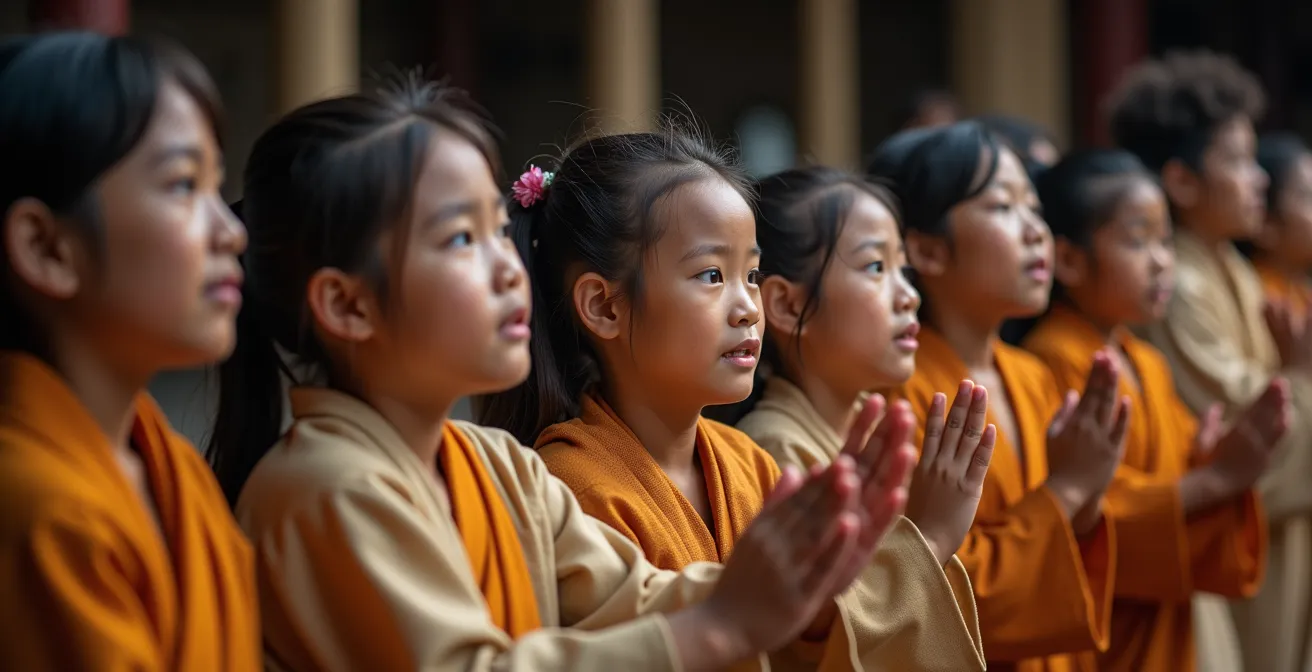
Many travelers believe that respectfully participating in a local ritual is about following a list of dos and don’ts. However, the key to a truly memorable experience lies deeper. It’s about understanding and entering the ‘ritual script’—the shared sequence of actions that reduces our mental effort and allows us to connect on an emotional level. This shift from a passive observer to an active participant doesn’t just create a memory; it fosters genuine human connection and breaks down cultural barriers.
There’s a universal moment every thoughtful traveler experiences: standing at the edge of a vibrant local ceremony, camera in hand, feeling a magnetic pull to join but paralyzed by the fear of being an intruder. We see the dance, hear the chant, smell the incense, yet remain separated by an invisible wall. We are observers, collecting sensory data but missing the essence of the event. The common advice is to “be respectful” and “ask permission,” but these guidelines only tell us how to avoid causing offense; they don’t teach us how to genuinely connect.
The traveler’s dilemma is often framed as a choice between watching from a safe distance or risking a clumsy intrusion. But what if the true path to meaningful participation isn’t about following a checklist of etiquette, but about understanding the underlying psychology of the ritual itself? The secret lies in recognizing the power of the ritual script. This is not just about tradition; it’s a cognitive and emotional roadmap that, when understood, allows an outsider to temporarily dissolve the boundary between “them” and “us.”
This article will guide you through that transformation. We will explore why these ancient scripts persist, how to discern an authentic invitation from a tourist performance, and the non-verbal cues that signal your peaceful intent. By delving into concepts like psychological safety and cultural appreciation, you will learn to move beyond mere observation and step into the heart of the experience, creating memories that are not just seen, but felt and shared.
The following sections break down the journey from respectful observer to welcome participant, providing anthropological insights and practical steps to enrich your cultural encounters.
Summary: The Traveler’s Guide to Ritual Participation
- Why Ancient Festivals Have Followed the Same Script for 500 Years?
- How to Ask for Permission to Join a Ceremony Without Being Intrusive?
- Hotel Luau vs. Local Feast: How to Spot a Staged Performance?
- The Body Language Mistake That Insults Elders in Traditional Villages
- How to Record Oral Folklore Before It Disappears from a Region?
- What Is “Psychological Safety” and Why Do You Feel Anxious in Your Group?
- Cultural Appreciation vs. Appropriation: How to Participate Respectfully?
- Why Cultural Exchange Programs Reduce Prejudice More Effectively Than Politics?
Why Ancient Festivals Have Followed the Same Script for 500 Years?
When you witness a ceremony that has been performed for centuries, like the Gion Matsuri in Japan or a Day of the Dead procession in Mexico, you’re not just seeing a historical reenactment. You are observing a powerful psychological technology at work. The reason these rituals persist with such rigidity is that their structure—the “ritual script”—is designed to do something profound to the human brain. Many ancient traditions, like the Japanese Obon Festival, have been celebrated for over 500 years, a testament to the script’s enduring power.
This script is a predictable sequence of words, gestures, and actions. Its predictability is its genius. By providing a clear set of instructions, the script dramatically reduces our cognitive load—the mental effort of figuring out “what to do next.” This frees up mental resources, allowing us to shift from analytical thinking to a more profound sensory and emotional state. It’s in this state that connection and transcendence occur.
As neuroscientists Patrick McNamara and Jordan Grafman explain, this is a deliberate feature, not a bug of tradition. In their review on the neuroscience of religion, they note how this structure facilitates a powerful shift in consciousness:
The rigid script isn’t just about tradition; it’s a tool that frees participants from the cognitive load of ‘what to do next.’ This allows them to shift from analytical thought to emotional and sensory experience, facilitating a state of flow or transcendence that is crucial for a memorable ritual.
– Patrick McNamara and Jordan Grafman, Advances in brain and religion studies
For a traveler, understanding this is the first step. You are not trying to “infiltrate” a private event. You are asking to be given a role, however small, within a script that is designed for collective experience. Your goal is to learn your lines, follow the choreography, and allow the script to do its work on you, just as it does for every other participant.
How to Ask for Permission to Join a Ceremony Without Being Intrusive?
The desire to participate is natural, but the fear of being intrusive is a sign of a thoughtful traveler. The key is to shift your focus from “getting permission” to “signaling respect and openness.” Permission is often granted non-verbally long before a single word is spoken. The approach begins with quiet observation from the periphery, demonstrating your interest not as a consumer of culture, but as a humble witness.
Before you even consider approaching someone, engage in a moment of internal reflection. The act of asking is less important than the intention behind it. Consider these questions not as a checklist for others, but as a mirror for yourself:
- Do I understand the potential significance of this event?
- Is my goal to honor this culture or to perform my interest for an online audience?
- Am I seeking a genuine human connection or just a photo opportunity?
- Could my presence inadvertently perpetuate a harmful stereotype?
Once your intentions are clear, identify the right person to approach. Look for a community elder or an organizer who is not in the midst of a crucial part of the ceremony. Your body language is your first sentence: maintain a respectful distance, make brief, friendly eye contact, and offer a small nod or slight bow. This posture communicates deference and respect far more effectively than words.
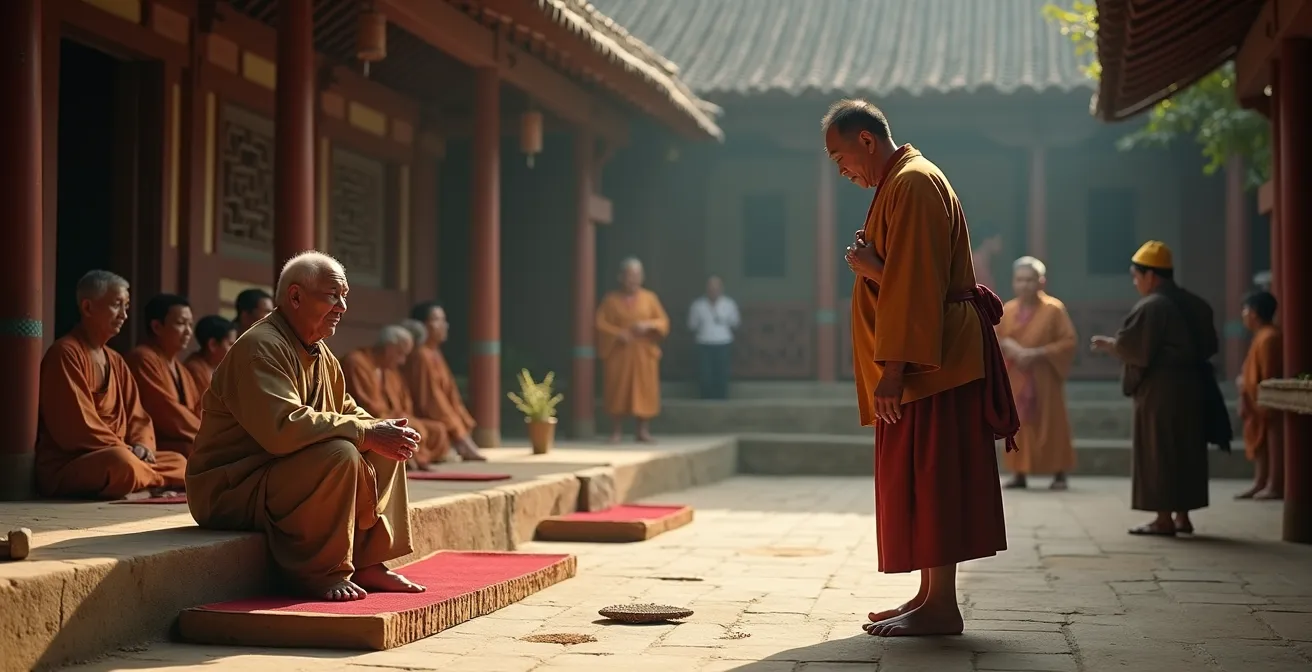
When you do speak, be simple and direct. A question like, “This is a beautiful ceremony. Would it be appropriate for me to observe more closely?” is often better than “Can I join in?” The former asks for guidance, positioning the elder as the expert and you as the respectful student. This approach doesn’t demand entry; it requests to be taught the rules of engagement, a far more welcome proposition.
Hotel Luau vs. Local Feast: How to Spot a Staged Performance?
One of the greatest challenges for a traveler is distinguishing between an authentic community ritual and a performance staged for tourists. The former offers a window into a culture’s soul; the latter is often a commodified echo. While many staged events are enjoyable and educational, understanding the difference is crucial for managing your expectations and seeking deeper connection. A ritual like the Dragon Boat Festival has maintained its authentic rituals for at least 1,500 years because its function is for the community, not an audience.
The most telling sign is the direction of focus. In an authentic ritual, the participants’ energy is directed inward—toward each other, a central altar, or the sky. They are performing for their gods, their ancestors, or their community. In a staged performance, the energy is directed outward—toward the audience. The performers seek applause, smiles, and reactions from the paying guests.
As you observe, look for other subtle clues that reveal the event’s primary purpose. This table, based on anthropological observation, can serve as a guide. As one scholarly text on the anthropology of rituals highlights, the function of the event is its most defining feature.
| Aspect | Authentic Ritual | Staged Performance |
|---|---|---|
| Primary Function | Social or spiritual function for the community | Economic function for audience entertainment |
| Participant Focus | Inward focus on each other or symbolic center | Outward focus toward audience for reaction |
| Demographics | All generations present, including restless children and elderly | Selected performers of specific ages |
| Clothing/Materials | Worn, meaningful garments with history | Pristine costumes for visual appeal |
| Time Structure | Unstructured social time before/after main event | Scheduled start/end times for ticketed audience |
Noticing these differences is not about judging staged performances as “bad.” They provide income for artists and can be a safe entry point into a culture. However, recognizing them for what they are allows you to seek out the local feast, the neighborhood procession, or the small temple ceremony where the “ritual script” is alive and functioning for its original purpose: to bind a community together.
The Body Language Mistake That Insults Elders in Traditional Villages
In many cultures, what you do with your body speaks far more loudly than your words. A common mistake for travelers is focusing so much on what to say that they forget what their posture, hands, and eyes are communicating. The most significant errors often occur when interacting with elders, where established codes of non-verbal respect are paramount. For example, in many parts of Asia and the Pacific, passing an object or money with only one hand can be seen as dismissive or rude. The respectful method is to offer it with both hands, or with the right hand supported by the left at the wrist or elbow.
This isn’t just arbitrary etiquette; it’s a part of the “ritual script” of daily life. These gestures are physical manifestations of a person’s awareness of social hierarchy and their place within it. Pointing with your index finger can be aggressive; a gesture with an open palm is preferred. Showing the soles of your feet to someone, especially an elder or a sacred object, is a profound insult in many Buddhist and Hindu cultures. These are not minor faux pas; they are breaches in the social fabric that can instantly mark you as an outsider who is not “safe” to interact with.
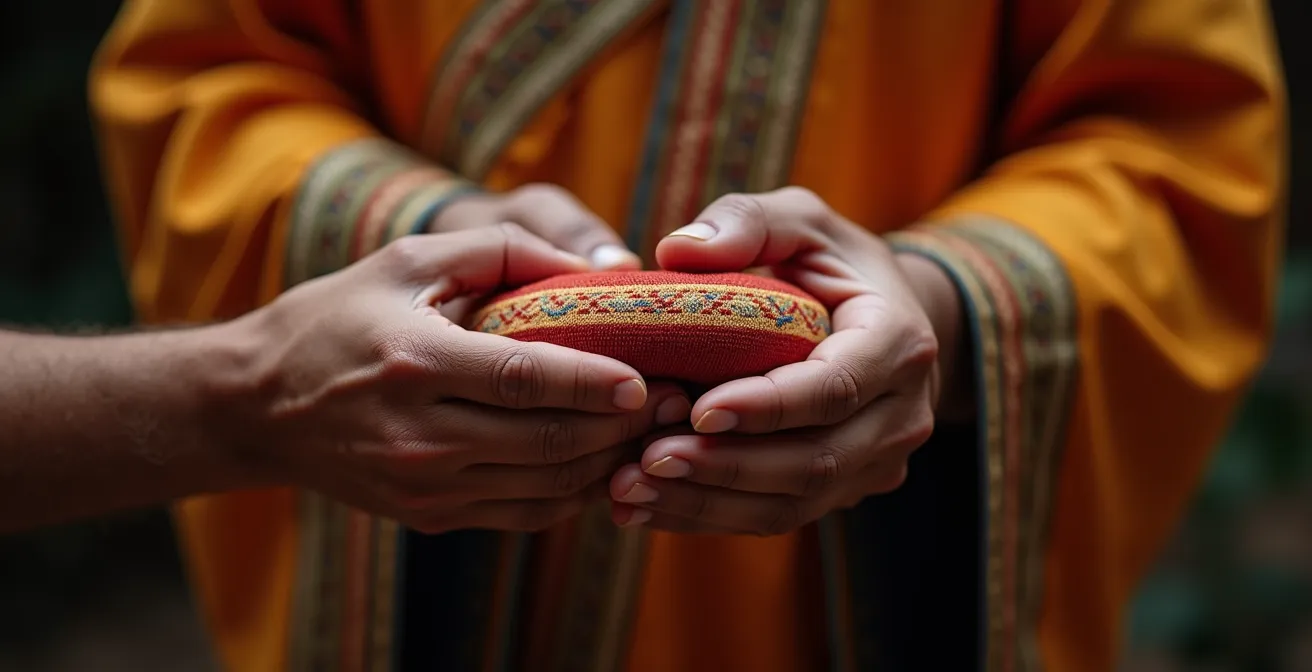
Anthropologist Amanda Zunner-Keating brilliantly reframes the importance of these actions. It’s not just about avoiding a mistake; it’s about actively participating in the language of respect. This non-verbal communication is your first and most important contribution to the ritual space.
Respectful body language isn’t just about avoiding offense; it’s a non-verbal form of participation that signals you are a safe and respectful presence.
– Amanda Zunner-Keating, Beliefs: An Open Invitation to the Anthropology of Magic
Before entering a new cultural space, research these basics of non-verbal communication. Observe how people greet each other, how they sit, and how they gesture. Mimicking these patterns is not appropriation; it is a way of saying, “I see your world, and I am doing my best to move within it respectfully.” It is the most fundamental way to join the dance before you’ve even learned the steps.
How to Record Oral Folklore Before It Disappears from a Region?
Sometimes, the deepest form of participation is not in a ceremony, but in the act of preservation. In many communities, the most valuable cultural treasures are not objects in a museum, but the stories, songs, and histories held in the memories of the elders. As a traveler, being invited to hear these stories is a profound honor. Having the skill to record them ethically is a way to give back, to participate in the transmission of heritage from one generation to the next.
This is not a task to be taken lightly. Simply hitting “record” on your phone is an act of extraction. Ethical documentation is an act of collaboration. It begins with establishing trust and ensuring the storyteller understands how their story will be used. The ultimate goal should be that the recording benefits the community of origin first and foremost, perhaps by creating an archive for younger generations or a resource for local schools.
The act of recording is more than capturing words; it’s about capturing context. The environment, the mood, and the non-verbal cues are all part of the story. An anthropologist’s field notes are as important as the audio file. If you are given the privilege to record, your duty extends to documenting the full context of the performance.
Your Action Plan for Ethical Folklore Recording
- Establish clear consent for recording and future use of the material.
- Document the emotional atmosphere during the recording session.
- Note the time of day and its cultural significance (e.g., storytelling after dusk).
- Record who else was present and their relationship to the storyteller.
- Capture the storyteller’s non-verbal cues, gestures, and the audience’s reactions.
This process transforms you from a mere tourist into a temporary cultural historian. You are no longer just a passive listener. You are actively helping to safeguard a piece of intangible heritage, like that of the Qingming Festival, which dates back at least 2,500 years. This is a profound responsibility and one of the most memorable ways to participate in the life of a culture.
What Is ‘Psychological Safety’ and Why Do You Feel Anxious in Your Group?
The feeling of anxiety you experience when standing at the edge of a ceremony is the absence of psychological safety. This term, coined by organizational behavior scholars, describes a shared belief that the group is safe for interpersonal risk-taking. It’s the feeling that you can be vulnerable, ask a “stupid” question, or make a mistake without fear of being shamed or ostracized. When you’re an outsider, you lack this safety, and your brain is on high alert for social threats.
Herein lies another genius of the ritual script. As the great anthropologist Victor Turner noted, rituals are often explicitly designed to create a temporary bubble of psychological safety. The predictable structure, the assigned roles, and the shared focus all work to lower social anxiety and foster a sense of unity. When everyone is following the same script, individual self-consciousness can dissolve into a collective identity.
Rituals, through their predictable scripts and defined roles, are often designed specifically to create a container of psychological safety where participants can be vulnerable and authentic.
– Victor Turner, referenced in The significance of liminality in rites of passage
Participation in these collective events has measurable effects. A review of neuroimaging and behavioral data from approximately 40,000 participants from the UK Biobank showed that people who regularly attend religious services—a form of ritual—have significantly different brain connectivity patterns, often associated with lower levels of depression and greater well-being. By providing a safe, structured environment for connection, rituals offer a powerful antidote to the anxiety of modern life.
As a traveler, when you are invited to participate, you are being offered a temporary grant of psychological safety. By accepting your role in the script, you agree to be vulnerable, and in return, the group offers a space where that vulnerability is protected. This is the moment the invisible wall between observer and participant crumbles. You feel less anxious not because you’ve mastered the rules, but because you’ve been accepted into the safety of the collective.
Cultural Appreciation vs. Appropriation: How to Participate Respectfully?
The line between cultural appreciation and appropriation is a source of great anxiety for conscientious travelers. Appreciation is about engaging with a culture to honor and learn from it, while appropriation typically involves taking elements from a marginalized culture out of context, often for personal gain or status, without giving credit or understanding its significance. Participation in a ritual is the ultimate test of this distinction.
The core difference often lies in context, recognition, and power. Are you participating within the context the ritual was designed for? Are you acknowledging the cultural origins and the people who are sharing their heritage with you? Is the exchange mutually beneficial, or does it primarily serve your desire for an “exotic” experience? A qualitative investigation of international K-pop consumers revealed that even in popular culture, fans are highly aware of this line, emphasizing the need to “know where your boundaries exist” and “be cautious” about crossing into insensitivity.
This framework, adapted from academic discussions on the topic, can help clarify your role. True appreciation requires a commitment to understanding, not just imitation. As one philosophical analysis of the topic makes clear, the intent to honor the original context is paramount.
| Criteria | Appropriation | Appreciation |
|---|---|---|
| Context | Strips cultural elements from original meaning | Honors action within original context |
| Recognition | Obscures or denies cultural contributors | Acknowledges and credits cultural origins |
| Power Dynamic | Dominant culture profits from marginalized | Collaborative effort with mutual benefit |
| Engagement Level | Surface-level aesthetic borrowing | Deep understanding of cultural significance |
When you participate in a ritual at the invitation of the community, you are engaging within the original context. By following their lead, you are acknowledging their authority. And by being a respectful presence, you are contributing to the social fabric rather than taking from it. In this scenario, participation becomes the most profound form of appreciation. It is a humble act of “learning by doing,” guided by the true owners of the culture.
Key Takeaways
- True participation is about entering a “ritual script,” not just observing from the outside.
- Authentic rituals focus energy inward on the community, while staged performances focus outward on an audience.
- Respectful body language is a form of non-verbal participation that creates psychological safety.
Why Cultural Exchange Programs Reduce Prejudice More Effectively Than Politics?
The experience of participating in a local ritual—sharing a meal, joining a dance, or simply sitting in shared silence—does more than create a good travel story. It fundamentally changes how we see the world and the people in it. The reason this direct, personal engagement is so much more effective at reducing prejudice than political treaties or news reports lies in the way our brains form memories.
Politics and media provide us with semantic knowledge—abstract facts and figures about “other people.” This information is processed analytically and is easily forgotten or overwritten by pre-existing stereotypes. Cultural exchange, on the other hand, creates powerful, emotional, first-person episodic memories. You don’t remember a statistic about a country’s hospitality; you remember the warmth of the smile from the woman who shared her food with you. You remember the shared laughter when you stumbled during the dance. These are personal, visceral memories.

As research in positive psychology and prejudice reduction shows, these episodic memories are far more “sticky” and powerful than abstract facts. They provide a strong, positive emotional counter-narrative to negative stereotypes.
Exchange programs create powerful, emotional, first-person episodic memories (‘I remember when we laughed about Y’). These personal memories are far more effective at overwriting abstract stereotypes than semantic knowledge about others.
– Stewart I. Donaldson, Following the science to understand how to reduce prejudice
When you move from observer to participant, you are no longer collecting facts about a culture; you are creating episodic memories with people. You are replacing a vague stereotype with a specific, human face. This is why a single afternoon spent participating in a community event can do more to build bridges than years of watching documentaries. It’s not just more memorable for you; it’s a small but powerful act that helps weave a more understanding and interconnected world.
Your journey from observer to participant is more than a travel strategy; it is a shift in mindset. By seeking to understand the script, respect the space, and connect with humility, you can transform your travels from a series of snapshots into a collection of profound, shared human experiences.