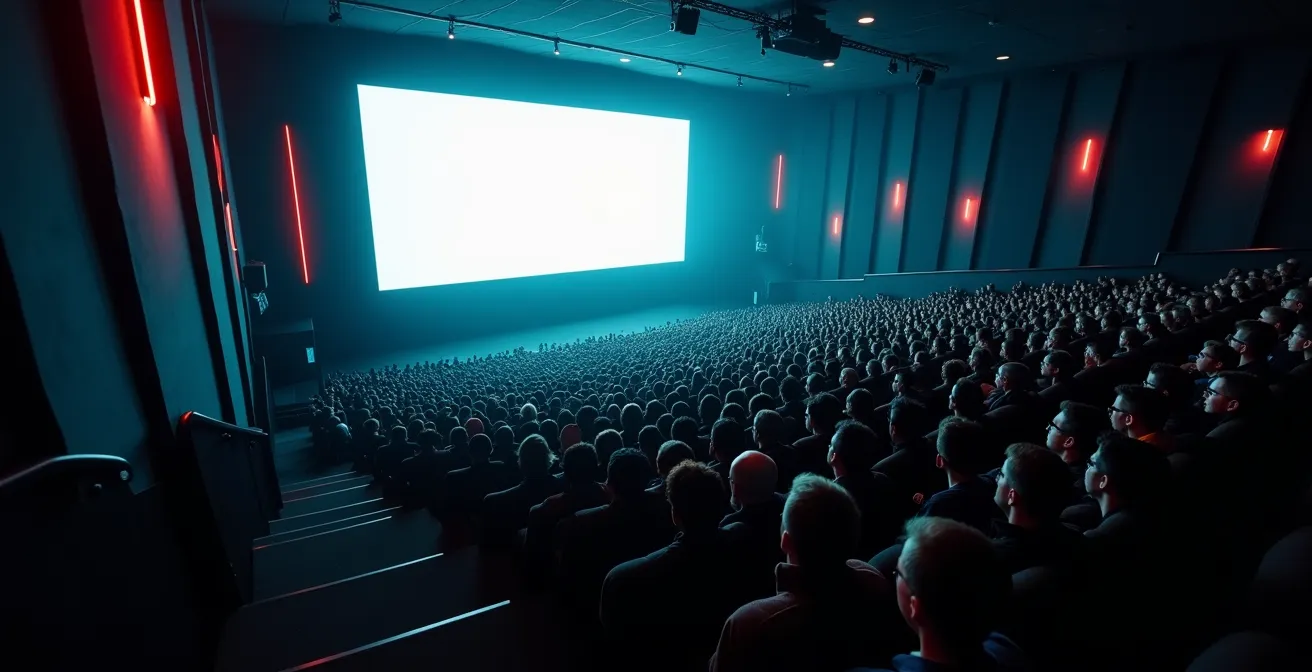
Contrary to the belief that waiting for streaming is just a matter of convenience, the opening weekend cinema experience is a fundamentally different, and neurologically superior, event.
- The shared experience of a crowd physically synchronizes audience brainwaves, amplifying emotional responses like laughter and shock.
- Premium formats like IMAX and Dolby are designed to maximize this collective immersion, a key part of the artistic intent you miss at home.
Recommendation: To truly experience a blockbuster as intended, you must participate in the cultural ritual of the opening weekend. The choice isn’t between a big screen and a small one; it’s between collective effervescence and solitary observation.
You see the buzz online. A new blockbuster is about to drop, and the world is divided. There are those who book their tickets months in advance, ready to dive in on opening night. And there are those who confidently declare, “I’ll just wait for it to hit streaming.” The common wisdom suggests this is a simple trade-off: the bigger screen and better sound of the theater versus the comfort of your own couch. But this view misses the point entirely. The debate isn’t about technology; it’s about sociology.
Of course, avoiding spoilers and being part of the immediate cultural conversation are valid reasons to go early. But these are merely symptoms of a much deeper phenomenon. What if the true magic of the cinema, the very thing that makes a good film a great one, isn’t on the screen at all? What if it’s in the air around you, in the shared breaths, the synchronized gasps, and the waves of laughter that ripple through a darkened room? The true value of the opening weekend is its power to generate collective effervescence—a term for the shared energy that turns a group of individuals into a unified, emotional entity.
This article will deconstruct that magic. We will explore the neurological basis for why laughing with 200 strangers feels profoundly different from laughing alone. We’ll analyze how premium formats are engineered to foster this collective feeling, and we will give you the practical tools to protect your own unspoiled experience. This is not just about watching a movie; it’s about understanding why *how* you watch it fundamentally changes the art itself.
This exploration will provide a complete picture, from the science of shared emotion to the practicalities of choosing the perfect seat. Let’s delve into what makes the theatrical experience a unique cultural ritual.
Summary: Why the Blockbuster Experience Is a Social Phenomenon
- Why Laughing in a Crowded Theater Feels Better Than Laughing Alone?
- IMAX vs. Dolby Cinema: Which Premium Format Is Worth the Extra $10?
- The Social Media Settings That Protect You from Spoilers Before You See the Movie
- How to Pick the “Sweet Spot” Seat in Any Movie Theater Layout?
- Streaming vs. Theater: When Is the Exact Date a Movie Hits Digital Platforms?
- What Happens to Your Brain When 50,000 People Sing the Same Chorus?
- Crowdfunding vs. Studio Backing: How Money Changes the Ending of a Movie?
- Why You Can’t Stop Watching After a Cliffhanger Even When You’re Tired?
Why Laughing in a Crowded Theater Feels Better Than Laughing Alone?
The feeling is unmistakable: a joke lands, and a wave of laughter washes over the theater. It feels bigger, more joyful, and more satisfying than a chuckle on your couch. This isn’t just your imagination; it’s a well-documented neurological phenomenon. Our brains are wired for social connection, and watching a comedy in a group triggers a process of affective contagion, where emotions literally spread from person to person, amplifying the initial feeling.
This shared experience creates a feedback loop. One person’s laugh gives another permission to laugh, and so on, until the entire room is participating in a moment of unified joy. It goes even deeper than that. Cutting-edge neuroscience research reveals that inter-subject brain correlation increases by up to 70% during the shared processing of humor. In simple terms, the brains of the audience members begin to sync up, firing in similar patterns at the same time. You aren’t just watching the same movie; for a moment, you are experiencing it with a shared consciousness.
This synchronization is the biological basis of collective effervescence. It explains why a scare is scarier, a sad moment more poignant, and a triumphant finale more exhilarating when experienced with a crowd. The presence of others changes the emotional texture of the film, adding a layer of communal feeling that is impossible to replicate in isolation. The experience becomes less about individual consumption and more about participation in a cultural ritual.
IMAX vs. Dolby Cinema: Which Premium Format Is Worth the Extra $10?
The communal experience isn’t just a happy accident; it’s an outcome that modern cinemas are meticulously engineering. Premium Large Formats (PLFs) like IMAX and Dolby Cinema are often marketed on their technical specs—bigger screens, better sound—but their true value lies in how they enhance and direct the audience’s collective focus. The fact that premium screens accounted for 66% of “Avatar: The Way of Water’s” opening weekend sales shows that audiences instinctively understand this added value.
IMAX, with its towering screen and stadium seating, physically unifies the audience’s gaze, creating a singular focal point that dominates peripheral vision. This architectural choice minimizes individual distractions and forces everyone to look at the same massive canvas, fostering a sense of shared awe. Dolby Cinema, on the other hand, uses its Dolby Atmos sound system and Dolby Vision’s perfect blacks to achieve a different kind of immersion. The object-based audio can place a sound with pinpoint accuracy in the theater, making a twig snap behind the entire audience simultaneously, triggering a collective jump-scare.
These technologies are not just about a clearer picture or louder explosions. They are tools designed to hijack the senses of an entire group at once, ensuring that key emotional beats land with synchronized impact. The choice between them often comes down to what kind of collective experience you seek.
| Feature | IMAX | Dolby Cinema | Collective Impact |
|---|---|---|---|
| Screen Size | Up to 8 stories tall | Standard large format | IMAX creates shared awe through scale |
| Sound System | 12-channel immersive | Dolby Atmos object-based | Atmos enables precise collective jump-scares |
| Seat Configuration | Stadium/traditional | Reclining luxury seats | IMAX keeps audience physically unified |
| Visual Brightness | Laser projection | Dolby Vision HDR | Both eliminate distractions for unified focus |
The Social Media Settings That Protect You from Spoilers Before You See the Movie
If the peak cinematic experience is a journey of shared, unspoiled discovery, then the greatest threat in the modern age is the digital spoiler. The very social media that builds hype can also ruin the collective gasp of a perfectly executed plot twist. Protecting this experiential scarcity—the a-ha moment that can only truly be felt once, with a crowd—requires a proactive digital defense strategy. It’s not about logging off entirely; it’s about curating your information intake with surgical precision.
The goal is to create a temporary “clean room” for your mind before you enter the theater. This involves muting specific keywords, character names, and hashtags related to the movie on platforms like X (formerly Twitter) and Instagram. It also means being ruthless about temporarily unfollowing or snoozing accounts known for rapid-fire reviews or meme-making. This isn’t antisocial; it’s pro-social. You are protecting your ability to have a genuine, in-the-moment reaction with your fellow audience members.
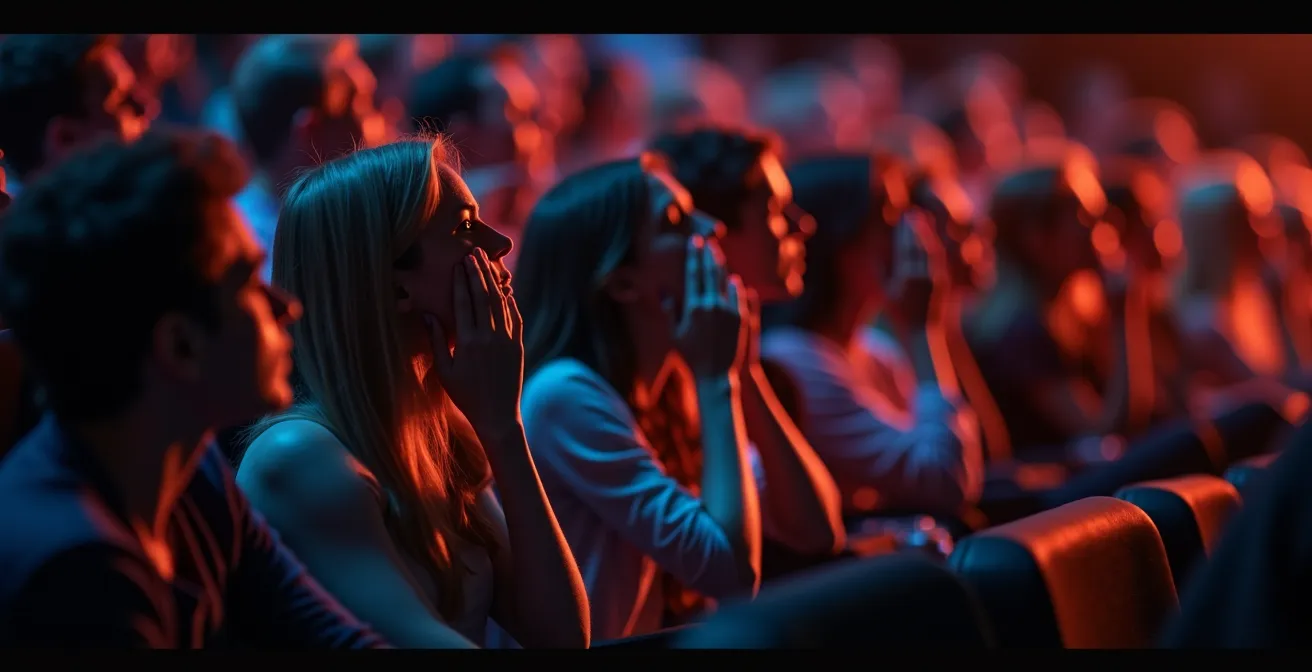
The image above captures the very thing you’re trying to preserve: that instant of unified shock and awe. To ensure you can be part of it, you need a plan. Here are the essential steps to building your spoiler-free bubble for opening weekend.
Your Action Plan: The Pre-Cinema Digital Lockdown
- Mute movie-specific keywords on Twitter/X, including character names and #MovieTitle hashtags.
- Temporarily unfollow entertainment news accounts and movie discussion groups.
- Enable the ‘Snooze’ feature on Facebook for friends who’ve already seen the film.
- Turn off YouTube recommendations and clear your watch history to avoid algorithm-driven trailer spoilers.
- Use browser extensions like ‘Spoiler Protection 2.0’ for automatic content filtering on websites.
How to Pick the “Sweet Spot” Seat in Any Movie Theater Layout?
Choosing a seat is more than a matter of comfort; it’s an act of positioning yourself within the collective. Where you sit determines not only your visual and auditory experience but also your connection to the social energy of the room. The “sweet spot” isn’t just about the perfect viewing angle; it’s about finding the epicenter of the audience’s emotional reactions. Think of it as the place where you can best feel the room breathe as one.
Experts in architectural psychology note that our seating choice can push us toward “unattached individuation” or “collective integration.” A seat too close to the front or isolated on the aisle can create a sense of separation, an “I-you” relationship with the screen. Conversely, a seat nestled within the core of the audience fosters a “we-connection,” where you feel part of a larger whole. You’re not just watching; you are participating.
The ideal location is typically about two-thirds of the way back from the screen and as close to the center as possible. This position achieves two critical goals. First, it aligns with the audio sweet spot where the sound mix is perfectly balanced as the engineers intended. Second, and more importantly for the collective experience, it places you where you can subconsciously register the maximum number of audience reactions. You hear the most laughter, feel the most tension, and become an integral part of the human element of the screening.
Streaming vs. Theater: When Is the Exact Date a Movie Hits Digital Platforms?
For those still weighing the “watch now vs. wait” decision, the timeline has become a critical factor. The once-sacrosanct theatrical window, which could last 90 days or more, has shrunk dramatically. Understanding this new landscape is key to making an informed choice. You are no longer waiting three months; the delay is often much shorter, making the decision to wait seem more tempting.
Currently, the industry data shows a 45-day average theatrical exclusivity window in 2024. This means a major blockbuster could be available for digital purchase or on a streaming service in about six weeks. However, this is just an average. A massive hit might be held in theaters longer to maximize box office revenue, while a film that underperforms could be fast-tracked to digital. There is no single, fixed rule.
But the real question isn’t “how long do I have to wait?” but “what am I losing by waiting?” The value of the opening weekend experience has a steep drop-off. This “social premium” varies by genre, as some types of films benefit more from a collective viewing than others.
| Genre | Opening Weekend Social Value | Streaming Social Value | Premium Differential |
|---|---|---|---|
| Superhero Blockbusters | Very High (shared excitement) | Medium (meme culture) | +70% |
| Horror | High (collective scares) | Low (solo viewing) | +85% |
| Comedy | High (contagious laughter) | Medium (watch parties) | +60% |
| Drama | Medium (shared emotion) | High (discussion groups) | +20% |
What Happens to Your Brain When 50,000 People Sing the Same Chorus?
While a movie theater may not hold 50,000 people, the principle of mass synchronization is identical. The experience of a crowd singing a chorus at a concert is a perfect, large-scale analogy for the neurological bonding that happens in a cinema. It’s the ultimate expression of collective effervescence, where individual identities merge into a powerful, shared moment. As neuroscientist Uri Hasson eloquently puts it, communication is a single act performed by two—or in this case, thousands of—brains.
Communication is really a single act performed by two brains.
– Uri Hasson, Princeton University neuroscience research on brain synchronization
This isn’t just poetry; it’s science. When we experience a compelling narrative or a powerful piece of music together, our brains begin to synchronize. This neural coupling is not a passive event. In fact, brain imaging studies demonstrate that enhanced intersubject correlations during movie viewing correlate with successful episodic encoding. This means that the more your brain activity is in sync with others in the audience, the more vividly you will remember the film later.
The shared experience literally burns the movie into your memory with greater intensity. You’re not just having more fun in the moment; you are creating a stronger, more lasting memory of the event. Waiting for streaming means forgoing this powerful memory-enhancing mechanism. You might remember the plot, but you will have lost the rich emotional and neurological texture that only a crowd can provide.
Crowdfunding vs. Studio Backing: How Money Changes the Ending of a Movie?
The very nature of the collective experience a film aims to create is often determined long before the cameras roll. The source of a movie’s funding—whether it’s a major studio or a grassroots crowdfunding campaign—profoundly shapes its narrative goals and, by extension, the kind of audience reaction it’s designed to provoke. This financial DNA dictates whether a film is built for broad consensus or niche passion.
Studio-backed blockbusters are engineered for mass appeal. Their goal is to create a powerful, unified, and overwhelmingly positive experience for the largest possible audience on opening weekend. This is achieved through extensive a-b testing of jokes, emotional beats, and even multiple endings to see which version generates the most favorable word-of-mouth. The result is a film optimized for maximum collective satisfaction, designed to make a diverse crowd feel a single, cohesive emotion.
Crowdfunded films operate on a different model. They are accountable not to a mass market, but to a core group of passionate believers who invested in a specific artistic vision. These films often preserve more idiosyncratic, challenging, or ambiguous endings, honoring the trust of their initial audience rather than aiming for universal approval. This can create an intense, but different, kind of collective experience—one of shared discovery and intellectual debate among a self-selected tribe. The funding model determines the social contract with the audience:
- Studio-backed: The film’s ending is shaped by test screenings to satisfy mainstream demographics and maximize positive buzz.
- Crowdfunded: The ending typically preserves a singular artistic vision to honor the trust of the initial investor-audience.
- Studio-backed: Post-credit scenes are often mandatory to build franchise potential and encourage repeat viewings from the crowd.
Key Takeaways
- The opening weekend experience is a sociological event of “collective effervescence,” not just a technical upgrade over streaming.
- Shared emotional responses like laughter and shock are amplified by neural synchronization, where audience members’ brain patterns align.
- Waiting for streaming means consuming a different version of the art, stripped of the crucial layer of collective emotion that filmmakers often design for.
Why You Can’t Stop Watching After a Cliffhanger Even When You’re Tired?
The modern blockbuster has perfected the art of psychological manipulation, and its most potent weapon is the cliffhanger. This narrative device—a moment of unresolved tension—is engineered to do more than just make you eager for a sequel. It’s designed to ignite immediate, widespread social speculation, turning every member of the opening weekend audience into a carrier for the film’s hype. It creates what psychologists call the Zeigarnik effect: our brains remember uncompleted tasks or unresolved stories far better than completed ones.
As noted in industry analysis, studios weaponize this social buzz, designing cliffhangers specifically for the opening weekend crowd to generate unified speculation. That burning need to discuss “what happens next?” is a powerful social glue. It transforms a passive viewing experience into an active, collective puzzle-solving exercise that spills out of the theater and onto social media, fueling the film’s cultural momentum. This drive is so powerful that it creates distinct cultural viewing patterns. For instance, data shows that Black Americans are 65% more likely to head to movies during opening weekend, a testament to the strong community value placed on participating in these cultural events as they happen.
By waiting for streaming, you don’t just risk spoilers; you opt out of this crucial phase of collective interpretation. You receive the answer to the cliffhanger as a simple data point, long after the vibrant, chaotic, and exciting period of shared theorizing has ended. You miss the fun of being wrong, the thrill of being right, and the connection forged by puzzling through it together.
The evidence is overwhelming. The choice to see a blockbuster on opening weekend is a choice to engage with the art form in its most complete, potent, and memorable state. It is an act of participation in a fleeting cultural moment, a shared ritual that is as much a part of the experience as the film itself. So the next time a big movie is on the horizon, don’t ask yourself if you can be bothered to go to the theater. Ask yourself if you can afford to miss it.
Frequently Asked Questions About the Optimal Cinema Experience
What’s the mathematical formula for the ideal viewing distance?
The THX standard recommends sitting at a distance where the screen fills a specific portion of your field of view, which typically places you about two-thirds of the way back from the screen in most standard theaters. This ensures immersion without causing eye strain.
Does the ‘sweet spot’ change for different movie genres?
Yes, to an extent. For epic action films, sitting slightly closer can enhance the feeling of immersion. For comedies, sitting a bit further back, in the heart of the audience, allows you to better sense the waves of laughter and participate in the collective joy.
How do I balance audio quality with crowd energy?
Fortunately, the acoustic sweet spot often overlaps with the social epicenter. The position approximately two-thirds back and centered horizontally is where sound engineers mix the audio to be most balanced, and it’s also where you are best positioned to feel the full effect of the crowd’s reactions.