Film scores are not just better for focus; they are architecturally designed to enhance it, while pop music is engineered to break it.
- The wide dynamic range of scores prevents the ear fatigue and subconscious stress caused by the hyper-compression in pop music.
- A score’s compositional intent is to support a narrative without hijacking conscious thought, making it the perfect sonic wallpaper for concentration.
Recommendation: Stop randomly searching for ‘focus playlists’ and start curating a personal library of film scores based on their psychoacoustic properties and your specific work tasks.
For any remote worker or student, the quest for the perfect productivity soundtrack is a familiar struggle. You need to drown out the dog barking, the construction noise, and your roommate’s conference call, but finding the right audio is a delicate balance. The standard advice is predictable: listen to instrumental music, avoid distracting lyrics, and turn to the endless lo-fi hip-hop streams or classical music playlists. This approach treats all non-lyrical music as a monolith, a simple tool to fill the silence. It assumes the primary enemy of focus is the human voice.
But what if the presence or absence of lyrics is a red herring? What if the real secret to unlocking a state of deep, uninterrupted work lies not in what the music lacks, but in its very sonic architecture? The difference between a pop song and a film score isn’t just words; it’s a fundamental conflict of purpose. Pop music is designed to be the main event, to hijack your attention with catchy hooks and compressed loudness. Movie soundtracks, on the other hand, are masterfully crafted to manipulate your emotions and maintain engagement while remaining firmly in the background. They are built to be the ultimate cognitive and emotional support system.
This article moves beyond the superficial advice. We will deconstruct the science of why film and video game scores are a fundamentally superior tool for focus. We’ll explore the psychoacoustic tricks composers use to direct your feelings, the critical importance of dynamic range in preventing ear fatigue, and how you can build a task-specific playlist that functions like an extension of your own mind. It’s time to stop fighting your music and start using it as the productivity hack it was always meant to be.
To fully grasp how to leverage this powerful tool, this guide breaks down the essential components, from the science of sound to practical playlist construction. The following sections will provide a complete blueprint for transforming your audio environment into a high-performance workspace.
text
Summary: A Sonic Blueprint for Uninterrupted Concentration
- How Composers Use “Infrasound” to Make You Feel Fear Without Knowing Why?
- How to Build a “Flow State” Playlist Using Video Game Scores?
- Original Score vs. Needle Drops: Which Creates a Stronger Emotional Memory?
- The Volume Mistake That Damages Your Hearing During Headphone Use
- Syncing BPM to Heart Rate: How to Choose Tracks for High-Intensity Interval Training?
- White Noise vs. Classical Music: Which Soundtrack Best Masks Distractions?
- Why High-Fidelity Earplugs Are the Best Investment for Frequent Concertgoers?
- Why We Crave the Chaos of Festivals Despite the Physical Discomfort?
How Composers Use “Infrasound” to Make You Feel Fear Without Knowing Why?
The power of a great film score often lies in what you feel, not what you consciously hear. Composers are masters of psychoacoustic manipulation, using frequencies outside the normal range of human hearing to create powerful emotional responses. The most potent of these is infrasound—sound waves below the 20 Hz threshold of human perception. While you can’t “hear” it, your body and brain certainly register its presence, often interpreting it as a sign of impending danger, a vestige of our evolutionary past where such vibrations signaled earthquakes or large predators.
This isn’t just cinematic theory; it’s backed by science. A landmark study published in Nature confirmed the profound physiological impact of these low frequencies. The research revealed that prolonged exposure to 6 Hz infrasound caused a decline in grey matter in brain regions associated with working memory. This demonstrates how deeply these sound waves can affect our cognitive state. Film composers, particularly in the horror and thriller genres, exploit this phenomenon to create a sense of unease and anxiety in the audience without a single note of overt music. They layer these imperceptible frequencies into the sound mix, triggering a primal fear response that the viewer can’t quite place, making the on-screen visuals infinitely more terrifying.
Case Study: The 19 Hz “Ghost Frequency” Discovery
The link between infrasound and unease was famously explored by British researcher Vic Tandy. In 1998, while working in a laboratory reportedly haunted, he discovered that a faulty fan was emitting a standing wave of sound at approximately 19 Hz. This “ghost frequency” was found to induce sensations of a ‘presence’ in the room, visual hallucinations, and a general feeling of dread. Tandy’s work opened new avenues for understanding how environmental infrasound directly impacts human perception and emotion, a principle that sound designers now consciously apply.
Understanding this concept is the first step in hacking your own sonic environment. By choosing scores that intentionally avoid these anxiety-inducing low frequencies, you can create a soundscape that promotes calm and focus, rather than one that subconsciously puts your nervous system on high alert. The same tool used to create fear can be avoided to engineer tranquility.
How to Build a “Flow State” Playlist Using Video Game Scores?
While film scores offer a linear emotional journey, video game soundtracks provide something even more valuable for productivity: adaptive music. Game composers face a unique challenge: creating a score that can loop for hours without becoming repetitive or distracting, while also adapting to the player’s actions—shifting from ambient exploration to intense combat on a dime. This makes video game scores a goldmine for building the ultimate “flow state” playlist, as they are intrinsically designed to support prolonged periods of concentration on specific types of tasks.
The key is to deconstruct these soundtracks by their intended function within the game. “Exploration” music, from games like Skyrim or No Man’s Sky, is often characterized by slow-building, atmospheric layers and modal harmony. This creates a sense of wonder and forward momentum, perfect for brainstorming and creative work. “Puzzle” music, from titles like Portal 2 or The Witness, is more minimalist and cerebral, using subtle variations and sparse instrumentation to encourage logical thinking without providing a distracting melody. Finally, “Strategy” music, found in games like Civilization, is often grand and orchestral, designed to support long-term planning and strategic thinking.
Your Action Plan: Building an Adaptive Work Playlist
- Establish the Base Layer: Start with ambient tracks from games known for their vast worlds (e.g., Skyrim, No Man’s Sky). These serve as your foundation for general focus work.
- Curate for Creativity: Create a sub-playlist of “Exploration Music.” Use this specifically for brainstorming sessions or when mapping out new ideas to foster a sense of discovery.
- Engineer for Problem-Solving: Isolate “Puzzle Music” layers (e.g., Portal 2, The Witness). Deploy this playlist when you need to tackle a complex analytical problem or debug code.
- Structure for Strategy: Compile “Strategy/Building Music” (e.g., Civilization, SimCity). This is your go-to for long-term project planning, writing reports, or any task requiring sustained, big-picture thinking.
- Audit for Listener Fatigue: As you build, prioritize tracks with modal harmony and subtle, non-repeating variations. This is the secret to avoiding the mental exhaustion that comes from predictable loops.
By curating your playlists based on this “compositional intent” rather than by game title or genre, you can create a dynamic sonic toolkit. Instead of a one-size-fits-all “focus” playlist, you’ll have a set of specialized audio environments, each perfectly tuned to the cognitive demands of your current task, helping you enter and maintain a flow state with scientific precision.
Original Score vs. Needle Drops: Which Creates a Stronger Emotional Memory?
Not all music in film is created equal. The distinction between an original score and a “needle drop” (a pre-existing pop song licensed for a scene) is fundamental to understanding why one is a tool for focus and the other is a cognitive hand grenade. An original score is composed specifically to serve the narrative. It’s the invisible emotional architecture of a film, designed to enhance a scene without pulling focus from it. A needle drop, by contrast, is a cultural artifact loaded with pre-existing memories and associations. When a director uses a well-known pop song, they are intentionally hijacking your attention and leveraging your personal history with that track.
This is precisely why pop music, even instrumental versions, is so detrimental to deep work. It’s designed to be memorable and demand attention. The original score operates on a different principle. As noted by experts in the field, its primary function is to keep you immersed in the moment. In an article on the subject, Inc. Magazine highlights this very point:
Film scores, for example, are composed with the intention to keep audiences engaged and in-the-moment without being too distracting.
– Inc. Magazine, Film Scores Boost Productivity
The neural pathways involved are distinct. An original score works in tandem with the visual information, creating a new, unified emotional memory. A needle drop creates a cognitive collision between the on-screen action and your own past experiences with the song, often pulling you out of the narrative. This makes it a powerful tool for a filmmaker, but a disastrous one for someone trying to maintain a fragile state of focus.
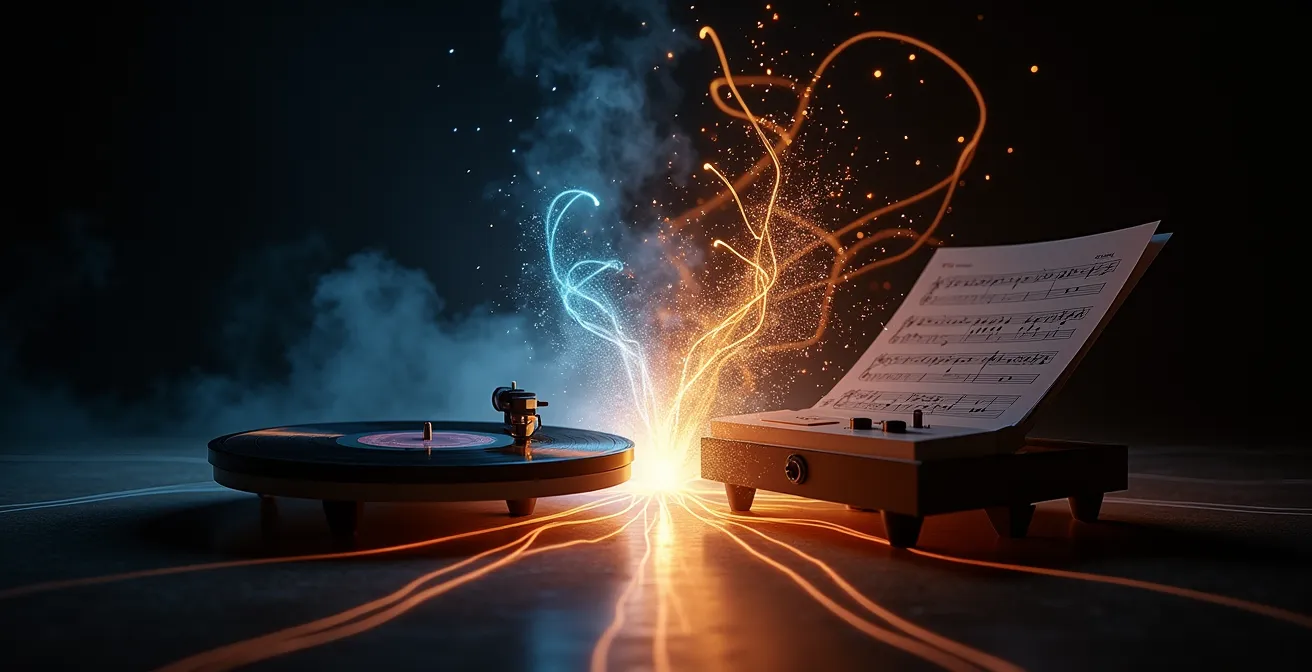
As this visualization suggests, the goal for deep work is to foster a single, streamlined cognitive path. An original score acts as a gentle guide down that path. A pop song creates a distracting fork in the road, forcing your brain to process a separate stream of nostalgic or lyrical information. For sustained productivity, the choice is clear: opt for the purpose-built emotional landscape of a score over the attention-demanding familiarity of a pop hit.
The Volume Mistake That Damages Your Hearing During Headphone Use
One of the most compelling arguments for using film scores for deep work has less to do with psychology and more to do with pure physics: dynamic range. For the past two decades, the music industry has been embroiled in the “Loudness War,” a trend of hyper-compressing pop songs to make them sound as loud as possible at all times. This squashes the natural peaks and valleys in the music, resulting in a fatiguing, relentless wall of sound. Film scores, by and large, have escaped this war. They retain a wide dynamic range, allowing for moments of quiet intimacy and soaring crescendos.
This difference is not trivial; it has a profound impact on your hearing and concentration. When you listen to a hyper-compressed pop song, your brain and ears are under constant assault. To make the music engaging enough to mask office chatter, you have to turn the volume up to a level where this compressed signal becomes physically taxing. This leads to rapid ear fatigue and subconscious stress. A film score, with its wide dynamic range, can effectively mask background noise at a much lower overall volume because its complex textures and varying frequencies are more efficient at covering a wider sonic spectrum.
This table, based on a comparative analysis, breaks down the critical differences and their impact on you as a listener. The source URL from The Hustle is available here, showing a deep dive into the productivity benefits of soundtracks.
| Aspect | Pop Music | Film Scores |
|---|---|---|
| Dynamic Range | Hyper-compressed (5-8 dB) | Wide (20-30 dB) |
| Loudness War Impact | High – constant maximum volume | Minimal – natural dynamics preserved |
| Ear Fatigue | Rapid onset (15-30 minutes) | Slower onset (2-3 hours) |
| Required Volume for Masking | Higher (75-85 dB) | Lower (60-70 dB) |
| Information Masking Efficiency | Low – simple structure | High – complex textures |
The mistake most people make is treating all music the same, cranking up the volume on a pop playlist to drown out distractions, unknowingly subjecting themselves to a barrage of sound that damages both their hearing and their focus. Choosing a film score allows you to achieve better noise masking at a lower, safer volume, enabling you to work for hours without the cognitive and physical burnout caused by the Loudness War.
Syncing BPM to Heart Rate: How to Choose Tracks for High-Intensity Interval Training?
The influence of a soundtrack’s tempo, or Beats Per Minute (BPM), extends beyond a simple mood-setter; it can be a powerful tool for physiological and cognitive regulation. For physical tasks like high-intensity interval training (HIIT), this connection is direct and profound. The right BPM doesn’t just motivate you; it can actually make the perceived effort of exercise feel lower, allowing you to push harder and achieve better results. This principle is known as auditory-motor synchronization, where the body’s rhythm naturally attunes to an external musical beat.
Scientific research backs this up definitively. According to a 2020 study in Frontiers in Psychology, listening to high-tempo music (170-190 bpm) made strenuous exercise feel significantly easier and directly boosted athletic performance. For a HIIT workout, this means structuring your playlist to match your intervals: select tracks in the 170-190 BPM range for your high-effort periods to maximize output, and choose slower tracks (around 100-120 BPM) for your recovery periods to help bring your heart rate down in a controlled manner. This turns your playlist from simple background noise into a personalized digital coach.
Case Study: Hans Zimmer’s BPM Strategy for Cognitive Work
The legendary composer Hans Zimmer consciously uses BPM to manipulate not just rhythm but cognitive engagement. He has revealed that 80 BPM is an ideal starting point for many scores, as it’s “seductive” and can easily be adapted for faster scenes. He notes that slowing down to 60 BPM (the pace of a resting heart rate) allows for more profound emotional depth, creating a state of calm contemplation. Conversely, pushing the tempo to 140 BPM becomes energetic and almost “dancy,” perfect for action but potentially distracting for deep focus. This demonstrates that BPM isn’t just for exercise; it’s a dial for controlling mental energy levels.
For deep work, the principle is the same but the application is different. You’re not trying to elevate your heart rate, but stabilize it. Choosing scores with a consistent BPM between 60 and 80 BPM can help induce a state of calm, focused alertness. By consciously selecting tracks based on their tempo, you can modulate your own physiological and mental state, whether you’re pushing through a final workout set or a final paragraph.
White Noise vs. Classical Music: Which Soundtrack Best Masks Distractions?
When distractions become overwhelming, many people turn to simple solutions like white noise machines or playlists of “rain sounds.” The principle behind this is sound masking: introducing a constant, unobtrusive sound to cover up more jarring, intermittent noises like conversations or sirens. White noise, which contains all audible frequencies at equal intensity, is a brute-force approach to this. It raises the overall ambient noise floor, making sudden sounds less noticeable. However, it’s a sonically blunt instrument—monotonous and often described as unpleasant to listen to for long periods.
Classical music and film scores offer a more sophisticated and effective form of sound masking. Unlike the flat, uniform texture of white noise, an orchestral score is information-rich. It contains a huge range of frequencies, textures, and instrumental timbres that change and evolve over time. This complexity is far more effective at masking human speech, which is notoriously difficult to cover because of its dynamic nature. The brain is less likely to be “pulled away” by a distant conversation when it’s already engaged in processing the complex sonic information of a cello section or a subtle woodwind melody.

Furthermore, nature sounds can be a powerful alternative that combines masking with mood enhancement. A compelling study has shown the tangible benefits of this approach. Specifically, research by the Acoustical Society of America demonstrates that the sound of a flowing mountain stream was highly effective at boosting mood and productivity in open-plan offices. This works because, like a film score, the sound is complex and randomized, effectively masking distractions while providing a psychologically positive stimulus. The ultimate choice depends on the task: for pure masking, a complex score is superior. For a combination of masking and relaxation, a high-quality nature recording can be an excellent tool.
Why High-Fidelity Earplugs Are the Best Investment for Frequent Concertgoers?
The previous sections focused on what audio to *add* to your environment. But an equally powerful productivity hack involves what you *subtract*. For anyone working in a noisy environment—a bustling open-plan office, a shared co-working space, or a loud coffee shop—achieving a state of focus requires taking control of your sonic world. This is where a dual-layer approach, combining hardware for both noise reduction and audio playback, becomes a game-changer. The cornerstone of this setup is not expensive headphones, but a pair of unassuming high-fidelity earplugs.
Unlike cheap foam earplugs that muffle all sound into an indistinct garble, high-fidelity earplugs are designed with special acoustic filters. They reduce the overall volume (decibels) of your environment without distorting the frequencies. This means you can turn down the world around you by 15-20 dB while still being able to understand a colleague speaking to you, or hear a fire alarm. This is your first layer of defense. The second layer is a pair of good noise-isolating (not necessarily noise-cancelling) headphones placed over the earplugs. This combination creates a near-perfect sanctuary of sonic control, allowing you to play your focus-enhancing film scores at a very low, safe volume.
This dual-layer system is not just theoretical; it’s a practical solution used by people who depend on focus in distracting environments. One developer’s experience perfectly captures its effectiveness:
As someone with ADD, having the ability to block out distractions (talking, background noise) while listening to music with headphones is huge for keeping focus. The combination of earplugs underneath noise-cancelling headphones creates perfect sonic control.
– Ben, developer with ADD
This setup is the ultimate portable focus environment. The earplugs reduce the chaotic ambient noise to a manageable hum, and the headphones deliver your curated soundtrack with crystal clarity, even at low volumes. It maximizes your signal-to-noise ratio, ensuring the only thing your brain is processing is the task at hand and the supportive sonic architecture you’ve chosen for it, all while protecting your hearing from both external noise and high-volume playback.
Key Takeaways
- Compositional Intent is Key: Pop music is designed to hijack your attention; film scores are engineered to support your focus without demanding it.
- Embrace Dynamic Range: The wide dynamic range of scores prevents the ear fatigue and subconscious stress caused by the hyper-compressed sound of modern pop music.
- Curate by Task, Not Genre: Build your work playlists by matching the music’s intended function (e.g., exploration, puzzle-solving) to the cognitive demands of your task.
Why We Crave the Chaos of Festivals Despite the Physical Discomfort?
After exploring the meticulous science of crafting the perfect, non-distracting work soundtrack, a paradox emerges: why do so many of us, including those who value deep work, actively seek out the sonic chaos of music festivals or work in bustling cafes with pop music blaring? If film scores are objectively superior for focus, why can some people still be productive surrounded by lyrical, attention-grabbing music? The answer lies in a powerful cognitive mechanism: habituation. Your brain is an incredibly adaptive machine, capable of learning to filter out consistent background stimuli, no matter how chaotic.
As Cal Newport, author of *Deep Work*, explains, the specific content of the music becomes less important once you’ve trained yourself to treat it as ambient noise. He states, “What I’ve learned is you have to train or habituate yourself to whatever the music type is… people habituate the different types of music, and then the actual content of the music doesn’t really matter.” This explains why a student who has spent years studying in cafes can tune out the pop music, or why a developer can code while listening to heavy metal. They have subconsciously trained their brain to relegate that specific audio input to the background.
However, habituation is a brute-force solution, not an optimal one. It requires significant cognitive overhead to actively suppress distracting information. A study from Georgetown University on students found that while upbeat instrumental “workflow music” kept spirits and attention high, the emotional activation from dramatic movie scores was particularly effective at maintaining engagement during long, arduous study sessions. This suggests that even for those habituated to other genres, scores provide a more efficient and engaging form of support. Craving the chaos of a festival is about community and sensory overload—a desired state of distraction. But when it comes to work, leveraging music that is *designed* for focus is an infinitely more efficient strategy than forcing your brain to ignore music that is designed for distraction.
Stop letting a randomly generated playlist sabotage your productivity. Start today by exploring the scores of your favorite films, deconstruct video game soundtracks by function, and build a sonic toolkit that is truly engineered for deep work. Your focus will thank you.