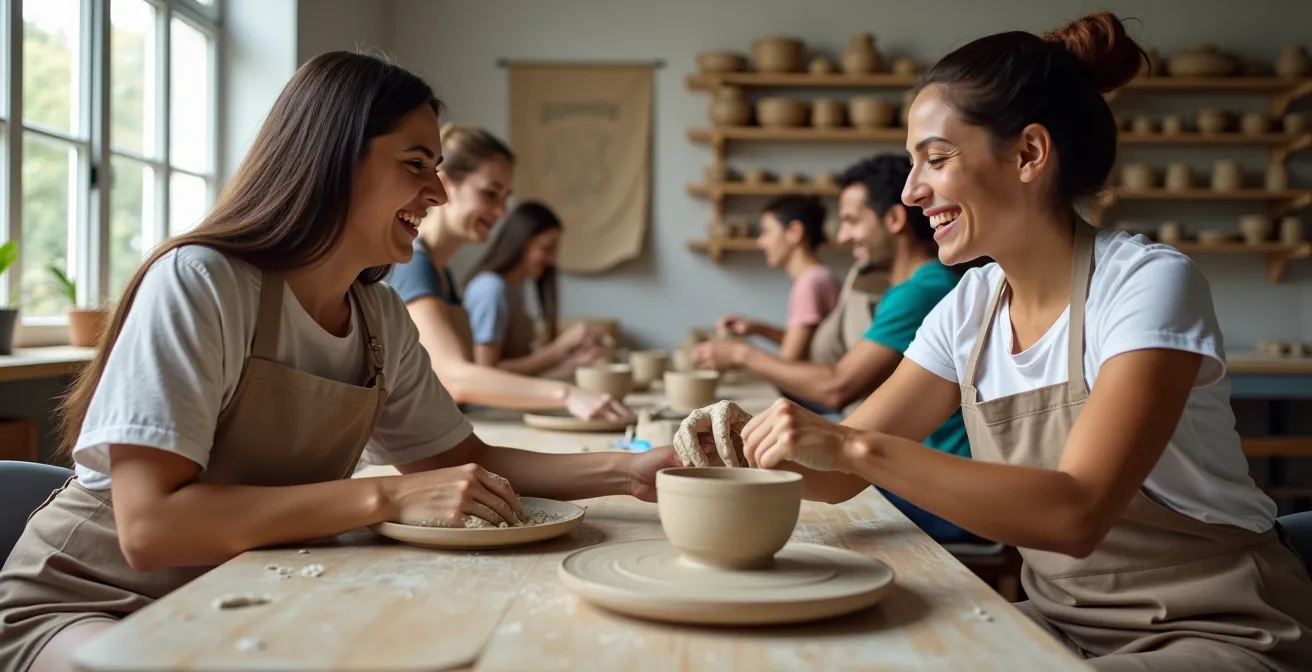
The key to authentic social connection isn’t small talk over dinner; it’s the shared vulnerability and collaborative creation found in a hands-on workshop.
- Working together on a tangible project like pottery creates a low-pressure environment where connections form naturally around a shared task.
- The physical, multi-sensory experience of an in-person class forges stronger memories and group synchronization than any virtual event or passive activity.
Recommendation: Skip the awkward dinner party and book a creative workshop to build relationships that are more meaningful, memorable, and authentic.
Another invitation to a dinner party lands in your inbox. The thought of making polite conversation for three hours, cycling through the same topics of work and weather, feels more draining than connecting. We’ve been told that sharing a meal is the cornerstone of socializing, but in a world of digital disconnection, these structured, formal gatherings often fail to build the genuine bonds we crave. We talk, but we don’t connect. We share a space, but not an experience.
The usual advice is to find common hobbies, maybe join a book club or a sports team. While these are valid options, they often miss a crucial ingredient for accelerated bonding. But what if the secret to forging real, lasting connections wasn’t in what you talk about, but in what you create together? What if the path to deeper relationships was paved not with words, but with clay, paint, or flour?
This article explores a more powerful alternative: the hands-on creative workshop. We will move beyond the superficial and dissect the psychological mechanics that make these experiences uniquely effective for building community. The core idea is simple but transformative: shared vulnerability and collaborative creation are the catalysts for authentic human connection. When you and another person struggle, learn, and succeed together in creating something tangible, you build a bond that polite conversation can’t replicate. This guide will provide you with the insights and practical strategies to leverage workshops as your new go-to for building a stronger, more vibrant social life.
In the sections that follow, we’ll explore everything from turning a pottery class into a networking opportunity to the vital differences between virtual and physical sessions, and even how to navigate the social anxiety of joining a new group alone. Get ready to discover how getting your hands dirty can build the cleanest, strongest connections.
Summary: The Art of Building Bonds Beyond the Dinner Table
- How to Turn a Pottery Class into a Low-Pressure Networking Event?
- Virtual Workshops vs. Studio Sessions: Is the Physical Experience Worth Double the Price?
- The Hidden Material Fees That Inflate Workshop Costs by 40%
- How to Secure a Spot in Popular Workshops Before They Sell Out in Minutes?
- Cultural Appreciation vs. Appropriation: How to Participate Respectfully?
- YouTube Tutorials vs. In-Person Classes: Which Accelerates Learning Faster?
- How to Use Local Art Classes to Learn a Language Faster Than Duolingo?
- How to Join a New Club Alone Without Having a Panic Attack?
How to Turn a Pottery Class into a Low-Pressure Networking Event?
The beauty of a workshop environment is that the activity itself becomes the social lubricant. Unlike a dinner party where conversation is the main event, a pottery class offers a shared focus that eliminates the pressure of direct, sustained eye contact and the need to constantly think of something clever to say. This creates a space for low-pressure interaction where connections can form organically. The goal isn’t to “network” in the traditional sense, but to build rapport through a shared, hands-on experience.
To maximize this, adopt a mindset of collaborative curiosity. Instead of focusing on your own project, look for opportunities to engage with others through the work itself. Simple actions can open doors to conversation. Arriving a few minutes early to help the instructor set up tools or asking a neighbor for their opinion on a glaze color are natural icebreakers. These small, task-oriented interactions build a foundation of familiarity without the formality of a business meeting.
Case Study: Breaking Down Silos with Clay
A tech startup was facing communication gaps between its design and development teams. They participated in a three-hour pottery workshop where cross-functional partners worked on shared projects. The result was a tangible shift in team dynamics. One developer noted that working on a creative task allowed them to see their colleagues’ strengths in a new light, breaking down the professional barriers that existed in the office. The collaborative creation fostered a sense of shared accomplishment and mutual respect that translated back to their professional roles.
The key is to use the environment to your advantage. Asking the instructor a question that invites group participation, like “Could you show that centering technique to all of us again?”, brings the group together. Partnering with someone during the glazing process involves collaborative decision-making, a simple but effective bonding exercise. Finally, suggesting a shared photo album for everyone’s finished pieces provides a natural reason to exchange contact information, turning a one-off class into a potential ongoing connection.
By focusing on the shared task of creation, you’re not just making a pot; you’re building a network of relationships grounded in a real, memorable experience.
Virtual Workshops vs. Studio Sessions: Is the Physical Experience Worth Double the Price?
In our increasingly digital world, the virtual workshop has become a convenient alternative. It’s often cheaper, requires no travel, and offers a lower social risk if you’re feeling anxious. But when the goal is genuine connection, is the convenience of a screen worth sacrificing the power of physical presence? The evidence suggests that for building deep bonds, the in-person studio session offers a return on investment that can’t be measured in dollars alone. The difference lies in the sensory richness and potential for group flow state synchronization.
A physical studio engages all your senses: the cool, damp feel of the clay, the earthy smell of the studio, the sound of the spinning wheel. This multi-sensory input is not just more enjoyable; it’s more memorable. Furthermore, research has demonstrated that hands-on artistic activities can significantly reduce levels of cortisol, the body’s stress hormone. This shared state of relaxed focus makes everyone more open and receptive to connection. A virtual class, confined to sight and sound, simply cannot replicate this profound physiological and psychological shift.
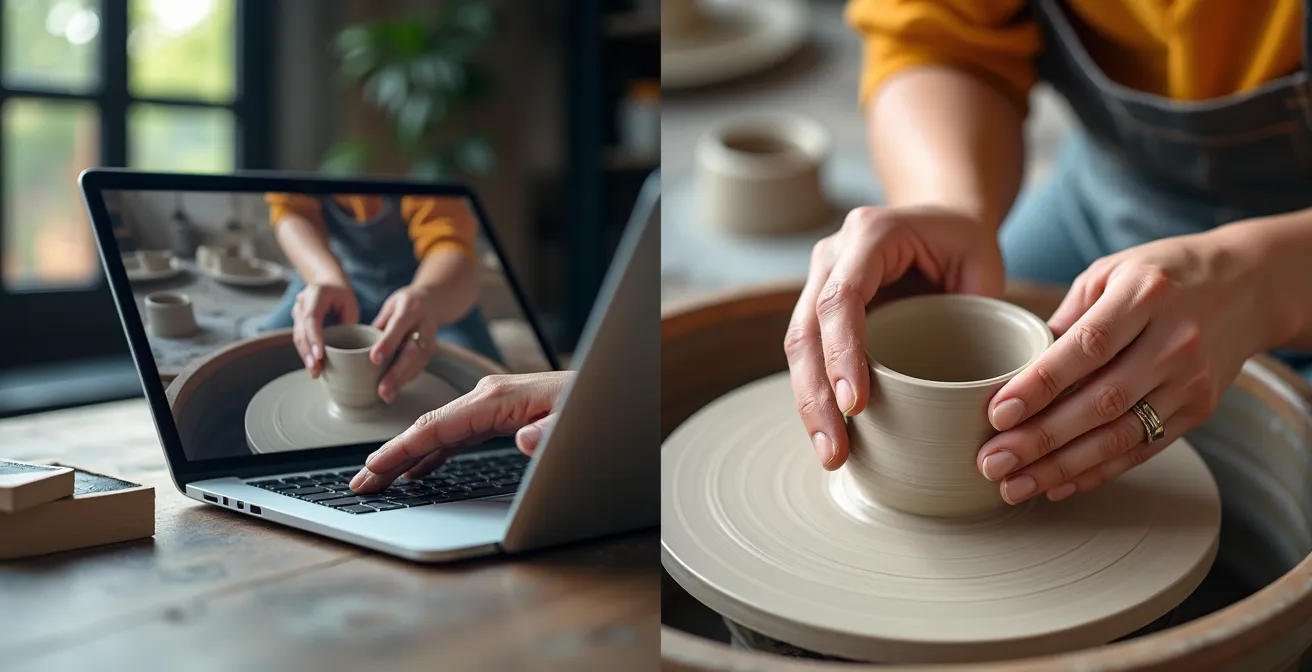
The physical space also allows for spontaneous, non-verbal communication that is lost online. A shared glance when a pot collapses, a collective laugh, or the simple act of passing a tool builds a subtle but powerful sense of togetherness. While virtual workshops are great for learning a technique, they fall short in fostering the environmental and sensory cohesion that turns a group of strangers into a temporary community.
The following table breaks down the core differences, making it clear where the true value of each format lies. As a recent comparative analysis highlights, the choice depends on whether your goal is simple skill acquisition or a deeper, more connected experience.
| Aspect | Virtual Workshop | Physical Studio |
|---|---|---|
| Cost | $30-50/person | $60-155/person |
| Social Risk | Low (easy to disengage) | High (requires vulnerability) |
| Sensory Experience | Visual only | Multi-sensory (touch, smell, sound) |
| Take-Home Object | Digital creation | Physical pottery piece |
| Group Flow State | Limited by tech barriers | Synchronized physical activity |
Ultimately, if your primary goal is to build strong social bonds, the investment in a physical workshop pays dividends in shared memories, sensory engagement, and the creation of a tangible memory anchor—a physical object that will forever remind you of the experience.
The Hidden Material Fees That Inflate Workshop Costs by 40%
You’ve found the perfect workshop, and the base price of $60 seems reasonable. But by the time you’re done, the final bill is closer to $100. This common scenario is due to a web of hidden fees for materials and services that aren’t always disclosed upfront. Understanding these potential extra charges is crucial for budgeting accurately and avoiding unpleasant surprises, ensuring your creative outing remains a positive experience from start to finish.
The most common additional costs are related to the clay itself, the glazes used for color, and the firing process that turns your soft creation into a permanent ceramic piece. Many studios include a base amount of clay but charge per kilogram for anything extra. Glazes can also be an add-on, with some studios charging per color. The firing fee is another major variable; the base price might only include the firing of one piece, with subsequent items incurring an extra charge. Some premium studios that charge around $155 per person often bundle everything for a more transparent, all-inclusive experience, but it’s never safe to assume.
Beyond the materials, logistical fees can also add up. Tool and apron rentals might seem minor, but they contribute to the total cost. More significantly, be aware of storage fees. Most studios have a limited window (often 2-4 weeks) for you to pick up your fired pieces. If you miss this window, you may be charged a weekly fee for storage, or your work could even be discarded. Being proactive and asking the right questions before you book is the best way to protect your budget and your artwork.
Your Pre-Booking Financial Checklist: 5 Questions to Ask
- Firing Fees: Does the base price include the firing of one or two pieces, and what is the cost for each additional item?
- Glaze Costs: Are a set of standard glazes included in the price, or do they cost extra per color or type?
- Clay Charges: Is there a per-kilogram charge for clay used beyond the initial amount provided for the class?
- Tool and Apron Policy: Are all necessary tools and a protective apron provided, or are these rented separately?
- Pickup and Storage Policy: What is the timeframe for picking up fired pieces, and is there a storage fee if that window is missed?
By clarifying these points beforehand, you can fully immerse yourself in the creative process without worrying about an inflated bill at the end, making the experience truly rewarding.
How to Secure a Spot in Popular Workshops Before They Sell Out in Minutes?
The most sought-after workshops, especially those led by well-known artists or held in boutique studios, can sell out almost instantly. This scarcity can be frustrating, but with the right strategy, you can significantly increase your chances of getting in. The key is to move beyond being a passive consumer and become a proactive member of the studio’s community. This involves getting on their radar before tickets even go on sale.
First, go beyond simply following their social media. Sign up for their email newsletter. Studios almost always give their newsletter subscribers early access or a direct heads-up before a public announcement. Set up a filter in your email client to ensure these newsletters land in your primary inbox and are marked as important. Second, engage with the studio online in a meaningful way. Comment on their posts, ask questions, and show genuine interest. This makes your name familiar to them. When it comes to booking, being a recognized name from a list of strangers can sometimes make a difference, especially if a waitlist spot opens up.
The most powerful, yet often overlooked, strategy is to organize a small group. Studios operate on tight margins, and guaranteed income is highly attractive. Instead of trying to snag a single spot, find two or three friends who are also interested.
The Small Group Booking Advantage
Many studios, like Sen by Prodigal which accommodates small groups, are far more flexible when approached with a guaranteed booking. Contacting a studio directly and saying, “I have a group of four people who want to take your next hand-building class,” is a compelling proposition. They may be willing to open up a special time slot for you that isn’t publicly available or give you first refusal on spots in their next scheduled workshop. This transforms you from a competitor fighting for a scarce resource into a valued client they want to accommodate.
This proactive, group-oriented approach not only helps you get into the class but also starts the community-building process before you even touch the clay.
Cultural Appreciation vs. Appropriation: How to Participate Respectfully?
Many art forms, from Japanese Kintsugi to Indigenous pottery techniques, are deeply rooted in specific cultural traditions. Participating in a workshop that teaches these arts can be a beautiful way to learn and connect with another culture. However, it’s crucial to approach these experiences with awareness and respect to ensure you are engaging in cultural appreciation, not appropriation. Appreciation honors the source culture, while appropriation trivializes or commodifies it without respect or context.
The first step is to do your homework on the studio and the instructor. An ethical instructor will be transparent about their connection to the tradition they are teaching. Look for those who openly share their training lineage, credit their mentors from the source culture, and integrate historical and cultural context into their lessons. A major red flag is a studio that uses sacred symbols purely for decoration or markets a class using cultural stereotypes without any deeper explanation of their significance.
During the workshop, your role is to be a respectful student. Listen with an open mind, not just to the techniques but to the stories and philosophies behind them. Ask thoughtful questions that show you are interested in the ‘why’ as well as the ‘how’. Avoid the impulse to “improve” or “modernize” a traditional technique without first understanding its original purpose and meaning. The goal is to learn from the tradition, not to claim it as your own or alter it for aesthetic purposes without understanding the implications.
Finally, consider the economic impact. Ethical studios often have relationships with the source communities. They might partner with cultural organizations, sponsor artists from those communities, or donate a portion of their proceeds from specific workshops. While not always a formal requirement, choosing a studio that demonstrates this kind of reciprocal relationship ensures that your participation contributes positively back to the culture you are learning from.
By approaching these workshops as a humble guest rather than a consumer, you can ensure your experience is one of genuine connection and mutual respect.
YouTube Tutorials vs. In-Person Classes: Which Accelerates Learning Faster?
YouTube is an incredible resource for learning almost anything, and pottery is no exception. You can find thousands of hours of tutorials on every technique imaginable, for free. However, when it comes to accelerating skill development and, more importantly, building bonds, the passive act of watching a video pales in comparison to the active, tactile feedback of an in-person class. The secret lies in the irreplaceable value of immediate, personalized guidance.
In a live class, an instructor can see your hand positioning, the pressure you’re applying, and the consistency of your clay. They can offer a small correction in real-time that saves you hours of frustration. This hands-on guidance is something a video cannot replicate. The learning process becomes a dialogue—a physical one between you, the instructor, and the clay. This dynamic, multi-sensory feedback loop dramatically shortens the learning curve. You learn through muscle memory and touch, not just by sight.
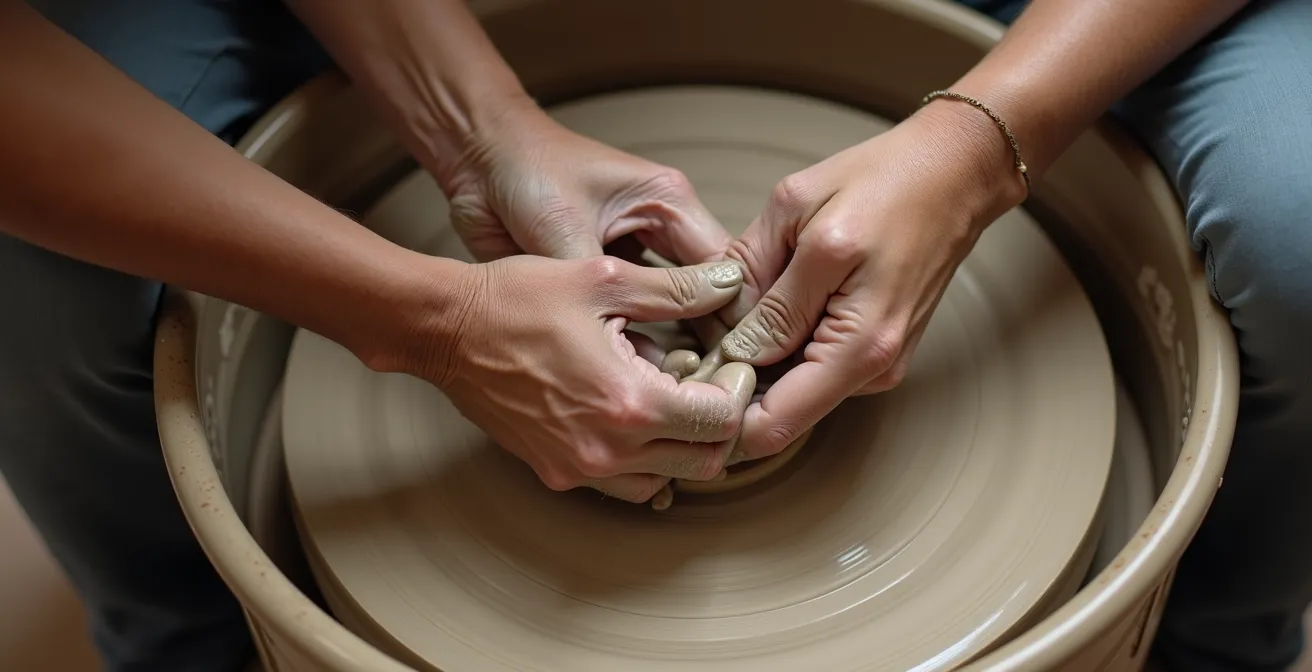
Furthermore, the group environment itself is a learning accelerator. You learn not only from the instructor but also from your peers. Watching someone else struggle with the same step you’re stuck on creates a powerful sense of “we’re in this together,” which is a core component of shared vulnerability. This collaborative atmosphere encourages questions and mutual support. In fact, some studies have shown that groups focusing on team building can see significant increases in overall performance, a principle that applies just as much to learning a new skill.
The Power of Tactile Team Building
Pottery classes designed for team building demonstrate this principle perfectly. Participants work together, sharing tools and techniques, while instructors provide step-by-step physical demonstrations. The tactile nature of the work requires participants to learn through touch and immediate feedback. The 2-3 hour session produces a tangible result that each person can take home, serving as a lasting reminder of their collaborative learning success.
While YouTube is a great supplement, the rich, interactive environment of a live class is where learning—and connection—truly flourishes.
How to Use Local Art Classes to Learn a Language Faster Than Duolingo?
Language learning apps like Duolingo are excellent for building vocabulary and understanding grammar rules. But fluency isn’t just about knowing words; it’s about using them in a natural, contextual way. This is where an unexpected tool can dramatically accelerate your progress: a local art class conducted in your target language. By immersing yourself in a task-oriented environment, you are forced to use the language for a real purpose, moving beyond rote memorization and into practical application.
The key is to choose a workshop that requires a high level of interaction and collaboration. A class where you are mostly listening to an instructor and working individually, like a traditional painting class, offers limited opportunities for practice. The goal is to find an activity where communication is essential to the creative process. This turns every step of the workshop into a practical language lesson.
Think about the language required in different settings. You need to ask for tools, describe a problem with your project, understand instructions, and coordinate with your neighbors. This is the real-world, functional language that apps often struggle to teach. The context of the shared task provides a powerful memory aid. You’ll forever associate the word for “kiln” or “glaze” with the physical object and the experience of using it.
To maximize this strategy, select your workshop based on its potential for interaction. Here’s a quick guide to how different activities stack up:
- High Interaction: Collaborative cooking classes are fantastic, as they involve constant discussion of recipes, requests for ingredients, and teamwork. Mural painting workshops also rank high, requiring coordination on colors and design.
- Medium Interaction: Group pottery classes offer good opportunities for sharing tools and asking for help with techniques. Dance workshops involve following verbal instructions and communicating with a partner.
- Low Interaction: Individual painting or drawing classes, where the focus is on listening to instructor demonstrations, provide the fewest chances for conversational practice.
In this setting, you’re not just a student memorizing verbs; you’re an active participant using language to create something real, which is the fastest path to genuine fluency.
Key Takeaways
- True connection is built through shared activities and vulnerability, not just conversation.
- In-person workshops offer a richer, multi-sensory experience that is more effective for bonding than virtual alternatives.
- Being proactive by asking questions about costs and booking as a small group can overcome the main barriers to participation.
How to Join a New Club Alone Without Having a Panic Attack?
The thought of walking into a room full of strangers can be daunting, even for the most extroverted person. For those with social anxiety, it can feel paralyzing. Yet, the desire for connection often pushes us to try. The good news is that a structured environment like a workshop is one of the safest and easiest places to do this. The secret is to give yourself a role and a purpose from the moment you walk in, shifting your focus from your anxiety to a simple, manageable task.
One of the most effective strategies is to arrive 10-15 minutes early. This accomplishes two things: it prevents you from walking into an already-formed crowd, and it gives you an opportunity to become part of the setup. Find the instructor and ask a simple question: “Is there anything I can help with?” This could mean setting out materials, arranging chairs, or just filling water cups. This small act immediately gives you a reason to be there and a task to focus your hands and mind on.
This “helper” role is a powerful social hack. The instructor will likely see you as proactive and may even introduce you to other early arrivals, instantly giving you a soft entry into a conversation. It transforms you from an outsider looking in to an insider contributing to the event. This strategy is beautifully illustrated by the experience of a once-shy participant:
I arrived 15 minutes early to help set up chairs and materials. This gave me something to do with my hands and a reason to be there. The instructor introduced me to other early arrivals as their ‘helper,’ which instantly gave me a role. By the time the class started, I already knew three people’s names and felt like I belonged.
– Solo Participant Success Story, teambuilding.com
Other strategies can also reduce pre-class anxiety. Choosing a hand-building pottery class over wheel-throwing is often less intimidating for beginners. Opting for smaller group sizes (5-8 people) creates a more intimate and less overwhelming setting. You can even contact the studio ahead of time to mention you’re coming alone; they are often happy to help facilitate introductions. The goal is to set yourself up for success by choosing the right environment and giving yourself a simple job to do.
Remember, everyone in that room is there for the same reason: to learn something new and connect. Your presence is not an intrusion; it’s a welcome addition to the community.
Frequently Asked Questions on Why Hands-On Workshops Build Stronger Bonds Than Dinner Parties?
How can I verify if a workshop instructor has authentic connections to the cultural tradition they’re teaching?
Look for instructors who openly share their training lineage, mention their teachers or mentors from the source culture, and provide historical context during classes. Legitimate instructors welcome questions about their background and learning journey.
What portion of workshop fees should go back to the source community?
While there’s no fixed percentage, ethical studios often partner with cultural organizations, sponsor artists from source communities, or donate 10-20% of proceeds from culturally-specific workshops to relevant nonprofits.
How do I know if a studio is using sacred symbols inappropriately?
Red flags include using religious or ceremonial symbols as mere decoration, marketing with cultural stereotypes, or teaching techniques without explaining their cultural significance and proper context.