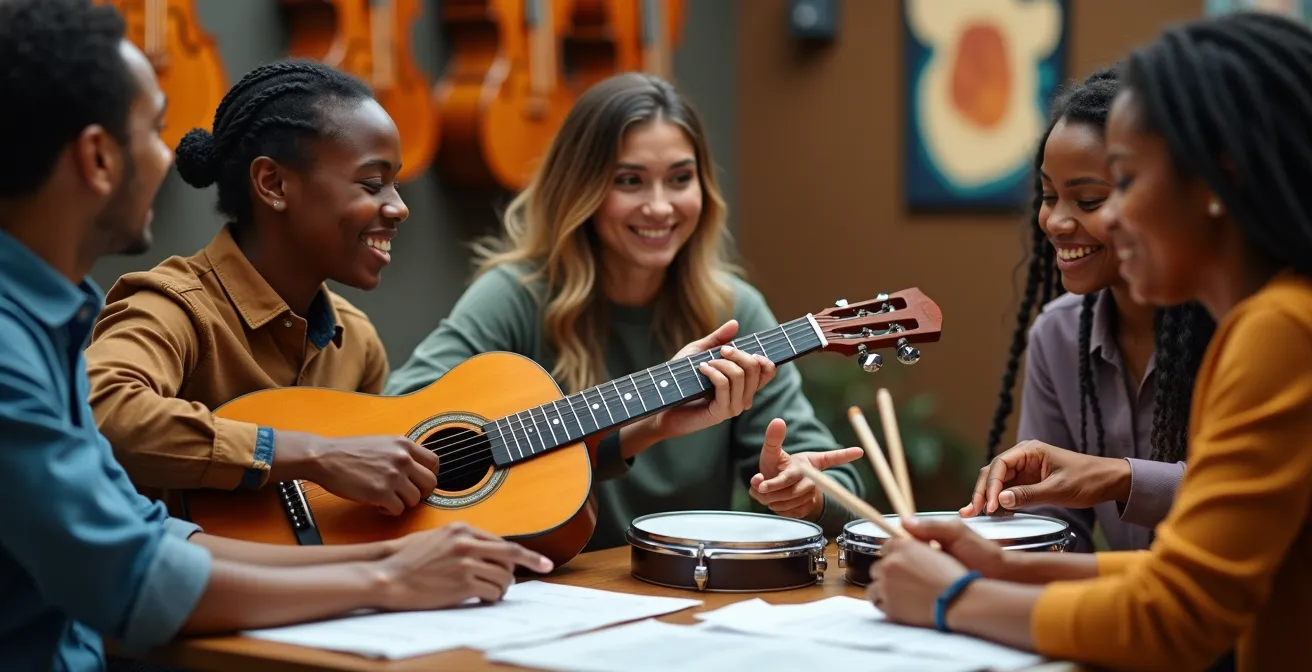
Political agreements often fail to change hearts and minds. This article argues that genuine prejudice reduction stems not from intellectual debate, but from embodied cultural experiences—like music, food, and art—that create neurological empathy and rewrite our subconscious perception of ‘the other’.
For decades, we have placed our faith in summits, treaties, and political discourse to bridge the divides between nations. We assume that rational argument and top-down policy are the most effective tools for fostering understanding. Yet, despite these efforts, prejudice and stereotypes persist, often immune to the logic of diplomacy. This raises a fundamental question for any globally-minded individual: if politics isn’t the ultimate answer, what is?
The common response points towards travel and exchange, but often relies on vague notions of “broadening horizons.” The truth is far more profound and scientifically grounded. The antidote to prejudice is not found in conference halls, but in the shared sensory experiences of daily life: the rhythm of a shared song, the taste of a home-cooked meal, the collaborative struggle of creating a piece of art. This is the realm of sensory diplomacy, a bottom-up approach that bypasses our brain’s fortified biases.
This article moves beyond the platitudes to explore the sociological and neurological mechanisms at play. We will investigate how shared cultural practices don’t just change our minds, but physically rewire our capacity for empathy. This is not about passive observation; it is about active, embodied participation. By understanding these principles, you can transform a simple trip abroad into a profound, perspective-altering experience that achieves what political rhetoric often cannot.
This guide will deconstruct the process, from the neurological impact of shared music to the practical steps for planning a truly immersive journey. Explore the sections below to understand the science and strategy behind using culture as the ultimate tool for connection.
Summary: Why Cultural Exchange Forges Deeper Bonds Than Diplomacy
- How Learning a Folk Song Rewires Your Brain’s Perception of “The Other”?
- How to Host an Exchange Student Without Disrupting Your Family Routine?
- Melting Pot vs. Salad Bowl: Which Integration Model Preserves Identity?
- The “U-Curve” of Adjustment: Why You Hate Your New Country After 3 Months?
- How to Use Local Art Classes to Learn a Language Faster Than Duolingo?
- The Etiquette Mistake That Alienates Locals in Japan and How to Avoid It
- The “Expat Blues” That Hit at Month 3 and How to Survive It
- How to Plan an Immersive Trip That Changes Your Perspective Forever?
How Learning a Folk Song Rewires Your Brain’s Perception of “The Other”?
Political negotiation operates on the level of conscious, rational thought—a domain where our deepest prejudices are often heavily defended. Cultural exchange, particularly through music, performs an elegant bypass of these defenses. It targets a more fundamental aspect of our humanity: our neurological capacity for connection. The power of learning a simple folk song lies in its ability to induce a state of shared experience that transcends language and logic. This isn’t poetry; it’s neuroscience. It is a phenomenon we can call neurological empathy.
When we engage in synchronized activities like singing or playing music together, our brains react in a remarkable way. As researchers have noted, this shared rhythm can lead to a literal harmonizing of minds. This is the essence of what transforms an outsider, “the other,” into a collaborator. As experts in the field have observed:
When people sing or listen to music together, their brainwaves can synchronize, creating a subconscious bond that bypasses rational, often prejudiced, thought processes.
– Müller & Lindenberger, Frontiers in Human Neuroscience
This synchronization fosters a sense of unity that is felt before it is thought. The shared vulnerability of learning a melody, the collective joy of a chorus, these are acts of sensory diplomacy. They create a temporary, shared identity that is powerful enough to chip away at long-held biases. This isn’t about agreeing on policy; it’s about feeling the same pulse. This shared somatic state builds a foundation of trust and connection that no political argument can replicate, demonstrating that even a cross-cultural musical education programme can produce measurable reductions in prejudice.
Ultimately, a song doesn’t convince you that someone is worthy of respect; it makes you feel a connection to them, rendering the very question of their worthiness irrelevant.
How to Host an Exchange Student Without Disrupting Your Family Routine?
The most profound cultural integration doesn’t happen during special occasions or planned “cultural nights.” It occurs within the beautiful mundanity of everyday life. The goal of hosting an exchange student is not to become a tour guide, but to temporarily expand the definition of family. The fear that this will disrupt your routine is valid, but it stems from the misconception that you must entertain a guest. The reality is that you are integrating a new member. This requires a shift from a mindset of hospitality to one of shared responsibility and routine.
The kitchen, the shared calendar, and the weekly chores list become the most powerful tools of diplomacy. This is where “the other” ceases to be an abstract concept and becomes the person who helps you chop onions or reminds you to take out the recycling. These small, repeated acts of collaboration build a fabric of trust and understanding. They are the essence of embodied cognition, where cultural learning is absorbed through doing, not just observing. The image of a family and a student cooking together is not just a pleasant scene; it’s a depiction of soft power in action.

As the image suggests, the magic lies in the seamless flow of shared activity. True integration is achieved when the student’s presence feels not like an addition that requires management, but a natural part of the household’s rhythm. It is in these unglamorous, everyday moments that the deepest bonds are formed, quietly dismantling stereotypes one shared task at a time.
Action Plan for Fostering Integration Through Daily Rituals
- Cultural Meal Prep: Establish sessions where the student teaches one dish while learning your family’s routine recipes, making the kitchen a two-way exchange.
- Shared Calendar: Create a unified calendar that includes both cultures’ holidays and celebrations as equal family events, not just acknowledging the student’s traditions but celebrating them.
- Integrated Responsibilities: Assign the student regular household chores alongside family members, positioning them as a contributing member, not a guest.
- Cultural Swap Evenings: Institute regular, informal evenings where family members and the student take turns sharing stories, games, or traditions from their backgrounds.
- Routine Buddy System: Pair the student with different family members for mundane tasks like grocery shopping or walking the dog, fostering one-on-one connections.
By focusing on integration into the mundane, you don’t just host a student; you create an environment where cultural barriers dissolve organically, without force or fanfare.
Melting Pot vs. Salad Bowl: Which Integration Model Preserves Identity?
For generations, the debate on cultural integration has been dominated by two metaphors: the “melting pot” and the “salad bowl.” The melting pot model champions assimilation, where individual identities are dissolved into a new, homogenous whole. The salad bowl, or multiculturalism, argues for the coexistence of distinct cultural elements, each retaining its original character. While the latter is an improvement, both models are ultimately static. They fail to capture the dynamic, generative potential of cultural interaction. Politics often gets stuck in this binary choice, but true cultural exchange points to a third, more vibrant model: the Cultural Kaleidoscope.
In a kaleidoscope, distinct elements (the colored glass) do not melt away, nor do they simply sit side-by-side. Instead, they interact to create new, beautiful, and ever-changing patterns. This is the essence of profound cultural exchange. It is not about assimilation or mere tolerance; it is about creative collaboration and mutual influence. Your identity is not erased, nor is it preserved in amber. It is enriched, expanded, and evolved through interaction with another. As research from Stanford University confirms, the impact of such interaction is significant and lasting. As lead author Tiffany Brannon notes from her study, even a brief opportunity to take part in another group’s culture can improve attitudes months later.
This kaleidoscopic model suggests that the goal of exchange is not just understanding, but creation. The following table contrasts these three models, highlighting the superior potential of an interactive approach.
| Aspect | Melting Pot | Salad Bowl | Cultural Kaleidoscope (Proposed) |
|---|---|---|---|
| Identity Preservation | Low – assimilation required | High – distinct elements remain | Dynamic – identities interact & evolve |
| Cultural Expression | Homogenized | Separate but coexisting | Interactive & generative |
| Power Dynamic | Dominant culture absorbs | Parallel existence | Mutual influence & creation |
| Innovation Potential | Limited | Moderate | High – new patterns emerge |
The most transformative exchange programs are those that don’t ask you to shed your identity or simply display it, but invite you to bring it into contact with another to see what new patterns emerge.
The “U-Curve” of Adjustment: Why You Hate Your New Country After 3 Months?
Every student embarking on a journey abroad pictures a linear ascent into cultural fluency and happiness. The reality is far more complex and emotionally turbulent. Sociologists have long described this process using the “U-Curve” of adjustment, a model that is both a warning and a source of comfort. It normalizes the inevitable crash that follows the initial excitement. Understanding this curve is crucial, as the moments of deepest frustration are also the moments of greatest potential growth. The process is not a failure; it is a feature of deep immersion.
The U-Curve model describes four distinct phases of adjustment: the initial “Honeymoon” phase (1-2 months) of excitement and novelty; followed by the “Culture Shock” or “Crisis” phase (2-6 months), where frustration, loneliness, and even hostility towards the host culture can set in. This is the bottom of the “U.” This trough is then followed by a gradual “Recovery” and, finally, “Mastery.” More nuanced research suggests a “W-Curve,” acknowledging that adjustment happens in waves and that even after recovery, new challenges can trigger another dip. This is the stage of productive discomfort, where your old certainties are stripped away, forcing you to adapt and build genuine resilience.

The person in the cafe, caught between their inner world and the foreign street outside, perfectly embodies this trough. It is a period of intense introspection and challenge. Political delegates are often shielded from this phase, operating in a bubble of curated experiences. The exchange student, however, lives it fully. It is in this uncomfortable space—navigating confusing social cues, missing home, feeling isolated—that true, lasting perspective shift occurs. You are not just learning about a culture; you are learning how to exist within it, and within yourself, when all familiar supports are gone.
Instead of fearing the bottom of the curve, recognize it as the necessary crucible where surface-level tourism is burned away, leaving behind authentic understanding.
How to Use Local Art Classes to Learn a Language Faster Than Duolingo?
Classroom-based language learning and apps like Duolingo focus on vocabulary and grammar in a vacuum. They treat language as an abstract system of rules to be memorized. However, an art class—be it pottery, cooking, or dance—approaches language from a completely different, and arguably more effective, angle: embodied language learning. In this context, language is not the subject; it is the tool. Vocabulary is acquired not through flashcards, but through physical action and immediate, tangible necessity.
When a pottery instructor says “knead the clay,” you don’t just memorize the verb; you perform the action. The word becomes linked in your brain to a physical sensation, a motor memory. This is sensorimotor coupling, a powerful learning mechanism that digital apps cannot replicate. You are learning with your whole body, not just your prefrontal cortex. This process also dramatically lowers the anxiety associated with making mistakes. In an art class, errors are part of the creative process. A misshapen pot or a misstep in a dance is not a failure but an iteration, which destigmatizes linguistic errors and encourages fearless communication.
This shared creative struggle fosters a unique social bond. As researchers point out, these activities are inherently social and emotional. In the words of Konrad et al., “Music is a pleasurable experience linked to emotional sharing and promotes social functions such as communication, cooperation, and social attachment.” This insight extends to all collaborative arts. Joining a local choir or a painting workshop provides a natural context for peer-to-peer conversation and correction, rooted in a shared goal. You learn the colloquialisms, the jokes, and the flow of natural conversation in a way that a structured lesson can never teach. You are not just learning a language; you are learning a culture’s way of being, creating, and connecting.
To learn a language quickly, stop studying it and start *using* it to create something beautiful, or even just something tangible, with other people.
The Etiquette Mistake That Alienates Locals in Japan and How to Avoid It
Many travelers approach foreign etiquette like a political briefing, memorizing a list of dos and don’ts: don’t tip, bow correctly, pass items with two hands. While well-intentioned, this rule-based approach often misses the point and can feel robotic or inauthentic to locals. In a culture like Japan’s, the biggest mistake is not breaking a specific rule, but failing to understand the underlying principle that connects them all: the pursuit of *wa* (和), or social harmony. True cultural fluency comes not from memorizing rules, but from internalizing the aesthetic and philosophical principles behind them, treating social interaction as a form of art.
This is the difference between following a law and appreciating a poem. Politics gives you the law; culture gives you the poem. For instance, the complex rules around gift-giving or the seating arrangements in a meeting are not arbitrary. They are part of a delicate, unspoken performance—a choreography of social harmony designed to show respect, manage status, and maintain smooth relationships. The goal is to develop *kuuki wo yomu*, the ability to “read the air.” This is an intuitive, non-verbal understanding of a social situation, akin to a musician feeling the rhythm of an ensemble or an artist sensing the balance of a composition.
A diplomat might know the rule not to stick chopsticks upright in a bowl of rice, but a culturally fluent person understands *why*: because it mimics a funeral rite, and doing so introduces the disharmonious concept of death into a communal meal. The first is rule-following; the second is empathetic understanding. By focusing on the “why”—the aesthetic and relational principles—you equip yourself to navigate new and unforeseen situations with grace, rather than needing a specific rule for every possible scenario. This principle-based interaction is flexible, authentic, and far more effective at building rapport than the rigid adherence to a memorized checklist.
Stop trying to be correct, and start trying to be harmonious. In that shift lies the key to genuine connection and the avoidance of deep, unintentional alienation.
The “Expat Blues” That Hit at Month 3 and How to Survive It
Right around the three-month mark, the initial thrill of being abroad often evaporates, replaced by a pervasive sense of frustration and isolation known as the “Expat Blues.” This is the heart of the Culture Shock phase. The charming quirks of the local culture now seem like insurmountable annoyances. Simple tasks become exhausting, and a deep longing for the familiar sets in. This experience is poignantly captured by the raw honesty of those who have lived it. One person, reflecting on their own adjustment, shared, “Wow, I am in the hostility phase for 5 1/2 months now. Honeymoon was over after two weeks.” This sentiment is a near-universal part of the deep immersion journey.
Surviving, and ultimately thriving, during this period requires a strategic shift away from passive observation and towards active, chosen engagement. It is precisely when you feel most like retreating that you must push yourself to connect. However, the nature of this connection matters. Forced, awkward social events are unlikely to help. The key, as research suggests, is engaging in collaborative activities that incorporate elements of the host culture, especially when you feel a sense of agency or choice in the matter.
A study published in *Psychological Science* found that participants showed measurably less implicit prejudice after working on a group activity that incorporated another culture’s elements, but critically, only when they felt they had freely chosen to participate. This is a powerful insight for overcoming the Expat Blues. Instead of waiting for an invitation, seek out a local pottery class, a community garden, a volunteer group, or a sports club. Choose something that genuinely interests you. This sense of autonomy and shared purpose provides an anchor in the turbulent sea of culture shock. It reframes your experience from one of passive suffering to one of active creation and connection.
The cure for the Expat Blues is not to hide from the foreign culture, but to find a small, meaningful corner of it where you can freely choose to be a creator, not just an observer.
Key Takeaways
- True prejudice reduction bypasses rational thought by creating subconscious, sensory bonds through shared activities like music and food.
- The “trough” of culture shock, while difficult, is a necessary and productive phase where the most profound personal growth and adaptation occur.
- The most transformative cultural immersion comes from active, project-based engagement, shifting the traveler from a passive consumer to an active co-creator.
How to Plan an Immersive Trip That Changes Your Perspective Forever?
A trip that changes your perspective is not planned like a vacation; it is designed like a research project. The conventional tourist itinerary, a checklist of sights to be seen and photos to be taken, encourages passive consumption. It keeps you firmly on the outside, looking in. A truly immersive journey, however, requires a different framework: project-based immersion. This approach provides a purpose, a structure for interaction, and a reason to move beyond the tourist bubble. It transforms you from a spectator into a participant.
The first step is to define a creative or learning project before you even book your flight. This project should be something that genuinely interests you and necessitates interaction with local people and environments. It could be a photo essay on local market vendors, a quest to learn and record three regional folk songs, or a project to create a recipe book based on dishes taught by local families. This goal becomes your compass, guiding your activities and forcing you into situations of productive discomfort where real learning happens. You’re no longer just “visiting”; you are there to accomplish something meaningful.
This framework is not just a philosophical exercise; its effectiveness is backed by robust data. It is a real-world application of the principles that reduce intergroup prejudice. A powerful meta-analysis covering over 24,000 participants confirmed that well-designed prejudice reduction interventions are effective at improving attitudes in real-world settings, and that these effects endure over time. Your personal project becomes your own, self-directed intervention. By planning your trip around a project, you create the very conditions—contact, collaboration, shared goals—that are proven to break down barriers and foster genuine understanding.
- Define a Creative Project: Before departure, choose a specific, tangible project, such as a photo essay on local street art, learning folk songs, or creating a family recipe book.
- Seek Local Participation: Contact local art centers, community workshops, or associations to participate in ongoing activities rather than dedicated tourist programs.
- Schedule Productive Discomfort: Plan at least one activity daily that requires meaningful interaction in the local language or forces you to navigate local customs without a guide.
- Create Accountability: Commit to documenting your project and sharing the results (a blog, a small exhibition, a presentation) with both your home and host communities upon return.
- Build in Reflection: Dedicate 30 minutes each day to journaling about moments of connection, confusion, and insight, turning experiences into lasting lessons.
Stop planning to see things and start planning to do things. Your perspective—and the world’s—depends on these small but powerful acts of creative, sensory diplomacy.
Frequently Asked Questions on Why Cultural Exchange Programs Reduce Prejudice More Effectively Than Politics?
Why is understanding the ‘why’ behind etiquette rules more important than memorizing the rules themselves?
Cultural etiquette represents the ‘choreography of social harmony’ deeply linked to aesthetic principles like ‘wa’ (和). Understanding the reasoning – such as how certain gestures connect to funeral rites or respect for elders – builds cultural empathy that political negotiation rarely achieves.
What is ‘kuuki wo yomu’ and why is it crucial for cultural integration?
‘Kuuki wo yomu’ means ‘reading the air’ – an intuitive, non-verbal understanding of social situations. It’s honed by observing cultural interactions, much like an art connoisseur learns to ‘read’ a painting, and is invaluable for diplomacy yet impossible to learn from political briefs.
How does principle-based interaction differ from rule-based interaction?
Politics tells you what you can and can’t do through rules. Cultural etiquette involves internalizing underlying principles of respect and aesthetics, allowing you to navigate new situations gracefully without needing a rulebook for every scenario.