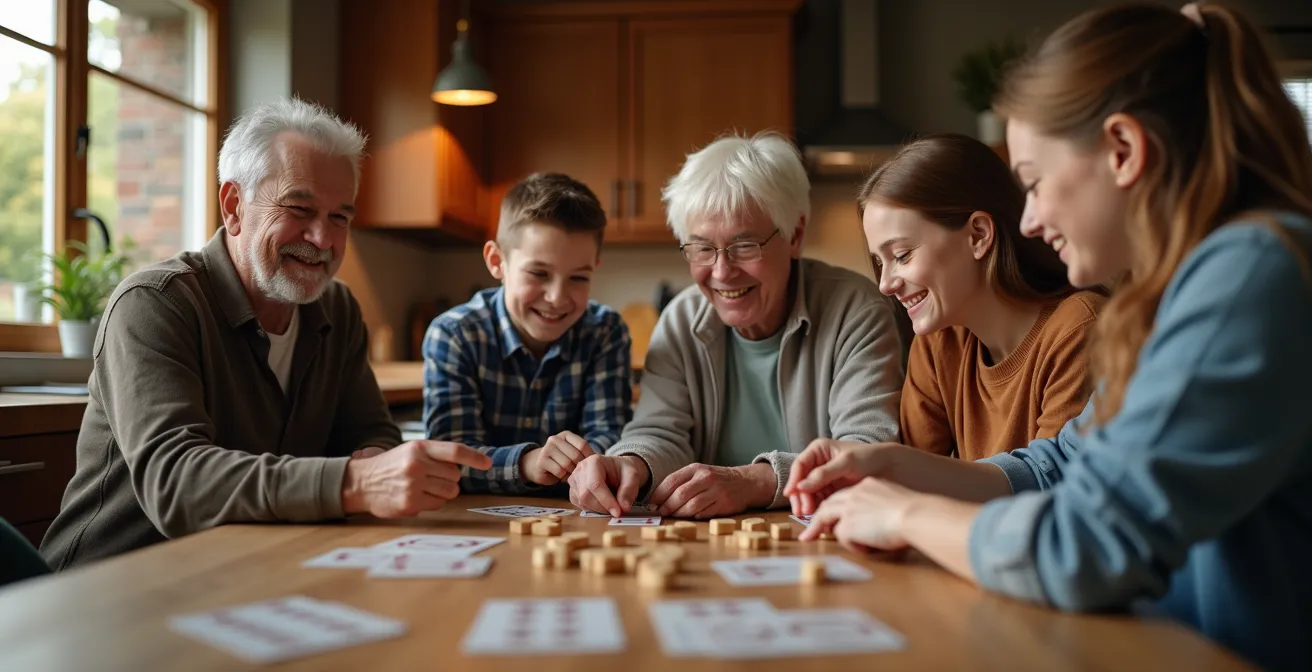
The secret to a peaceful family game night isn’t just avoiding competition; it’s actively practicing collaboration.
- Cooperative games shift the family dynamic from a “me vs. you” battle to an “us vs. the problem” team effort.
- They create a safe space to develop real-world skills like negotiation, empathetic listening, and shared problem-solving.
Recommendation: Reframe playtime as a deliberate training ground for building a more resilient and connected family unit.
Many parents dream of a wholesome family game night, only to have it descend into sibling squabbles, accusations of cheating, and tears of frustration. The common advice is often to “find a game everyone likes” or simply to avoid competitive activities altogether. While well-intentioned, this advice misses a fundamental opportunity. The goal shouldn’t just be to prevent conflict, but to actively build the skills that manage it. It’s easy to see competition as the enemy of harmony, but this view is incomplete.
What if we reframed game night not as a contest of winners and losers, but as a practical, low-stakes training ground for family teamwork? This is where the power of cooperative games truly shines. They aren’t merely a “nicer” alternative; they are a structured environment designed to foster a collaborative mindset. These games provide a unique space to practice the very skills—communication, shared strategy, and collective problem-solving—that are essential for a harmonious family life outside of the game.
This article will explore how cooperative play serves as a powerful tool for family bonding. We’ll examine how to engage even screen-focused teenagers, how to choose games that captivate everyone, and how the skills learned around the game table translate into reduced stress and better leadership abilities in the real world. By shifting the focus from individual victory to collective success, you can transform game night into a cornerstone of your family’s relational strength.
Summary: How Cooperative Play Builds a Stronger, More Harmonious Family
- How to Host a Game Night That Gets Teenagers Off Their Phones?
- Board Games vs. Video Games: Which Develops Better Strategic Thinking in Kids?
- The Mistake of Choosing Games That Bore the Parents or Frustrate the Kids
- How to Turn Weekend Cleaning into a Competitive Game Everyone Enjoys?
- Why Adults Who Play Games Are 20% Less Stressed at Work?
- Chess vs. Go: Which Game Offers a Steeper Cognitive Challenge?
- How to Prioritize Your TV’s Traffic on Your Router for Lag-Free 4K?
- Why Chess Players Make Better CEOs Than MBA Graduates?
How to Host a Game Night That Gets Teenagers Off Their Phones?
The magnetic pull of a smartphone screen can feel like an unbeatable opponent in the quest for family connection. For teenagers, the digital world offers constant novelty, social connection, and serialized storytelling that a simple board game often can’t match. The key isn’t to ban phones, but to offer something more compelling. The solution lies in shifting from simple, repetitive games to immersive, narrative-driven cooperative experiences. These games create a sense of investment and a “fear of missing out” on the next part of the story, a feeling they are very familiar with from their favorite streaming shows.
As The Tabletop Family found, story-rich games like Stuffed Fables or The Adventures of Robin Hood are highly effective because they create an ongoing campaign with meaningful consequences. Each session builds on the last, turning game night into a shared episodic adventure. Granting teenagers autonomy is also crucial. By appointing them the “Game Night Curator,” you empower them to research and choose the game, transforming them from a reluctant participant into an engaged host. This sense of ownership is a powerful motivator.
Starting with a familiar format can also ease the transition. If your teens enjoy cooperative video games like Overcooked, beginning there and then moving to a tabletop equivalent can bridge the gap. The goal is to build a habit around shared goals and collective storytelling, making the game night an event they anticipate rather than endure.
Your Action Plan: Engaging Your Teen in Game Night
- Let them choose: Grant your teenager the role of “Game Night Curator” to research and select the game, increasing their investment.
- Start digitally: Begin with familiar digital co-op games before introducing tabletop versions with similar mechanics.
- Pick a narrative: Select campaign-style games with ongoing storylines that build anticipation for the next session.
- Set meta-goals: Introduce collective scoring or team achievements that exist beyond simply winning or losing the game.
- Be consistent: Schedule regular, predictable sessions to make cooperative gaming a family habit.
Ultimately, by making the shared experience more rewarding than their solo screen time, you create a new, positive family ritual.
Board Games vs. Video Games: Which Develops Better Strategic Thinking in Kids?
The debate between board games and video games often centers on the vague notion of “screen time.” However, a more constructive question is: what kinds of strategic skills do we want our children to develop? While many video games excel at honing reflexes and rapid decision-making, cooperative board games are uniquely positioned to build a different, arguably more valuable, set of life skills. They are a training ground for the strategic skills of collaboration.
As Co-op Board Games Research highlights in its analysis, “Cooperative games develop a unique and arguably more valuable set of skills: negotiation, empathetic listening, and consensus-building.” These are not strategies for defeating an opponent, but for lifting up a team. While a competitive game teaches a child to optimize their own moves, often in secret, a cooperative game forces them to articulate their strategy, listen to differing opinions, and work toward a group consensus. This shift is fundamental. A 2024 study examining play patterns confirms that reducing passive screen time can increase engagement in activities requiring this kind of deeper strategic thought.
This distinction becomes clear when comparing the thinking processes involved. Competitive games often promote zero-sum calculations, where one person’s gain is another’s loss. Cooperative games, by contrast, teach systems thinking—the ability to see how one’s actions impact the entire group and the overall outcome. This fosters a mindset of shared responsibility and collective problem-solving, skills directly applicable to family dynamics and future professional life.
This table breaks down the different strategic skills nurtured by each type of game, showing how cooperative play focuses on building consensus rather than individual dominance.
| Skill Type | Cooperative Games | Competitive Games |
|---|---|---|
| Decision Making | Collaborative consensus-building | Individual optimization |
| Problem Solving | Systems thinking approach | Zero-sum calculations |
| Social Intelligence | Managing group dynamics | Reading opponents |
| Communication | Explicit strategy articulation | Information hiding |
The choice is not about which is “better” in a vacuum, but about which set of strategic abilities you wish to cultivate for a more collaborative and empathetic family life.
The Mistake of Choosing Games That Bore the Parents or Frustrate the Kids
One of the fastest ways to kill a family game night is a mismatch in engagement. This happens when a game is either too simple for adults, leading to boredom and disinterest, or too complex for children, causing frustration and meltdowns. The common mistake is choosing a game that aims for a “one-size-fits-all” level of complexity, which often satisfies no one. The solution is to embrace the concept of asymmetric gameplay, where players have different roles or abilities but work toward the same goal.
This approach allows each family member to contribute meaningfully at their own skill level. A perfect example is the cooperative game Flash Point: Fire Rescue. In this game, adults can take on specialist roles with complex actions, like the Paramedic or Hazmat Technician, which require strategic planning. Meanwhile, younger children can play as the CAFS Firefighter, handling the more straightforward but equally vital task of putting out fires. Everyone is essential, engaged, and feels a sense of accomplishment.
This principle of differentiated but unified purpose is the cornerstone of a successful multi-generational game night. It ensures that no one is just a spectator or, worse, a liability. Instead, the game’s design itself teaches the family how to leverage each other’s unique strengths.
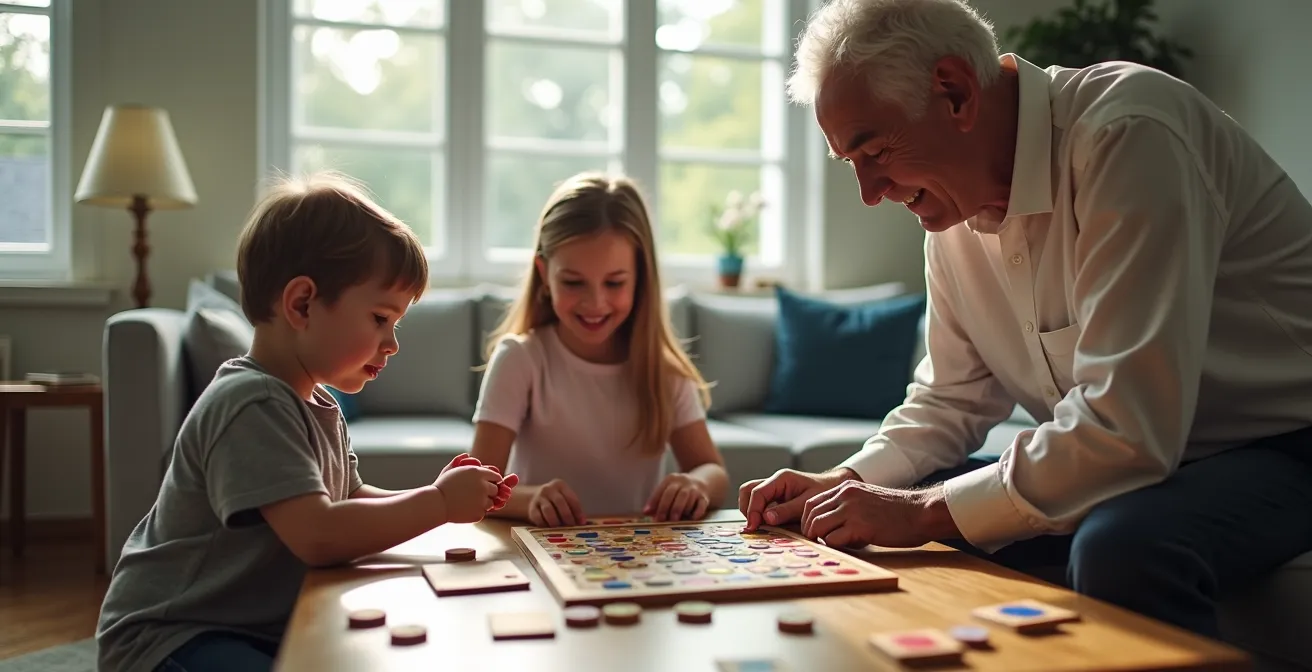
As the image above illustrates, true family engagement isn’t about everyone doing the same thing. It’s about finding a shared activity where each person, from the youngest child to the oldest grandparent, can find a role that is both challenging and rewarding for them, all while contributing to the team’s success.
By seeking out games with asymmetric roles, you’re not just picking a better game; you’re modeling a core principle of a healthy family: everyone has a valuable part to play.
How to Turn Weekend Cleaning into a Competitive Game Everyone Enjoys?
The title suggests a competitive framework, which can certainly motivate some families. However, framing chores as a competition risks creating winners and losers, potentially leading to resentment if one person feels they did more work for the same “loss.” To align with the goal of family harmony, we can adapt this idea into a powerful cooperative mission. Instead of racing against each other, the family teams up to defeat a common enemy: “The Mess Monster” or “Chaos Inc.” This reframing shifts the entire dynamic from internal conflict to external challenge.
The first step is creating a “mission briefing.” This isn’t just “time to clean”; it’s “Team, we have 60 minutes to reclaim the Living Room Zone from the clutches of the Mess Monster!” From there, you assign specialized roles that play to each person’s strengths: one child can be the “Dust Ninja,” another the “Vacuum Captain,” while a parent acts as the “Organization Expert” or “Mission Commander.” This gives everyone a sense of purpose and importance within the team.
Setting a timer creates urgency and focuses the team on working together efficiently against the clock, not against each other. Celebrating progress at key checkpoints—like when the floor is cleared or all the toys are put away—maintains morale. Most importantly, the reward is collective. When the mission is a success, the entire family unlocks a shared prize, like a movie night or a special dessert. This reinforces the idea that you win together. This approach is incredibly effective because it taps into the same bonding power seen in gaming; a Hasbro study found that 96% of families who play games together report feeling closer.
This simple shift turns a source of conflict into a powerful opportunity for connection and shared victory.
Why Adults Who Play Games Are 20% Less Stressed at Work?
While the specific “20% less stressed” figure may be anecdotal, the underlying principle is sound and supported by research into workplace well-being. The stress-reducing benefits of cooperative gaming for adults go far beyond simple escapism. Playing these games actively cultivates soft skills that are directly transferable to the modern workplace, equipping adults to better handle professional pressures. Cooperative games are, in essence, a training ground for collaborative problem-solving and empathetic communication.
When you play a game like Pandemic, you’re not just moving pieces on a board; you’re negotiating strategy, managing limited resources as a team, and adapting to unforeseen crises. These are the exact challenges faced in any collaborative work environment. Studies on mental health in the workplace show that interactive programs, including team-building games, can be highly effective. In fact, some analyses suggest that mental health programs with games can yield up to a 4x ROI through reduced absenteeism and increased engagement.
The act of playing together creates a state of “flow” and psychological safety, a low-stakes environment where it’s okay to make mistakes and learn from them. This process helps build mental resilience. By successfully navigating a complex, game-based challenge with others, adults reinforce their own capacity to handle real-world complexity with a calmer, more strategic mindset. The shared laughter and sense of collective achievement also provide a powerful antidote to the isolation and pressure of professional life.
This experience of genuine, collaborative enjoyment helps recharge the social and emotional batteries that are often drained by the demands of a high-stress job. It’s a proactive way to practice the very skills that make work less stressful.
For adults, cooperative play isn’t an escape from reality; it’s practice for mastering it.
Chess vs. Go: Which Game Offers a Steeper Cognitive Challenge?
The question of which classic game, Chess or Go, presents a greater cognitive challenge is a fascinating debate. Both are masters of pure strategy, demanding immense foresight and calculation. However, from a family harmony perspective, this question misses a more important point: what kind of mindset do these games cultivate? Both Chess and Go are fundamentally zero-sum games. There is one winner and one loser. Your success comes directly at the expense of your opponent’s failure. This teaches individual optimization and the art of outmaneuvering another person.
Cooperative games operate on a completely different paradigm: the positive-sum mindset. In these games, all players win together or they all lose together. Success is not about being better than the person across the table; it’s about making the entire system—the team—function better. This fosters a focus on system optimization rather than individual glory. Communication shifts from hiding intentions to articulating them clearly. The emotional challenge is not about managing the pressure of one-on-one competition, but about managing group dynamics, navigating disagreements, and building consensus.
The real-world applications of these two mindsets are profoundly different. A zero-sum mindset is useful for scenarios like market share capture, where one company’s gain is another’s loss. A positive-sum mindset, however, is essential for value creation, where partners, colleagues, or family members collaborate to achieve something that no one could accomplish alone. The growing popularity of cooperative games, with market data revealing that sales increased by 20 million units in 2024, reflects a broader cultural shift towards valuing collaboration.
The table below clearly contrasts the core principles of these two gaming philosophies, highlighting the different life lessons each one teaches.
| Aspect | Chess/Go (Zero-Sum) | Cooperative Games (Positive-Sum) |
|---|---|---|
| Victory Condition | One winner, one loser | All win or lose together |
| Strategic Focus | Individual optimization | System optimization |
| Communication | Hidden intentions | Open collaboration |
| Emotional Challenge | Managing competition | Managing group dynamics |
| Real-world Application | Market share capture | Value creation together |
For building family harmony, teaching children how to create value together is a far more powerful cognitive lesson than teaching them how to defeat one another.
How to Prioritize Your TV’s Traffic on Your Router for Lag-Free 4K?
This technical-sounding question offers a perfect metaphor for a modern family challenge: how do we prioritize genuine connection in a home saturated with digital distractions? Think of your family’s capacity for connection as your “relational bandwidth.” Just like a Wi-Fi network, this bandwidth is finite and can become congested. When every family member is on their own device, consuming their own content, the shared connection “lags.” A 2024 report showed American households averaged 17 screens, up from just 8 in 2015, making this “traffic” problem more real than ever.
Optimizing this relational bandwidth requires a conscious strategy, much like setting Quality of Service (QoS) on a router. The first step is to identify your family’s “high-bandwidth” activities—those that provide dense, meaningful interaction. A cooperative board game is a high-bandwidth activity; a family sitting in the same room watching a movie on their individual tablets is a low-bandwidth one. You must diagnose the “connection issues.” Is communication “buffering” due to hesitation or fear of judgment? Are there “packet losses” from constant misunderstandings?
Setting your family’s “QoS” means deliberately scheduling and protecting time for these high-bandwidth activities. A weekly, non-negotiable game night is a way of telling your family’s “network” that this connection is the top priority. It’s about consciously strengthening the family’s “firmware”—the underlying protocols of communication, trust, and empathy—through regular, focused practice. By treating your family connection with the same intentionality you’d use for your home tech, you can ensure a strong, “lag-free” bond.
It’s a proactive approach to ensure that your most important connections are always prioritized.
Key Takeaways
- Shift the goal of game night from individual winning to collective problem-solving and shared success.
- Embrace asymmetric games where different ages and skill levels can contribute meaningfully to a common goal.
- Use cooperative play as a deliberate practice to build real-world family skills like communication, negotiation, and empathy.
Why Chess Players Make Better CEOs Than MBA Graduates?
The idea that the strategic, zero-sum mastery of a chess grandmaster makes for a superior CEO is a compelling but outdated notion. It evokes an image of a lone genius, directing forces with cold, calculating precision. While chess cultivates incredible foresight and individual discipline, this model of leadership is increasingly ill-suited to the complexities of the 21st-century organization. The modern business landscape demands collaboration, innovation, and psychological safety—skills that are not the primary focus of a one-on-one competitive battle.
The skills honed in cooperative games are far more aligned with contemporary leadership needs. A successful co-op game requires you to facilitate a diverse team, leverage each person’s unique abilities, listen to different perspectives, and adapt as a group to system-wide crises. This mirrors the challenges of a modern CEO. As one analysis on the topic of leadership development puts it:
The modern, successful CEO is not a lone grandmaster but a collaborative leader who fosters a ‘win together’ culture. The skills honed in complex cooperative games—facilitating diverse opinions, leveraging unique team member skills, adapting to unforeseen system-wide crises—are far more applicable to leading a 21st-century organization.
– Modern Leadership Analysis, Cooperative Gaming and Leadership Development
The family unit is the first “organization” a child belongs to. It is the primary training ground for their future leadership style. By prioritizing cooperative play, parents are not just fostering harmony at home; they are instilling a collaborative leadership mindset. They are teaching their children that the greatest achievements come not from defeating others, but from empowering a team to win together. This is a far more valuable lesson for a future CEO—or any contributing member of society—than simply learning how to checkmate an opponent.
By choosing cooperative games, you are consciously coaching the collaborative leaders of tomorrow, starting today in your own living room.