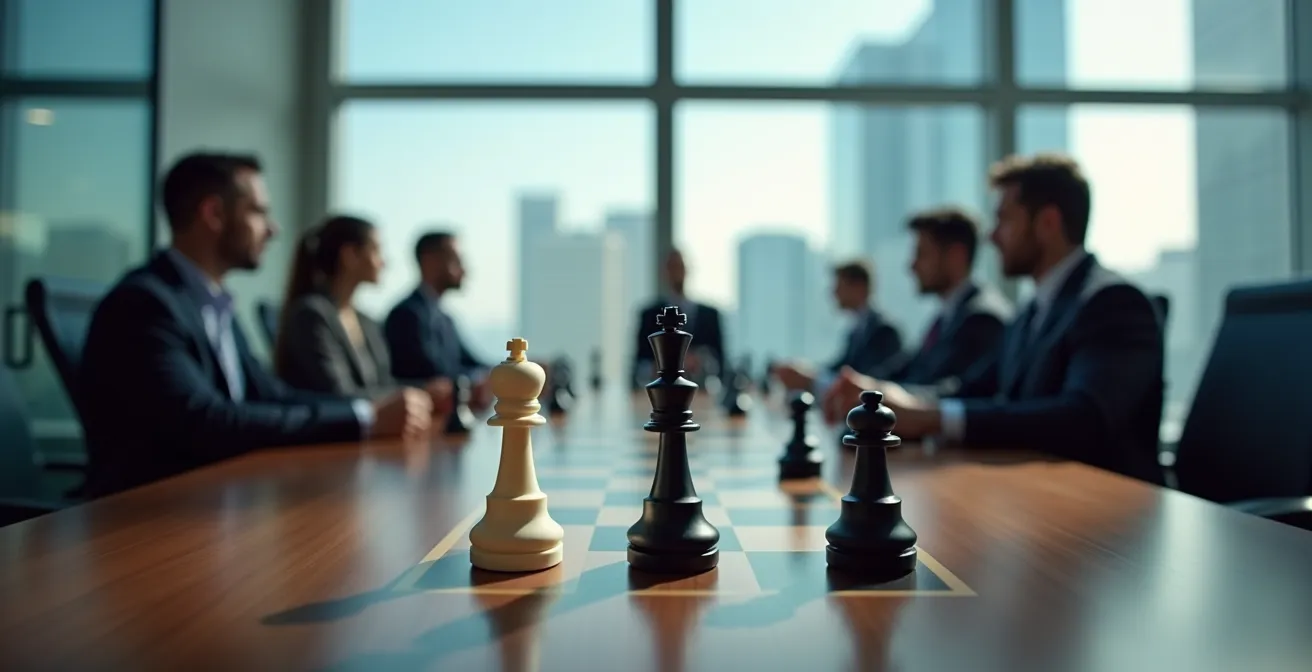
The most effective leadership training isn’t found in a lecture hall; it’s simulated on the 64 squares of a chessboard.
- Chess builds a “cognitive architecture” for decision-making under pressure, far surpassing theoretical MBA models.
- It trains concrete skills like resource allocation, pattern recognition, and managing “analysis paralysis” in a high-stakes environment.
Recommendation: Shift your view of chess from a mere hobby to a powerful executive decision simulator.
In the relentless pursuit of a competitive edge, aspiring leaders are funnelled into a familiar pipeline: undergraduate business degrees, prestigious MBA programs, and an endless cycle of leadership seminars promising transformation. Yet, as the corporate world accelerates in complexity, many find these traditional frameworks insufficient. The theories of Porter’s Five Forces or the SWOT analysis, while valuable, often crumble when faced with the volatile, uncertain, complex, and ambiguous (VUCA) reality of the modern market.
What if the most potent training ground for executive leadership wasn’t a classroom, but a game board? This isn’t about simply learning to “think a few moves ahead.” The argument is more profound: consistent, serious chess practice forges a superior cognitive architecture for leadership. It moves beyond abstract theory to build a mental operating system hardwired for high-stakes decision-making, pattern recognition, and psychological resilience. An MBA teaches you the language of business; chess teaches you how to think in it.
This article deconstructs the core mechanics of strategy games, demonstrating how they serve as a high-fidelity simulator for the challenges a CEO faces daily. We will explore how chess builds mental models for resource management, inoculates against analysis paralysis, and even cultivates the soft skills that define elite leadership. It’s time to re-evaluate the true source of strategic mastery.
For those inspired to sharpen their skills after reading our analysis, the following video offers a practical starting point with a curated list of top online instructors to begin your journey.
To fully grasp this concept, we have structured this analysis to dissect the specific cognitive skills honed by strategic gameplay. This exploration will move from direct comparisons with other games to the deep, transferable principles that apply to corporate and even personal strategy.
Table of Contents: The CEO’s Gambit and the Skills It Builds
- Chess vs. Go: Which Game Offers a Steeper Cognitive Challenge?
- The “Analysis Paralysis” Trap in Strategy Games That Mirrors Real Life
- How to Apply “Resource Management” Mechanics to Your Household Budget?
- How to Memorize Opening Strategies Without Boring Repetition?
- How to Prepare Mentally for a Weekend-Long Gaming Tournament?
- Egyptian vs. Mesopotamian: Which Structure Was Harder to Build?
- Which Soft Skills Do Recruiters Actually Value from Volunteer Work?
- Why Cooperative Games Are Better for Family Harmony Than Competitive Ones?
Chess vs. Go: Which Game Offers a Steeper Cognitive Challenge?
To appreciate chess as a tool for cognitive development, it’s useful to place it in context. The ancient game of Go, with its vast board and minimalist rules, is often cited as the ultimate strategic challenge. Computationally, this holds true. While chess has an estimated 10^120 possible positions, research on game complexity shows Go has a staggering 10^170. This makes Go a game of immense spatial control and influence, a war of territorial encirclement.
However, for the specific cognitive skills required of a modern CEO, chess presents a more direct and potent simulation. Chess is a conflict between hierarchical, asymmetric forces. Each piece has unique capabilities, constraints, and value—a perfect mirror for managing diverse teams, business units, and corporate assets. The game forces a constant calculus of trade-offs within a defined, dynamic system. While Go is about building influence in an open field, chess is about maximizing the potential of a specialized, limited army. It’s this direct parallel to organizational structure that makes its lessons so transferable.
Case Study: From Chess Master to PayPal CEO
Peter Thiel, a co-founder of PayPal and a legendary venture capitalist, exemplifies this transfer of skill. Before his business triumphs, Thiel was a USCF-rated Chess Master, once ranked among the highest under-21 players in the United States. In a Stanford lecture series, he explained how his passion for synchronizing the worlds of chess and business was instrumental to his success. As highlighted in an analysis of his career, his ability to evaluate positions, understand competitive dynamics, and execute long-term plans was honed on the chessboard long before it was applied in the boardroom.
Ultimately, the question isn’t just about difficulty, but about relevance. As business leader Alan Trefler notes, “Like champion chess players, leaders must be looking towards the future to consider a variety of scenarios.” Both games train this foresight, but the constrained, hierarchical, and dynamic nature of chess provides a more direct simulation of the modern corporate battlefield.
The “Analysis Paralysis” Trap in Strategy Games That Mirrors Real Life
Every executive knows the feeling: a high-stakes decision looms, data floods in, and the sheer volume of possibilities leads to strategic gridlock. This is “analysis paralysis,” a state where the fear of making the wrong choice leads to no choice at all. In the corporate world, this hesitation can be fatal. Strategy games, and chess in particular, are a powerful inoculation against this corporate disease precisely because they impose a critical constraint: the clock.
The pressure of the chess clock forces a player to balance analytical depth with decisive action. You cannot analyze every possible variation. Instead, you develop heuristics, a powerful pattern recognition engine, and the intuition to identify the 2-3 most promising candidate moves. This trains the brain to apply the 80/20 principle under duress: focusing finite mental energy on the decisions that will have the greatest impact. It’s a direct simulation of making a call with incomplete information before a market window closes.
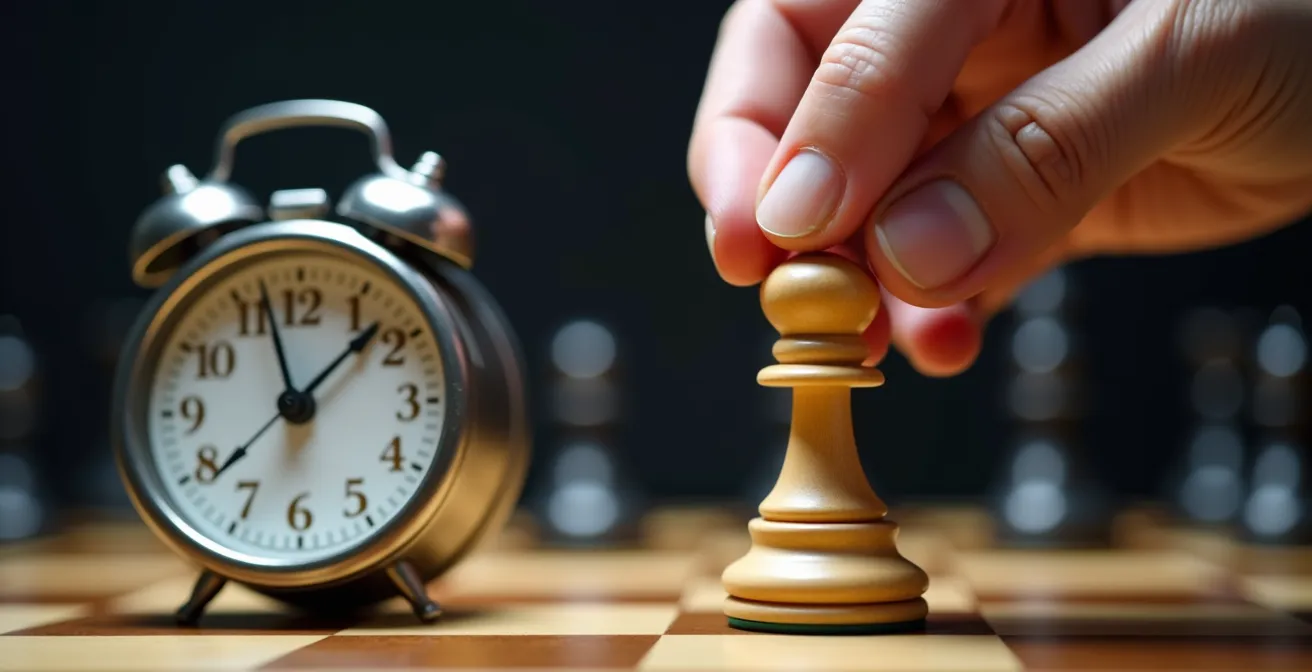
As retired US Army General Stan McChrystal described modern warfare, “The enemy could move multiple pieces simultaneously or pummel us in quick succession, without waiting respectfully for our next move.” While chess is turn-based, the psychological pressure of the clock and an opponent’s relentless threat mirrors this real-world chaos. It forces you to build a robust, efficient decision-making process that can withstand pressure and deliver timely action, transforming you from a passive analyst into a decisive leader.
Action Plan: Overcoming Analysis Paralysis
- Set strict time boundaries for each decision phase, similar to chess clock discipline.
- Identify the top 3 candidate moves or options quickly rather than analyzing all possibilities.
- Apply the 80/20 principle: focus on the decisions that will deliver 80% of the impact.
- Build in mandatory decision checkpoints or “gate reviews” to prevent endless analysis loops.
- Practice rapid post-decision analysis to learn from outcomes and improve intuition, rather than freezing before the next choice.
How to Apply “Resource Management” Mechanics to Your Household Budget?
The question of applying game mechanics to a household budget is a micro-level application of a macro-level skill: strategic resource allocation. In chess, you don’t just have an army; you have a portfolio of assets with varying values, capabilities, and strategic potential. A pawn is not a queen, and a bishop moves differently from a knight. Winning is not about hoarding pieces, but about deploying the right asset, at the right time, to the right square to maximize its impact. This is the essence of corporate strategy.
This skill is more critical than ever. In a business environment of accelerating change, recent business research indicates that average CEO tenures have plummeted, demanding faster and more impactful strategic decisions. A CEO who thinks like a chess player doesn’t see their company as a static org chart; they see it as a dynamic position on the board. They understand that a “pawn” (a junior talent) positioned correctly can become a “queen” (a future leader), and that sometimes you must sacrifice a “knight” (a niche project) to secure a long-term positional advantage for the “rook” (a core business unit).
The following table provides a direct translation of this mindset from the chessboard to the boardroom, illustrating how each piece represents a different type of corporate asset requiring a unique management strategy.
| Chess Piece | Traditional Value | Business Equivalent | Strategic Flexibility |
|---|---|---|---|
| Pawn | 1 point | Entry-level talent | High potential if positioned well |
| Knight | 3 points | Specialist teams | Unique capabilities in complex situations |
| Bishop | 3 points | Department heads | Long-range strategic influence |
| Rook | 5 points | Core business units | Direct, powerful execution |
| Queen | 9 points | Key revenue streams | Most versatile but requires protection |
This “resource allocation calculus” is a mental model that scales from managing a multi-billion dollar corporation to optimizing a household budget. It trains the mind to see beyond simple accounting and understand the strategic, interconnected value of every asset at your disposal.
How to Memorize Opening Strategies Without Boring Repetition?
The question itself contains a common misconception about strategic mastery, both in chess and in business. The goal is not memorization; it’s deep understanding. As business author Bill Peña aptly puts it in a piece for Entrepreneur Magazine, “Grandmasters don’t memorize all possible moves; they deeply understand the strategic goals of an opening.” A novice memorizes moves; a master understands the underlying principles—control of the center, piece development, king safety.
This is the exact difference between a mid-level manager executing a playbook and a CEO setting the strategic direction. A manager might memorize the steps of a product launch plan. A CEO understands the market dynamics, competitive positioning, and customer psychology that make the plan viable in the first place. They can adapt or even discard the plan when the underlying conditions change, because they are not just following a script. This is the core of an effective cognitive architecture for leadership.
Consider the story of Chess.com. The founders were initially “laughed out of VC rooms.” They weren’t just executing a known business model; they understood the deep strategic goal: building a community and an accessible platform for a global passion. Instead of rote repetition of failed VC pitches, they adapted, bootstrapped, and focused on the core principles of user engagement. Their success, achieving a billion-dollar valuation without venture backing, wasn’t from a memorized formula but from a deep, flexible understanding of their “position on the board.” They knew the *why* behind their moves, allowing them to navigate a complex path to victory.
How to Prepare Mentally for a Weekend-Long Gaming Tournament?
A weekend chess tournament is not a casual pastime. It’s a multi-day marathon of intense, focused mental exertion. It’s the cognitive equivalent of running an ultramarathon. Preparing for such an event is a direct simulation of preparing for a high-stakes, extended business scenario: a critical M&A negotiation, a product launch week, or a crisis management situation. The key to peak performance in both arenas is treating oneself as a “corporate athlete.”
This means moving beyond pure intellectual preparation into the realm of holistic performance management. Mental stamina is not an infinite resource. It is profoundly affected by sleep, nutrition, stress management, and structured recovery. A chess player who arrives at a tournament sleep-deprived and poorly nourished will blunder, no matter how much theory they know. Similarly, an executive who enters a crucial negotiation week exhausted and running on caffeine is a liability to their organization.
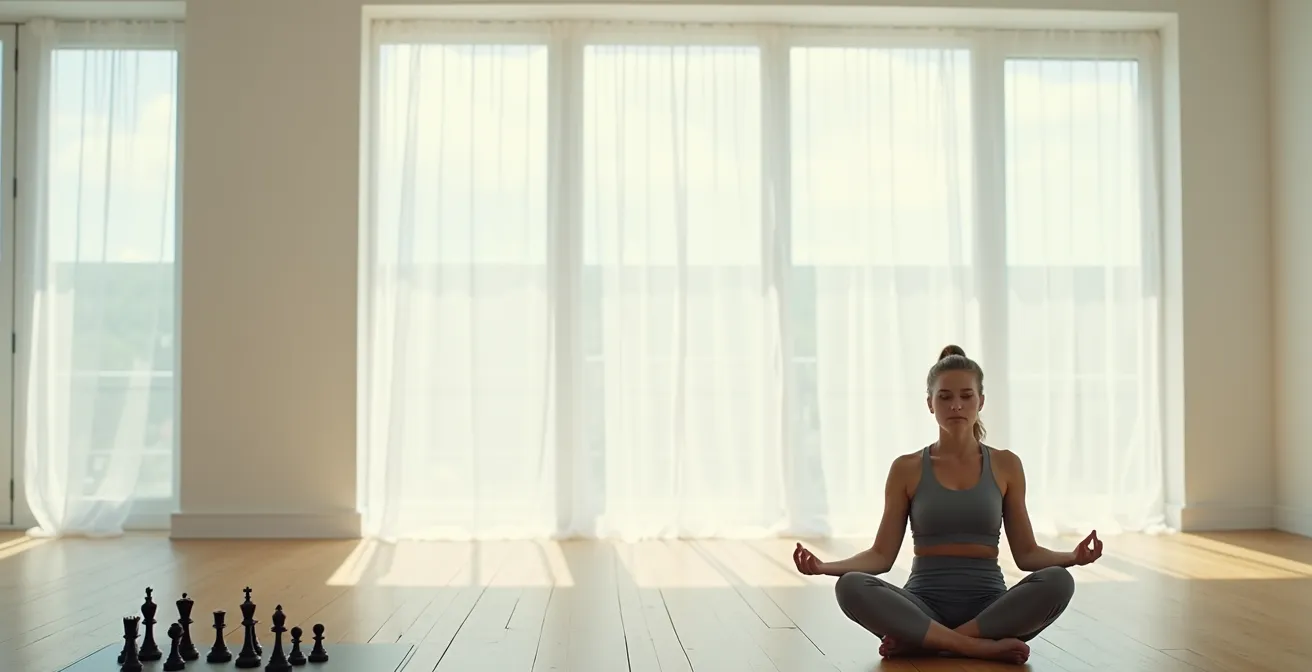
The discipline required for tournament preparation builds a personal operating system for sustained high performance. It involves creating rituals and routines that protect your most valuable asset: your cognitive capacity. The skills learned—mindfulness to maintain focus, strategic nutrition for stable energy, and structured breaks to prevent burnout—are not just “nice-to-haves” for an executive; they are mission-critical components of leadership endurance.
- Establish a consistent sleep schedule at least two weeks before the event (7-8 hours minimum).
- Practice mindfulness meditation for 15 minutes daily to build focus and emotional resilience.
- Implement strategic nutrition timing: complex carbohydrates 3 hours before performance, light proteins during.
- Schedule structured, non-negotiable breaks every 90 minutes during intense preparation phases.
- Develop a personal “reset ritual”—a quick physical or mental routine—to use between major decision points or rounds.
Egyptian vs. Mesopotamian: Which Structure Was Harder to Build?
This question, seemingly from a different discipline, offers a powerful metaphor for two fundamentally different leadership and strategic models. The Great Pyramids of Egypt are monolithic marvels of centralized command. They required immense, specialized resources (massive, unique stone blocks) and a rigid, top-down plan executed over a single, massive construction phase. This is the Pyramid Leadership Model: powerful, impressive, but static and unchanging.
In contrast, the Ziggurats of Mesopotamia were iterative platforms. They were often built up over generations, with new layers added upon the old. They used more standardized components (like baked bricks) and allowed for adaptation and evolution. This represents the Ziggurat Leadership Model: adaptive, scalable, and focused on building a resilient platform rather than a single, perfect monument. In his strategic evolution, General Stan McChrystal captured this exact shift:
I stopped playing chess, and I became a gardener. First I needed to shift my focus from moving pieces on the board to shaping the ecosystem.
– General Stan McChrystal, Leading Sapiens
McChrystal’s transition from “chess master” (Pyramid model) to “gardener” (Ziggurat model) is the journey of the modern CEO. A novice sees chess as moving pieces to execute a fixed plan. A master understands they are shaping a dynamic ecosystem on the board, where the potential of the pieces evolves with the position. The most effective CEOs don’t just command; they cultivate. They build scalable systems and empower their teams, acting as gardeners of a complex, evolving organization.
| Aspect | Pyramid Model (Egyptian) | Ziggurat Model (Mesopotamian) | Best Application |
|---|---|---|---|
| Structure | Monolithic, unchanging | Iterative, evolving platform | Hardware vs. Software projects |
| Leadership Style | Centralized command | Distributed authority | Crisis vs. Growth phases |
| Resource Model | Massive unique blocks | Standardized components | Custom vs. Scalable solutions |
| Timeline | Single construction phase | Continuous building | Product launch vs. Platform development |
Which Soft Skills Do Recruiters Actually Value from Volunteer Work?
While volunteer work is often cited as a source of soft skills, the underlying abilities recruiters seek are universal. One of the most critical, yet underdeveloped, is listening. In a world saturated with noise, the ability to truly hear—to understand context, intent, and unspoken needs—is a superpower. And surprisingly, the silent, intense game of chess is a formidable training ground for it.
Chess is a dialogue conducted in moves, not words. Every move your opponent makes is a statement. A pawn push might be a quiet question, a knight fork a loud threat, a king-side castling a declaration of intent. To succeed, you must learn to “listen” to the board. You must suspend your own plans and biases to fully comprehend what your opponent is trying to achieve. Failure to listen leads to blunders and defeat. This is precisely the skill that according to research with over 140 top CEOs, is ranked as one of the most critical for leadership.
As CEO Alan Trefler states, “For people who tend to be quick to answer, sometimes you can come to answers without properly understanding the context of the questions. I think listening skills are important today and will be increasingly important in coming years, because frankly, fewer and fewer people listen well.” Chess forces you to slow down and understand the context of your opponent’s “question” before formulating your “answer.” It builds the discipline of empathetic analysis—the ability to step into another’s shoes to understand their strategy, which is the foundation of effective negotiation, management, and leadership.
Key Takeaways
- Superior Pattern Recognition: Chess hardwires the brain to identify opportunities, threats, and strategic patterns, creating an intuitive “feel” for market dynamics that theoretical models can’t replicate.
- Dynamic Resource Allocation: The game provides a live simulation for managing a portfolio of asymmetric assets (talent, capital, time) to maximize impact and achieve long-term objectives.
- Psychological Resilience: By forcing decisions under time pressure and against a live opponent, chess builds the mental stamina, focus, and emotional control essential for high-stakes executive leadership.
Why Cooperative Games Are Better for Family Harmony Than Competitive Ones?
The premise that cooperative games are “better” for harmony is valid in many social contexts. Unbridled competition can indeed be divisive. However, for a leader, the most critical skill isn’t choosing one mode over the other, but knowing when to compete and when to cooperate. The ultimate level of strategic mastery is transforming a competitive, zero-sum game into a collaborative, win-win outcome. And mastering competition is the first step.
As Virgin Group founder Richard Branson, an avid player, states, “Business is like a giant game of chess.” He recognizes that the game “combines the most remarkable aspects of many different sports – tactics, planning, bravery, and risk-taking.” The goal of a CEO isn’t simply to “win” a family game night; it’s to navigate a competitive marketplace. Understanding the brutal logic of competition is a prerequisite for rising above it. Chess, by forcing you to deeply analyze an opponent’s goals and perspective, is the ultimate training in strategic empathy. You learn to see the world from their side of the board to anticipate their moves.
This is the very skill required to find common ground and build partnerships. By understanding what your “opponent” (a competitor, a negotiating partner, a rival department) truly wants, you can identify opportunities for mutual gain that they may not even see themselves. The mindset of a true grandmaster-CEO is not just to crush the competition, but to reshape the game itself. The following steps outline how to build a collaborative mindset from the lessons of a competitive framework:
- Recognize when competition serves the overarching goal versus when collaboration yields a better outcome.
- Practice switching between competitive and cooperative modes based on the context of the situation.
- Develop empathy by deeply analyzing opponents’ perspectives to see them as potential partners.
- Build trust incrementally through small, verifiable collaborative wins before attempting major partnerships.
- Create win-win scenarios by focusing on “expanding the pie” rather than just fighting for your existing slice.
The MBA provides a map of the business world, but chess provides the compass and the resilience for the journey. It builds a superior cognitive architecture for navigating the complex, competitive, and ever-changing landscape of modern leadership. The question is no longer whether you have the time for chess. It’s whether your ambition can afford for you to ignore it. Your first move is waiting.