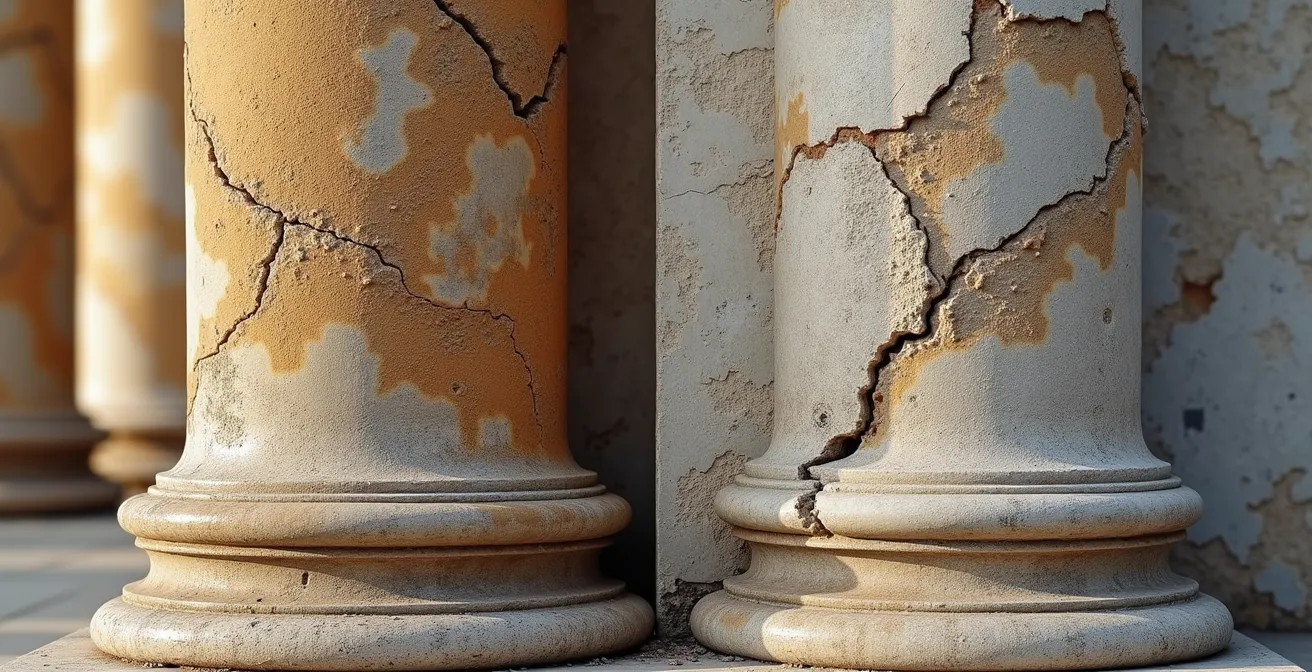
The durability of ancient structures isn’t due to a lost magic recipe, but a fundamentally different engineering philosophy: they were designed to evolve, not just resist.
- Roman concrete was a “living” material capable of self-healing cracks when exposed to water.
- Materials like bronze were chosen for their ability to age gracefully, where wear and patina add character rather than signify decay.
- Ancient design was often symbiotic with its environment, using elements like light and even human interaction as part of the structure’s long-term story.
Recommendation: Engineers today should study not just *what* ancient builders built, but *how* they thought—designing for adaptation and longevity rather than mere short-term resilience.
As a civil engineer, one can’t help but feel a sense of profound admiration, tinged with a bit of professional envy, when contemplating a structure like the Pantheon. Its unreinforced concrete dome has stood for nearly two millennia, while modern concrete bridges and buildings often show signs of critical decay within a few decades. We possess advanced chemical admixtures, computer modeling, and reinforcement technologies, yet our creations are frequently ephemeral compared to those of our ancient predecessors. Why does a Roman aqueduct endure while a 20th-century overpass crumbles?
The common answers—that Romans used special volcanic ash or had access to limitless cheap labor—are only a small part of a much more complex and fascinating truth. These explanations treat ancient engineering as a collection of lost recipes. But what if the real secret wasn’t a specific ingredient but an entirely different design philosophy? This perspective views structures not as static objects designed to resist the inevitable march of time, but as dynamic, living systems intended to co-exist with and even be improved by their environment. It’s a philosophy of embracing change, not just fighting it.
This article will deconstruct this ancient engineering mindset. We will explore the material intelligence of self-healing concrete, learn how to read the life story of a building from the marks on its stones, and understand how even the angle of the sun was a critical design consideration. This is a journey into an approach where time was not the enemy, but an essential partner in creation.
The following sections will dissect the key principles of this enduring engineering legacy, from the microscopic chemical reactions in Roman mortar to the macroscopic logistics of pyramid construction, revealing a mindset that has much to teach us today.
Summary: Why Ancient Structures Endure
- Why Roman Concrete Gets Stronger with Time While Ours Cracks?
- How to Mentally Reconstruct a Ruin Using Archaeological Clues?
- Egyptian vs. Mesopotamian: Which Structure Was Harder to Build?
- The “Touch” Mistake That Wears Down Monuments Over Centuries
- Why the Light at Sunset Reveals Masonry Details Invisible at Noon?
- Bronze vs. Resin: Which Material Survives a House with Kids and Pets?
- When Is the “Golden Hour” for Stone Monuments to Capture Texture?
- Why Reading Buildings Tells You More About a City Than a Guidebook?
Why Roman Concrete Gets Stronger with Time While Ours Cracks?
The stark difference in longevity between Roman and modern concrete is a source of constant fascination and study. While our high-performance Portland cement-based structures have a design life often limited to decades, Roman marine concrete has lasted nearly 2000 years, with some structures like breakwaters appearing even stronger after centuries submerged in seawater. For years, the secret was attributed solely to the use of pozzolanic ash. However, recent discoveries reveal a far more sophisticated “material intelligence” intentionally engineered into the mix.
The key lies in the ubiquitous white chunks, or “lime clasts,” found throughout Roman concrete. For a long time, these were dismissed as evidence of poor mixing or low-quality control. As MIT Professor of Civil and Environmental Engineering, Admir Masic, notes, this assumption never sat well with him.
The idea that the presence of these lime clasts was simply attributed to low quality control always bothered me.
– Admir Masic, MIT Professor of Civil and Environmental Engineering
His team discovered these clasts are not a flaw but a feature. They are pockets of quicklime, a result of “hot mixing” at high temperatures. When a micro-crack forms in the concrete and water seeps in, it activates this quicklime. The lime dissolves and recrystallizes as calcium carbonate, effectively stitching the crack back together. This self-healing mechanism is a brilliant example of a “living” material designed to respond and adapt to damage, a stark contrast to our modern approach where a crack is simply the beginning of the end.
MIT’s Self-Healing Concrete Experiment
To prove this theory, the MIT team created two concrete samples: one using the Roman hot-mixing technique with lime clasts and another with modern cement. They deliberately cracked both and ran water through them. The results were stunning: within two weeks, the cracks in the Roman-style concrete had completely healed, stopping the flow of water. The modern concrete sample remained cracked, with water continuing to pass through it, demonstrating the incredible, intentional durability engineered by the Romans.
How to Mentally Reconstruct a Ruin Using Archaeological Clues?
Standing before a ruin, an engineer’s mind naturally begins to deconstruct the construction process. We see more than just weathered stone; we see a blueprint frozen in time. Mentally reconstructing an ancient structure requires training your eye to spot the subtle but deliberate marks left behind by its builders. These are the equivalent of an ancient project manager’s notes, revealing logistics, tools, and techniques.
The surface of a wall is a text. Look closely for putlog holes—small, square openings left by the wooden scaffolding that supported the masons. Their spacing can tell you about the size of the scaffolding bays and the rhythm of construction. Likewise, the patterns of chisel marks are not random; they can indicate the type of tool used, the direction of the stoneworking, and even distinguish the work of different teams of masons. On larger blocks, you might find a protruding knob of stone called a lifting boss. These were intentionally left on the block to provide a secure attachment point for cranes and lifting gear, only to be chiseled off after the stone was set in place—or sometimes left, giving us a direct insight into their heavy-lifting logistics.
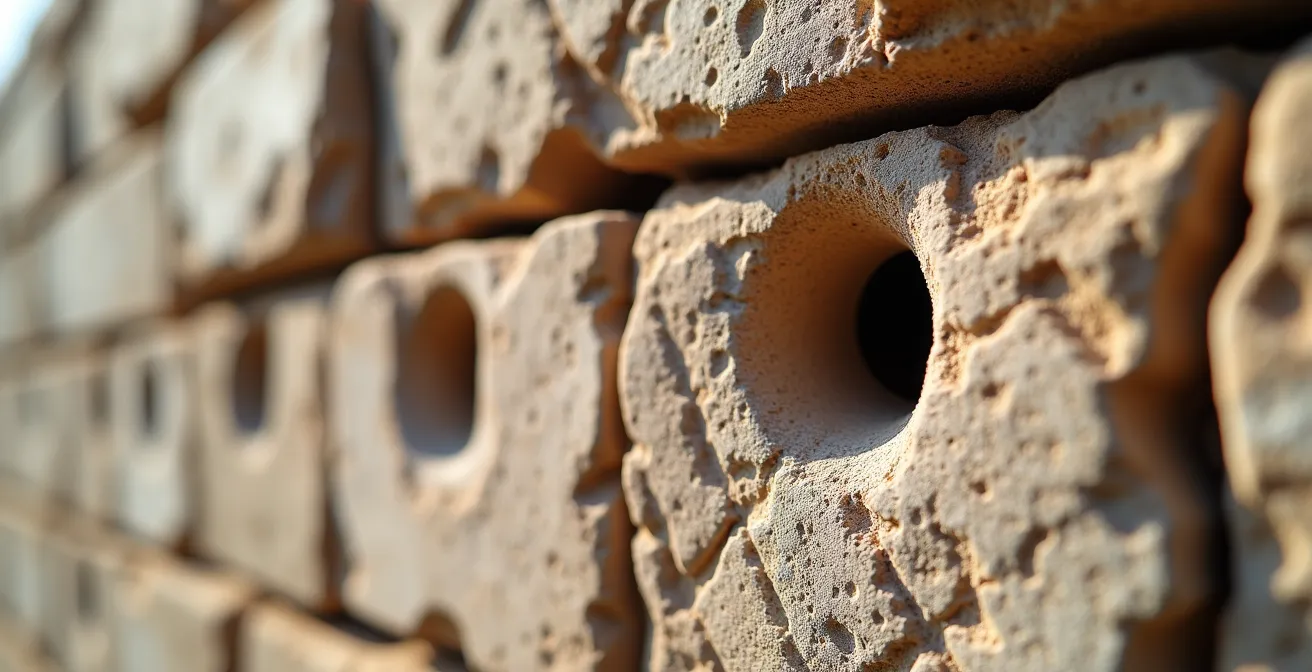
By piecing together these clues—the rhythm of putlog holes, the angle of tool marks, the presence of lifting bosses, and the type of mortar—we can begin to visualize the structure not as a ruin, but as a bustling construction site. We can infer the sequence of assembly, the scale of the labor force, and the sophistication of their equipment. This forensic analysis allows us to appreciate monumental achievements like the Pantheon’s dome. With its 43.3-meter diameter, it remains the world’s largest unreinforced concrete dome since its completion in 126 AD, a feat made understandable only by reading the construction clues left in its very fabric.
Egyptian vs. Mesopotamian: Which Structure Was Harder to Build?
When considering monumental ancient construction, the Egyptian pyramids and Mesopotamian ziggurats represent two colossal, yet fundamentally different, engineering paradigms. Asking which was “harder” to build requires us to look beyond sheer size and analyze the unique material, logistical, and environmental challenges each civilization faced. It’s a comparison between mastering mass and mastering material production.
The primary challenge for the Egyptians was one of scale and precision with massive, monolithic materials. They had to quarry, transport, and lift multi-ton blocks of limestone and granite with breathtaking accuracy. The Great Pyramid, for instance, involved moving an estimated 2.3 million blocks. This required an unprecedented level of project management, developing sophisticated logistics for river transport and labor mobilization. The engineering focus was on permanence; these were tombs built to last for eternity, and the choice of stone reflects that ambition.
In contrast, the Mesopotamians worked primarily with a more humble material: mud-brick. Their primary challenge was not lifting immense weight but rather the mass production and assembly of millions of individual units. Ziggurats were built with a core of sun-dried mud-bricks and a protective outer layer of baked bricks. While the raw material was readily available, its lack of durability meant these structures required constant maintenance and rebuilding to survive. Their engineering focus was on creating massive, terraced forms with limited resources, a testament to organizational skill rather than material strength.
This comparative analysis, sourced from a deep dive into ancient engineering technologies, highlights these divergent approaches.
| Aspect | Egyptian Pyramids | Mesopotamian Ziggurats |
|---|---|---|
| Primary Material | Limestone and granite blocks | Mud-brick construction |
| Main Challenge | Quarrying and transporting massive stones | Mass-producing millions of bricks |
| Durability Focus | Built for eternity (afterlife) | Required constant maintenance |
| Labor Organization | Seasonal workforce mobilization | Year-round specialized craftsmen |
| Transportation | River barges and sledges | Local materials, minimal transport |
The “Touch” Mistake That Wears Down Monuments Over Centuries
As engineers, we are trained to think about structural loads, wind shear, and material fatigue. Yet, one of the most significant long-term threats to ancient monuments is far more subtle: the cumulative effect of human touch. A single hand brushing against a stone wall seems harmless, but when multiplied by millions of visitors over decades, it becomes a powerful agent of erosion. This “death by a thousand cuts” is a serious conservation challenge, turning admiration into abrasion.
The mechanism of damage is both physical and chemical. Physically, each touch removes microscopic particles of stone. Imagine a popular statue in a museum; if a million touches a year each remove a single microgram, that’s a gram of material lost annually. Over a century, that’s 100 grams of irreplaceable history sanded away. Chemically, the damage can be even more insidious. The acidic oils and salts present in human sweat react with the minerals in the stone, particularly calcite-based materials like marble and limestone. This causes micro-pitting, discoloration, and a slow, irreversible degradation of the surface.
However, the narrative of touch is not entirely negative. In some contexts, wear is not damage but a form of veneration that adds a layer of cultural history to the object. The famous bronze statue of St. Peter in the Vatican is a prime example. Its right foot has been worn smooth by centuries of pilgrims touching and kissing it. Here, the material loss is not seen as damage but as a physical record of devotion. The wear itself becomes part of the monument’s story, distinguishing it from unintentional, destructive erosion caused by casual tourism.
This duality forces us to distinguish between destructive wear and meaningful polishing. It’s a reminder that the relationship between humans and structures is a complex interaction, where our presence can either degrade or enrich the historical narrative embedded in the material. This concept underscores the need for thoughtful conservation strategies that manage public access while preserving the integrity of these irreplaceable assets.
Why the Light at Sunset Reveals Masonry Details Invisible at Noon?
The way we perceive a structure is profoundly influenced by the quality and angle of light. For an engineer or architect analyzing an ancient building, light is not merely for illumination; it is a powerful diagnostic tool. The same stone wall that appears flat and featureless under the high, direct sun of midday can transform into a rich tapestry of detail under the low-angled “raking light” of sunrise or sunset.
This phenomenon is a simple matter of physics. At noon, the sun is high overhead, casting short, weak shadows. This “flat” light illuminates the surface evenly, hiding subtle variations in texture. However, during the “golden hour” just after sunrise or before sunset, the sun is low on the horizon. Light strikes the wall at a very shallow angle. This raking light catches the edges of every subtle protrusion and casts long, dramatic shadows from every small recess. Suddenly, tool marks, faint inscriptions, surface erosion, and the precise fit of masonry joints become startlingly clear.
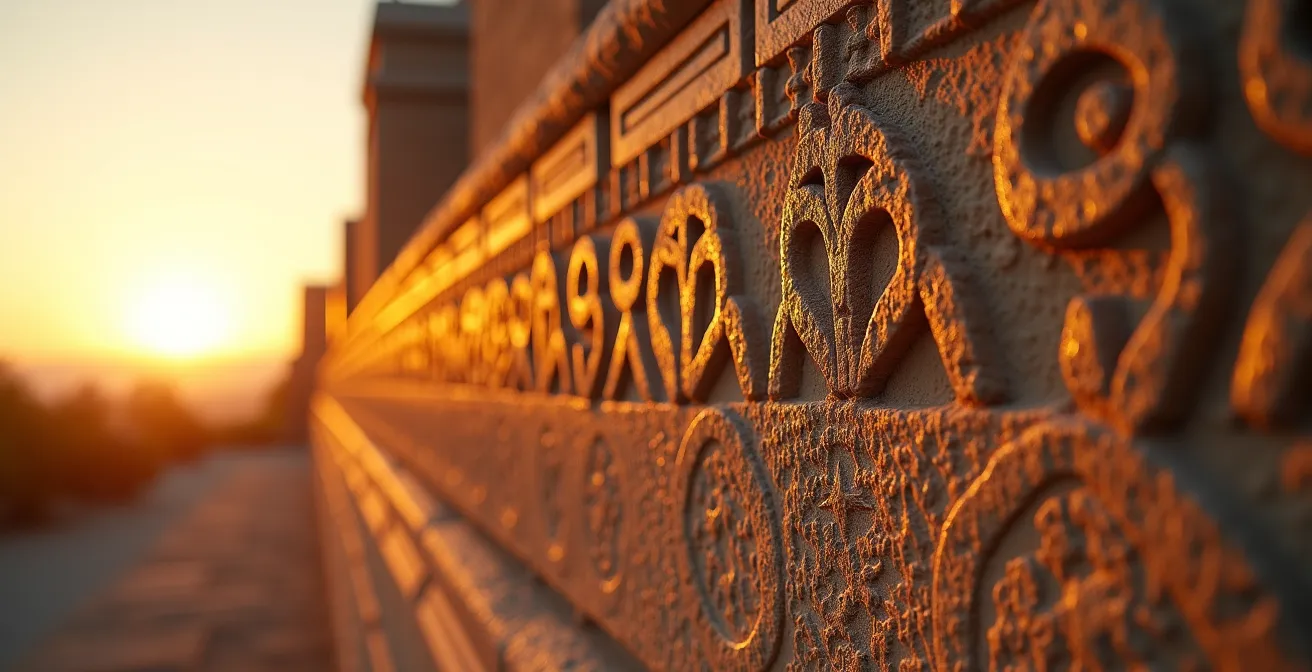
Ancient builders, who worked their entire lives under the sun, understood this relationship intuitively. The orientation of a temple, the placement of a relief carving, and even the texture of a wall were often designed with the path of the sun in mind. They knew that certain details would only “awaken” at specific times of day, creating a dynamic, changing experience for the observer. For us, this means that a full analysis of a structure is incomplete without observing it under different lighting conditions. A visit at noon might reveal the building’s form, but a visit at dawn reveals its soul—the story of its making, written in shadow.
Action Plan for Structural Analysis Using Light
- Assess Orientation: Determine the cardinal direction the facade faces. This is the primary factor in predicting optimal observation times. East-facing surfaces are best at sunrise, while west-facing ones are best at sunset.
- Schedule Golden Hour Visits: Plan site inspections during the first and last hours of daylight to leverage the sharp, textural details revealed by low-angle raking light.
- Observe During Blue Hour: Don’t leave right after sunset. The “blue hour” provides soft, diffuse light that is excellent for evaluating the overall form and color of the stonework without the distraction of harsh shadows.
- Factor in Seasonality: Remember that the sun’s angle and path change throughout the year. The long shadows of winter can reveal different details than the shorter shadows of summer.
- Utilize Digital Tools: For advanced analysis, consider Reflectance Transformation Imaging (RTI). This computational photography method captures a surface from multiple light angles to create an interactive digital model where light can be moved to reveal texture with incredible precision.
Bronze vs. Resin: Which Material Survives a House with Kids and Pets?
While we’ve focused on monumental structures, the ancient philosophy of material longevity can be illustrated with a modern domestic comparison: a bronze sculpture versus a resin one. This analogy brings the concepts of graceful aging and material resilience down to a relatable scale, highlighting a profound difference in how materials are intended to exist over time in a dynamic environment like a family home.
A cast resin sculpture is a product of modern chemistry. It is often created to be a perfect, flawless replica of an original form. Its value lies in this initial perfection. However, in a house with children, pets, or just the general chaos of life, this perfection is fragile. A scratch on resin is a permanent flaw. A fall can cause a crack that is often irreparable. Exposure to sunlight can cause the material to yellow and become brittle over time. The resin object is designed to resist damage, but it fails poorly. Its story is one of gradual, irreversible decay from a state of perfection.
A bronze sculpture, on the other hand, embodies an ancient material philosophy. Bronze is inherently resilient. If it’s knocked over, it might dent, but it won’t shatter. A dent can often be hammered out or, more profoundly, be left as part of its history. As a Materials Conservation Specialist might say:
Bronze ‘lives’ by developing a patina; dents and wear become part of its character and history.
– Materials Conservation Specialist, Analysis of Material Aging in Domestic Environments
Over time, bronze develops a patina, a surface layer of oxidation that is chemically stable and often considered beautiful. It doesn’t degrade under UV light and is unaffected by temperature shifts. A scratch on bronze is not a “flaw” in the same way; it becomes part of the texture. The object is not just surviving; it is accumulating a history. It is designed not for static perfection, but for dynamic longevity. It can be passed down through generations, with each mark adding to its narrative.
| Property | Bronze | Resin |
|---|---|---|
| Response to Damage | Develops patina, dents add character | Scratches seen as permanent flaws |
| Repairability | Can be hammered out or re-welded | Cracks often irreparable |
| Thermal Stability | High, unaffected by temperature | Can warp in heat, brittle in cold |
| UV Resistance | Completely UV-indifferent | Yellows and degrades over time |
| Generational Value | Can be passed down, gains history | Disposable culture, replaced when damaged |
When Is the “Golden Hour” for Stone Monuments to Capture Texture?
The concept of the “golden hour” is well-known in photography, but for an engineer studying a monument, it is a critical window for structural and textural analysis. It’s not just about aesthetics; it’s about using predictable solar patterns to extract information. While the basic principle involves low-angled light, a deeper understanding requires considering not just the time of day, but the time of year and the building’s specific geometry.
The orientation of a surface dictates its optimal viewing time. An east-facing wall will catch the dramatic raking light of sunrise, while a west-facing facade will be best observed at sunset. North and south faces are more complex, as their illumination depends heavily on the sun’s seasonal path across the sky. In the northern hemisphere, a south-facing wall will receive direct, low-angled light during winter days when the sun is low, but much higher, flatter light in the summer.
This seasonal variation can create unique, transient phenomena that reveal deep insights into a structure’s design. The Colosseum in Rome offers a perfect example of this principle in action.
Seasonal Light Phenomena at the Colosseum
During the winter months, the Colosseum experiences a specific and powerful lighting effect. The sun rises much lower on the horizon than in summer. On clear winter mornings, these low-angled rays penetrate deep into the structure through the eastern arches, casting long, dramatic shadow patterns across the interior walls. This light-and-shadow play highlights the curvature of the vaults and the texture of the masonry in a way that is completely invisible during the summer, when the higher sun illuminates the interior from above. Observers who understand this can witness the building performing a sort of annual architectural light show, revealing different aspects of its three-dimensional form depending on the season.
This demonstrates that a true “reading” of a building requires repeated observation across time. The structure is not a static object but a dynamic instrument that interacts with the sun’s annual cycle. Understanding these patterns allows an observer to anticipate when and where a building will reveal its secrets, turning a passive viewing into an active analysis of form, texture, and the deliberate interplay between architecture and astronomy.
Key Takeaways
- Material Intelligence: Ancient materials were often designed as “living systems” with properties like self-healing, a stark contrast to modern materials designed for static resistance.
- Design for Graceful Aging: The engineering philosophy valued materials that aged with character (e.g., bronze patina), embedding the passage of time into the structure’s identity rather than viewing it as decay.
- Symbiosis with Environment: Ancient builders demonstrated a profound understanding of environmental factors, using light, water, and even human interaction as integral components of a structure’s design and longevity.
Why Reading Buildings Tells You More About a City Than a Guidebook?
A guidebook tells you names, dates, and interesting anecdotes. An engineer, however, can read a building and understand the very DNA of the city itself: its ambitions, its resources, its social structure, and its core philosophy. Buildings are the most honest historical documents we have. They don’t just describe the past; they are a physical embodiment of it. By learning to read their language of materials and forms, we can understand a civilization’s story in a way no text can convey.
Consider the city of Rome. Its story is written in concrete. The Roman engineering innovation of combining lime, volcanic ash, and aggregate was not just a technical achievement; it was the catalyst for an urban revolution. This new material freed architects from the post-and-lintel limitations of stone, enabling them to create vast interior spaces with arches, vaults, and domes. For the first time, the interior of a building became the main architectural event. This shift reflects a societal change: a focus on public assembly, civic life, and the creation of large-scale, functional urban infrastructure. The enduring success of Rome came from a mindset of solving city-scale problems first—like moving water and people—and then dressing those engineered solutions with artistry.
This philosophy of function-first engineering is why so many of their structures still work. An aqueduct is a pure expression of its purpose. This contrasts sharply with our modern approach, where we consume materials at an astonishing rate. It is estimated that modern cities consume 10 billion tons of concrete annually, twice as much as all other building materials combined. Yet, we build with a shorter time horizon. We are building for the now, while they built for the ages. Reading a building is to understand this fundamental difference in intent, to see the values of a society solidified in stone and mortar.
To be a better engineer, look beyond the spec sheets and stress-test results. Look at the Pantheon, a medieval bridge, or a simple stone wall. Ask not just “How was it built?” but “How was it intended to live?” By adopting this deep-time perspective, we can begin to design and build structures that don’t just serve our generation, but carry our story into the future.
Frequently Asked Questions on Monument Preservation
How does human touch chemically affect stone monuments?
The acidic oils (sebum) and salts in human sweat react with calcite-based stones like marble and limestone, causing micro-pitting and discoloration that accumulates over time.
Are there examples where wear adds historical value?
Yes, the foot of St. Peter’s statue in the Vatican has been worn smooth by centuries of pilgrims’ touches, where the wear itself has become part of the object’s cultural significance.
What’s the difference between destructive wear and meaningful polishing?
Destructive wear removes material without purpose, while meaningful polishing through veneration creates a physical record of devotion and becomes part of the monument’s history.