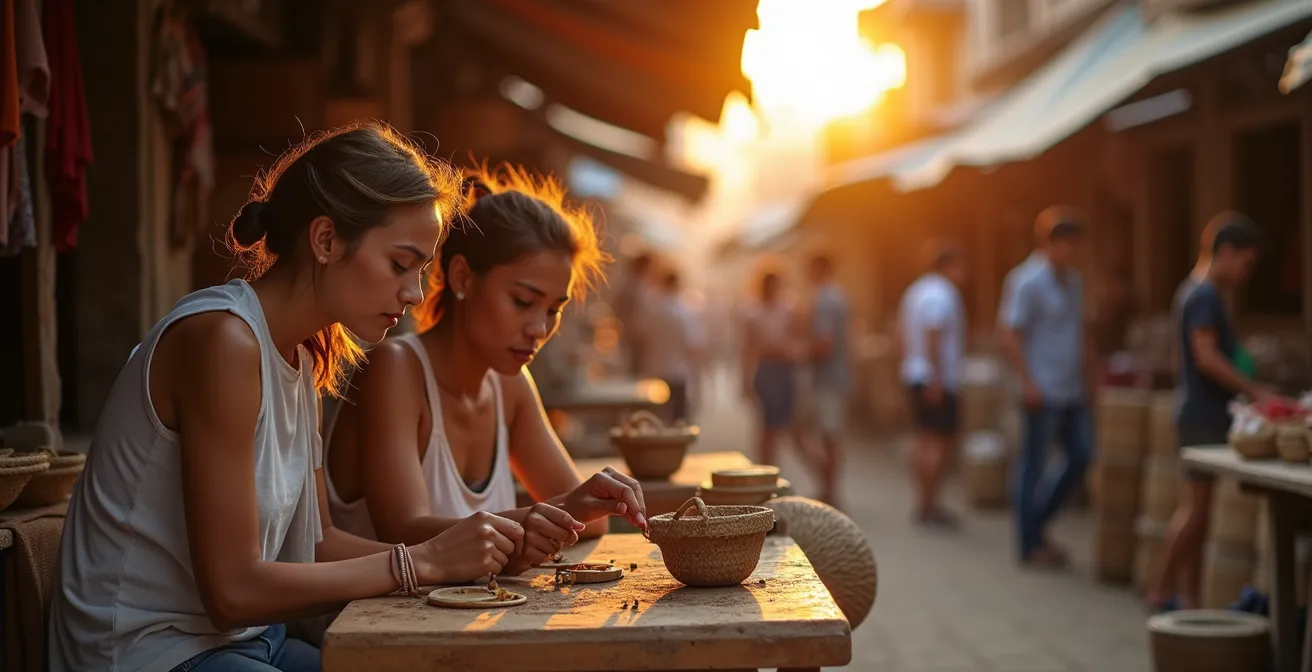
The secret to a life-changing journey isn’t visiting more places, but shifting your role from a passive cultural consumer to an active, humble participant.
- True immersion is a mindset, not a destination. It’s about contributing, creating, and connecting rather than simply observing.
- Authentic encounters are engineered through structured methods that invite serendipity, even in the most popular locations.
Recommendation: For your next trip, don’t start with a list of sights to see. Start by identifying one small way you can participate in the local daily life—be it a craft, a ritual, or a community project.
For the experienced traveler, the thrill of checking another landmark off the list has faded. You’ve seen the postcard views, navigated the subways, and sampled the famous street food. Yet, a persistent feeling remains—a sense of being on the outside looking in, separated from the real, vibrant life of the place by an invisible wall. You’re tired of the well-trodden path and the generic advice to “eat where the locals eat.” You crave something deeper: a genuine connection that doesn’t just give you stories to tell, but fundamentally alters your perspective.
The common approach to achieving this is to venture “off the beaten path,” but that often just leads to a different kind of isolation. The true barrier to immersion isn’t geography; it’s our mindset. We’ve been trained to be observers, to consume culture as a spectacle. But what if the key to unlocking a transformative experience wasn’t about where you go, but about changing your role? What if, instead of being a spectator, you became a participant?
This guide rejects the superficiality of mass tourism. It’s built on a single, powerful principle: the most profound travel experiences happen when you stop watching and start doing. We will explore a framework for shifting from a passive observer to an active contributor, showing you how to budget for longer stays, find connection in solitude, understand unspoken social codes, and integrate your transformation back home. This is the blueprint for a journey that changes not just what you see, but who you are.
To witness the profound impact of seeing a culture from the inside out, the following documentary offers a powerful visual testament to how immersion shatters preconceived notions and reveals a shared humanity. It exemplifies the very perspective shift this guide will help you engineer.
This article provides a complete roadmap to planning and experiencing this deeper form of travel. Below, you will find a summary of the key strategies and mindsets we will explore, designed to guide you from the initial planning stages to the crucial process of integrating your journey’s lessons upon your return.
Summary: Crafting Your Transformative Journey
- How to Budget for a Month-Long Cultural Immersion in Europe for Under $2,500?
- Solo Wandering vs. Local Guides: Which Offers a Deeper Connection?
- The Etiquette Mistake That Alienates Locals in Japan and How to Avoid It
- Why Returning Home Feels So Empty After a Deep Cultural Experience?
- When to Visit Popular Cities to Ensure Authentic Local Encounters?
- How to Experience the Colosseum Alone by Waking Up at 5 AM?
- How to Use Local Art Classes to Learn a Language Faster Than Duolingo?
- Why Participating in a Ritual Is More Memorable Than Watching One?
How to Budget for a Month-Long Cultural Immersion in Europe for Under $2,500?
The greatest barrier to deep, immersive travel is often perceived to be cost. A month-long trip feels like a luxury reserved for a select few. However, this assumption is rooted in a tourist mindset of paying for services. A slow traveler, focused on participation, unlocks an entirely different economic model. The goal is not just to spend less, but to reframe your value. Instead of being a customer, you become a collaborator. This shift is crucial and is reflected in emerging travel patterns, where spending is increasingly directed toward meaningful experiences.
The most effective strategy is to trade your time and skills for accommodation and food. This isn’t just a budget hack; it’s the fastest path to immersion. Platforms like Workaway and Worldpackers connect you with families, farms, and small businesses seeking help. By contributing a few hours of work each day, you eliminate your biggest expenses and are immediately integrated into a local’s daily life. You share meals, participate in chores, and build relationships from a place of mutual contribution, not commercial transaction. While recent data shows that 54% of European travelers expect to have more money for travel, the smart immersionist focuses on reducing the need for it altogether.
This approach stands in stark contrast to conventional budget options like hostels or even short-term rentals, which can keep you firmly inside a tourist bubble. The following table breaks down how participatory lodging options deliver far more than just financial savings; they are engines for cultural connection.
| Option | Cost Savings | Connection Potential Score | Time Commitment |
|---|---|---|---|
| Workaway/Worldpackers | Free accommodation + meals | 9/10 – Direct local family integration | 4-6 hours/day |
| House-sitting | Free accommodation only | 6/10 – Limited local interaction | Pet care responsibilities |
| Short-term rentals | 30-50% below hotels | 4/10 – Tourist bubble risk | No work required |
By choosing an option from the top of this list, you are not just finding a place to sleep. You are choosing a participatory mindset from day one, laying the groundwork for a truly transformative journey. Your budget becomes a reflection of your commitment to deep connection, not a limitation on your experience.
Solo Wandering vs. Local Guides: Which Offers a Deeper Connection?
The experienced traveler often faces a crossroads: embrace the solitary freedom of solo wandering or leverage the curated knowledge of a local guide? The common assumption is that going it alone is more authentic. However, true connection is not a byproduct of a specific method but of intention. Both approaches can lead to profound immersion or keep you at a surface level, depending entirely on your mindset. A guide can be a cultural bridge or a bubble; solitude can lead to insight or isolation.
The key is to reject passivity in both scenarios. If you hire a guide, your role is not to be led, but to engage in a dialogue. Come with thoughtful questions that go beyond “What is this building?” Ask about their family’s traditions, their opinion on a local issue, or the story behind a neighborhood mural. Turn the tour into a conversation. If you choose to wander solo, you must avoid aimlessness. The secret is structured serendipity—creating a framework that invites unexpected encounters. Instead of just “getting lost,” give your wandering a purpose.
One of the most effective techniques for this is what can be called the “Three Cafés Method.” It transforms a random walk into a focused cultural observation exercise, forcing you to slow down, pay attention, and engage in small, manageable ways. It provides a concrete plan for the solo wanderer seeking genuine connection.
Your Action Plan: The Three Cafés Method for Structured Wandering
- Choose a non-tourist neighborhood using local transit maps, not tourist guides.
- Visit three different local cafés, staying one hour minimum at each.
- Set a clear objective: observe one non-verbal cultural cue per café (e.g., how people greet, pay, or interact with staff).
- Learn and use one new word from the menu in each location, practicing your pronunciation with the staff.
- Attempt one small conversation using only gestures and your newly learned words to ask for something simple.
Ultimately, the debate is not about solo versus guided. It is about being an active participant versus a passive recipient. Whether you are following a guide or your own intuition, the depth of your connection will be determined by your willingness to engage, ask, listen, and contribute to the moment.
The Etiquette Mistake That Alienates Locals in Japan and How to Avoid It
Nowhere is the gap between surface-level tourism and deep immersion more apparent than in Japan. Many travelers pride themselves on knowing the basic rules: don’t tip, slurp your noodles, and bow. While these are important, they are merely the visible tip of a vast cultural iceberg. The most significant mistake a foreigner can make is to master these superficial actions while remaining oblivious to the underlying principles that govern Japanese social harmony. This is the difference between performing a script and understanding the play.
The core concept that many visitors miss is the dynamic between ‘Tatemae’ and ‘Honne’. Tatemae is the public face, the behavior and opinions one displays to maintain harmony. Honne represents one’s true feelings. A local might agree with your suggestion (Tatemae) not because they consent, but to avoid conflict. A traveler who takes this “yes” at face value is fundamentally misreading the interaction and may unknowingly cause inconvenience or offense. True respect comes from recognizing this nuance—understanding that a pause or an indirect answer is often a polite “no.”
This depth of understanding extends beyond simple interactions. It involves interpreting silence, modulating your voice to match the environment, and grasping the weight of social obligations. Focusing only on the “do’s and don’ts” without comprehending the ‘why’—the cultural value of harmony—is what truly alienates you. It marks you as a temporary observer, incapable of genuine connection. To move beyond this, one must learn to read the air, not just the guidebook.
Checklist for Deeper Japanese Etiquette
- Master ‘Sumimasen’ Nuance: Use it not just as “excuse me,” but as a form of gratitude for an imposition, acknowledging the trouble you may be causing.
- Practice ‘Tatemae vs Honne’: Learn to recognize that an initial “yes” often means “I hear you and wish to maintain harmony,” not “I agree.” Look for confirming signals.
- Understand Reciprocal Giving: Be aware that every gift or favor you receive creates a social obligation (‘okaeshi’) for you to return it in some form later.
- Read the Silence: Treat pauses in conversation as moments for reflection, not awkward gaps to be filled. Rushing to speak demonstrates impatience.
- Observe Volume Modulation: Actively match your speaking volume to the social setting—louder in a bustling izakaya, near-silent on a train.
By focusing on these deeper principles, you shift from simply avoiding mistakes to actively demonstrating a sophisticated and respectful understanding of the culture. This is the key that unlocks more meaningful and authentic relationships with the people you meet.
Why Returning Home Feels So Empty After a Deep Cultural Experience?
Reverse culture shock is the profound sense of disorientation and emptiness experienced upon returning to one’s home country after a deep immersion abroad. It’s an ache that standard tourists rarely feel. It arises because you haven’t just visited a place; you have allowed it to change you. Your perspective has shifted, your daily rhythms have been altered, and you’ve connected with a different way of being. Returning home can feel like stepping back into a world that no longer fits, where conversations feel superficial and the vibrant sensory input of your journey is replaced by a monotonous routine.
This feeling is not a sign of a bad trip; it is the hallmark of a successful one. It proves that the immersion was real. The emptiness comes from the gap between your transformed self and an unchanged environment. Friends and family, unable to grasp the depth of your experience, may offer polite but brief interest before returning to familiar topics. This can lead to a sense of isolation, as if the most significant part of your recent life is invisible to those around you. The key is not to resent this gap, but to actively work on bridging it.
The transformation you’ve undergone is fragile. Without a conscious effort to integrate it, the new perspectives can fade, and the “emptiness” can win. The solution is to treat your return not as an end, but as a new beginning: the integration phase. This involves creating deliberate practices that keep the spirit of your journey alive in your daily life. It’s about translating the external journey into an internal, sustainable change. This requires a plan to weave the lessons, habits, and sensory memories of your travels into the fabric of your life back home.
Your 30-Day Transformation Integration Plan
- Week 1 – Sensory Anchoring: Cook one meal from your trip each week. Create and listen to a playlist of music you discovered abroad. Intentionally use scents (incense, spices) that remind you of the place.
- Week 2 – Storytelling as Processing: Host a small, themed dinner. Instead of a generic trip summary, focus on sharing one specific story about a cultural learning or a meaningful connection.
- Week 3 – Habit Integration: Identify one daily ritual you adopted abroad (e.g., a morning tea ceremony, an afternoon siesta, a daily walk) and consciously incorporate it into your routine at home.
- Week 4 – Community Contribution: Channel your new perspective. Volunteer with a local refugee organization, start a language exchange, or find another way to connect with the culture you miss within your own community.
By actively integrating your experience, you honor the transformation. The emptiness subsides as you realize the journey isn’t over; it has simply moved inside you, becoming a permanent part of who you are.
When to Visit Popular Cities to Ensure Authentic Local Encounters?
Even for the traveler committed to deep immersion, iconic cities like Rome, Paris, or Kyoto present a unique challenge: the sheer volume of tourists. It can feel impossible to find an authentic moment amidst the crowds. The slow travel answer isn’t to avoid these places altogether, but to manipulate the one variable you can control: time. Strategic timing is not about finding the cheapest flights in the off-season; it’s about aligning your presence with the rhythm of local life, not the tide of tourism.
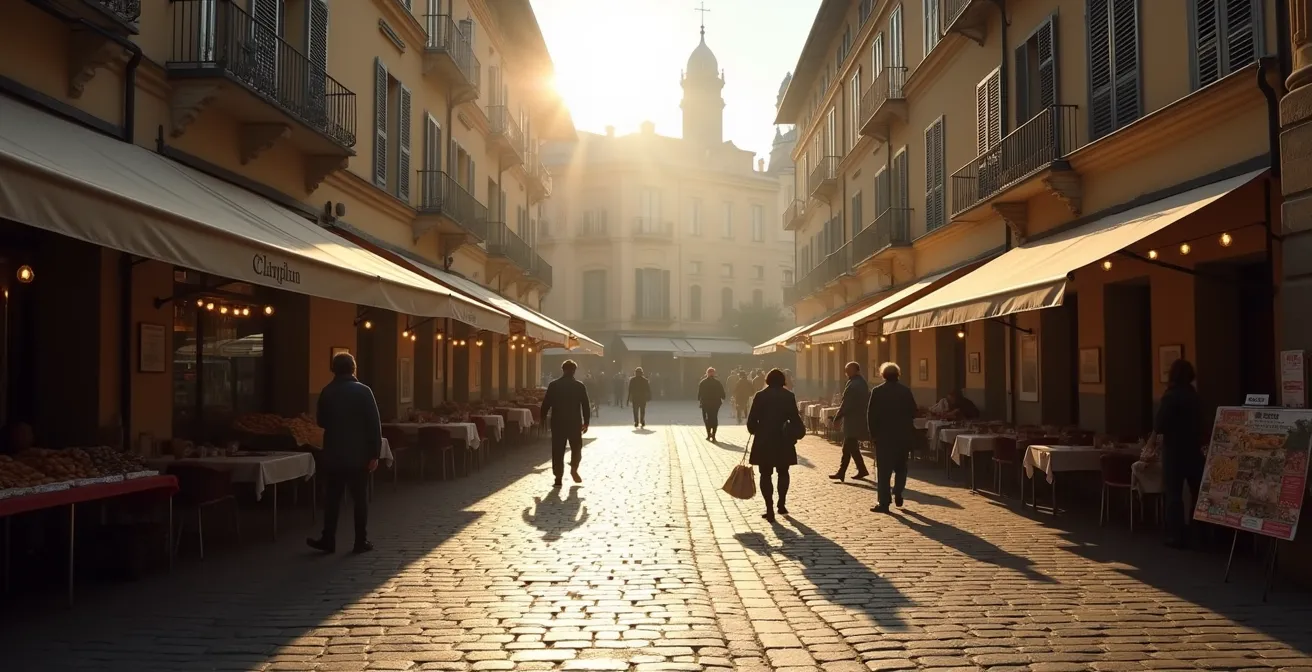
The first layer of this strategy is seasonal. Visiting in the “shoulder seasons” (like April-May or September-October in Europe) is common advice, but the goal isn’t just fewer crowds. It’s about being there when the city is for its residents. Think about local festival dates, school holidays, and community events that are not designed for tourists. These are windows into the city’s true character. The second, more powerful layer is daily timing. The soul of a city is most palpable in the early morning and late evening, the hours when the locals reclaim their spaces. Waking up at dawn to see a baker opening his shop or a piazza being hosed down offers a connection that is impossible at midday.
This desire for genuine moments reflects a broader shift in traveler values. The focus is moving away from acquiring material souvenirs and toward collecting meaningful experiences. In fact, new data from the Mastercard Economics Institute reveals that 12% of tourism sales now go to experiences, the highest share in at least five years. To tap into this, you must seek out the moments before and after the “show” of tourism begins. Visit the famous market an hour before it officially opens to watch the vendors set up and interact with each other. Stroll through a popular district after the tour buses have departed, when residents are out walking their dogs.
By consciously choosing to exist outside of peak tourist hours, you are not just avoiding queues. You are stepping into a parallel version of the city—one that is quieter, more authentic, and infinitely more welcoming to the traveler seeking a real connection.
How to Experience the Colosseum Alone by Waking Up at 5 AM?
The Colosseum. A magnificent, awe-inspiring monument… and a symbol of overwhelming mass tourism. For the immersive traveler, a site like this poses a dilemma. To skip it feels like a missed opportunity, but to visit it amidst a sea of selfie sticks feels like a betrayal of your travel ethos. The solution, once again, lies in a radical shift in timing and preparation. The goal is not merely to see the Colosseum, but to create the conditions for a conversation with its history.
This means arriving before the gates even open, ideally while the sky is still dark. The experience begins not inside, but outside, watching the first rays of dawn illuminate the ancient arches. This pre-opening ritual is crucial. It’s a moment of solitude where the monument is yours alone, allowing you to absorb its scale and gravity without distraction. This quiet observation transforms the structure from a tourist attraction into a personal encounter. You are no longer one of thousands; you are a solitary witness to 2,000 years of history waking up to a new day.
Case Study: The Power of Solitude at Historical Sites
An informal study of travelers who visited the Colosseum during the first hour of opening revealed a consistent theme of a transformative experience. By preparing the night before (reading Seneca or other contemporary texts) and arriving in silence, participants shifted their mindset from sightseeing to historical communion. Without the noise of crowds, they could hear the echo of their own footsteps on the ancient stones, allowing their imaginations to populate the empty corridors. Several described the experience as having a ‘conversation with ghosts‘ rather than simply ticking an item off a checklist, proving that solitude and preparation are key ingredients for deep connection with historical places.
When the gates finally open and you are among the first to step inside, the feeling is entirely different. You are not entering a crowded stadium; you are exploring a silent, cavernous space that still holds the energy of your solitary vigil. You can walk the corridors and feel their emptiness, a powerful contrast to the chaotic history they contain. This approach requires sacrifice—an early alarm and a disciplined plan—but the reward is immense. You get to experience the Colosseum not as it is today, but with a glimpse of what it was: a place of profound and terrifying human drama.
How to Use Local Art Classes to Learn a Language Faster Than Duolingo?
Language learning is a cornerstone of cultural immersion, but app-based tools like Duolingo, while useful, often teach language in a sterile, disembodied way. They give you the words but not the world they belong to. A more powerful and holistic approach is to learn language through a shared, hands-on activity. Enrolling in a local art class—be it pottery, painting, cooking, or dancing—can accelerate your language acquisition far more effectively because it grounds vocabulary in physical action, sensory experience, and human connection.
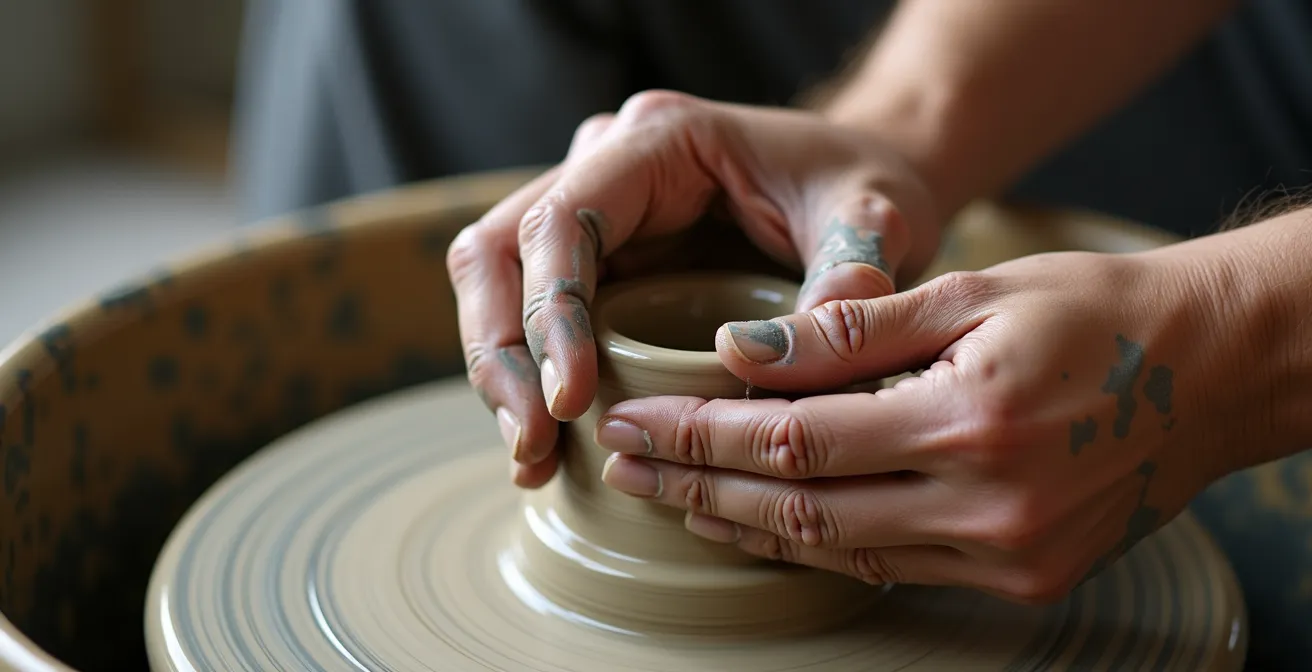
In a pottery class, you don’t just learn the word for “clay” (e.g., *argile* in French, *arcilla* in Spanish); you feel its texture, smell its earthiness, and learn to ask your instructor, “Is this too wet?” (*Est-ce trop humide?*) Your brain forms a much stronger neural connection to the vocabulary because it’s linked to a multi-sensory experience and a tangible goal. This is called embodied cognition—the idea that our minds are not separate from our physical bodies. Learning becomes a “whole body” activity.
Furthermore, the art class environment naturally breaks down the inhibitions that often paralyze language learners. The focus is on the shared task, not on your grammatical perfection. A laugh with your instructor over a lopsided pot creates a bond that no app can replicate. These moments of shared vulnerability and creativity are where real communication happens. This aligns with the growing understanding among travelers that deep engagement is paramount; indeed, 36% of travelers now say cultural immersion is essential for an authentic experience. An art class is a perfect microcosm of this immersion.
Instead of drilling abstract verb conjugations, you are using the language as a tool to accomplish something real and creative. You are not just a student of a language; you are an apprentice in a craft, and the language is simply part of the workshop’s air. This shift from academic exercise to practical application is the secret to learning not just faster, but more deeply.
Key Takeaways
- The essence of transformational travel is the shift from a passive observer to an active participant in the culture you are visiting.
- Authenticity is not found, but created through intentional strategies like strategic timing, structured wandering, and participatory lodging.
- The journey’s impact is secured after you return, through a conscious process of integrating new perspectives and habits into your daily life.
Why Participating in a Ritual Is More Memorable Than Watching One?
You can watch a hundred videos of a Balinese temple ceremony, but the memory will be fleeting and two-dimensional. It is only when you are handed a flower to place on the offering, when you feel the coolness of the holy water on your forehead, that the experience becomes a part of you. This is the ultimate expression of the participatory mindset: moving from being a spectator of a ritual to a humble participant within it. The difference is profound and permanent.
Watching a ritual engages your eyes and ears; participating in it engages your entire being. Your body learns the rhythm of the procession, your hands learn the texture of the ceremonial objects, and your heart feels the collective energy of the community. This full-body engagement creates memories that are encoded not just as facts, but as feelings and muscle memory. The experience moves from your short-term intellectual memory to your long-term emotional core. As experts in deep travel experiences note, this is where the magic lies.
Travel is all about embracing the unexpected. Unplanned moments are often the most memorable when you participate rather than observe.
– Travel For Teens Cultural Programs, Cultural Immersion Programs Guide
This principle is not limited to grand religious ceremonies. It applies to the “micro-rituals” of daily life: joining the locals for their evening *passeggiata* in an Italian town, helping a vendor pack up their stall at the end of the day, or learning the steps of a local dance at a community festival. Each act of participation, no matter how small, is an investment in a deeper connection.
Case Study: From Spectator to Participant at a Community Festival
During local harvest festivals in rural Italy, travelers who moved beyond taking photos and actively participated reported forging lasting bonds. One traveler’s account describes how simply offering to help prepare traditional foods at a community stall led to an invitation to a private family dinner. This single act of cultural contribution transformed a one-day visit into a week-long immersion with a local family, creating connections that have been maintained for years. The traveler stopped being a tourist and became, for a short time, part of the community fabric.
To be invited into a ritual is an act of profound trust and welcome from a community. To accept with humility and respect is the greatest honor a traveler can pay. It is in these moments that the wall between “us” and “them” dissolves, and you are left with the simple, powerful feeling of shared humanity. These are the moments that change you forever.
The journey from a tourist to a true traveler is a conscious choice. It requires planning, courage, and a willingness to be vulnerable. By embracing a participatory mindset, you don’t just visit the world; you connect with it. Start planning your next journey not by the sights you will see, but by the life you will share.