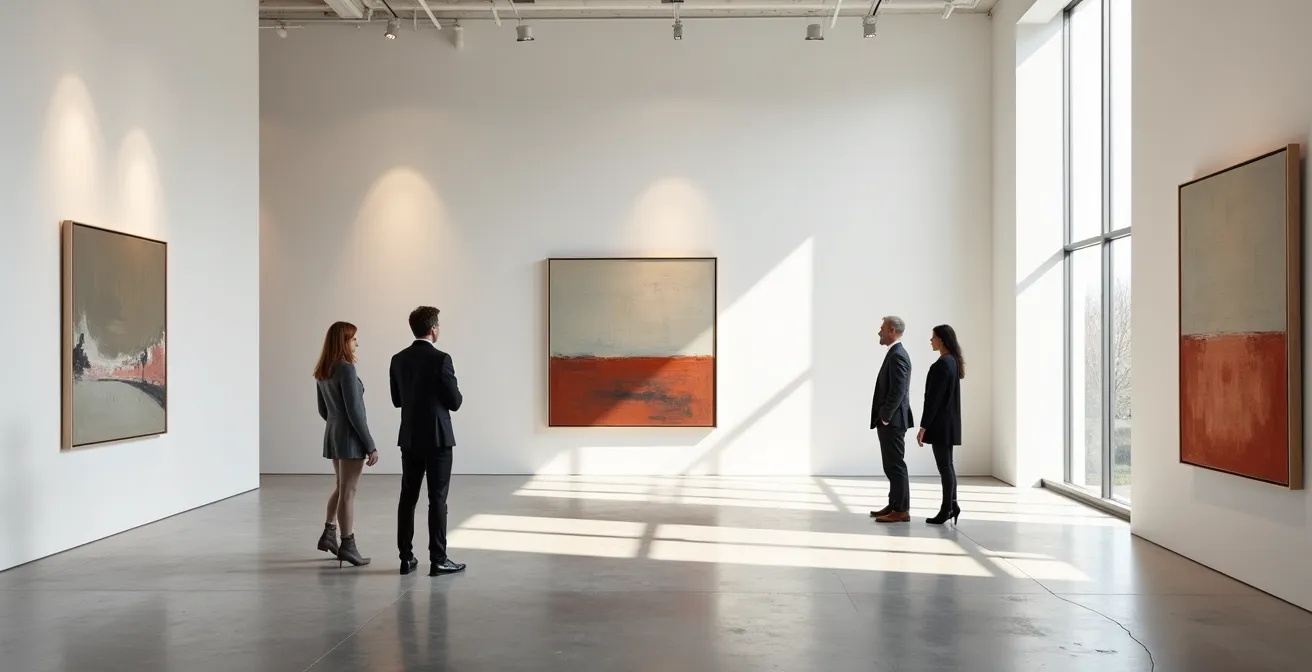
Owning fine art is not about personal taste; it is a calculated performance of cultural capital used to navigate and ascend social hierarchies.
- Your preference for a specific art movement, like Abstract Expressionism, is a class signifier, not just an aesthetic choice.
- The language you use (and misuse) in a gallery reveals your social origins more than your knowledge.
Recommendation: Treat art acquisition and appreciation as a strategic skill. This guide decodes the unspoken rules so you can perform your role convincingly.
There is a specific, quiet anxiety that surfaces when you first step into a world of immense wealth and influence. It’s the feeling that you are being judged not on your merits, but on a series of unspoken codes you have yet to decipher. One of the most potent of these codes is art. The common advice—”just buy what you love”—is a platitude designed to keep outsiders out. It naively presumes that taste is a pure, personal impulse rather than what it truly is: a learned and performed script. Liking the “wrong” thing, or liking the “right” thing for the wrong reasons, is an immediate social disqualifier.
But what if the key wasn’t to “develop” taste, but to understand the sociology of it? What if you could see the matrix of signals behind every canvas and sculpture? This is not about becoming an art historian; it’s about becoming a fluent reader of cultural capital. The possession of “fine art” is less about the object itself and more about demonstrating a mastery of the aesthetic distinctions that define the elite. It’s a performance, and like any performance, the script can be learned.
For those who prefer a more direct format, the following video offers a compelling case study in late 20th-century pop culture aesthetics and its enduring digital afterlife. Its viral resurgence demonstrates the unpredictable trajectories of cultural artifacts, a phenomenon even the most discerning collector must acknowledge.
This article will not tell you what to like. Instead, it will dissect the social mechanics at play, providing a strategic guide to navigating the art world as a tool for social positioning. We will explore how different art eras signal different philosophies, the critical mistake of misusing jargon, and even why the very act of visiting a museum can be a social test.
Summary: A Strategic Guide to Art as a Status Symbol
- What Your Preference for Abstract Expressionism Says About Your Class?
- How to Distinguish “Modern” from “Contemporary” in 10 Seconds?
- Optimism vs. Irony: Which Art Era Fits Your Personal Philosophy?
- The Mistake of Using Jargon You Don’t Understand in an Art Gallery
- How to Start a “Fine Art” Collection with a Budget of $1,000?
- The “Guilty Pleasure” Myth That Stops You From Enjoying Romance Novels
- What Does Abstract Sculpture Actually Mean and How to Talk About It?
- Why Museums Exhaust You Faster Than a Hike?
What Your Preference for Abstract Expressionism Says About Your Class?
A preference for Abstract Expressionism is rarely about a simple love for Pollock’s drips or Rothko’s brooding color fields. It’s a signal of alignment with a specific moment of cultural power. As a movement, it was a declaration of independence; according to art historians, it was the first specifically American movement to achieve international influence, effectively dethroning Paris and centering the art world in New York. To appreciate it is to implicitly appreciate this assertion of American cultural dominance. It signals an understanding of art history not as a series of aesthetic developments, but as a series of power shifts.
The upper echelons reinforce this by treating its interpretation as a form of intellectual credentialing. Institutions like Harvard offer courses on bridging spirituality and expressionism, teaching the “practical skills for successful artwork interpretation.” This is the mechanism: the art is intentionally opaque, and the ability to “decode” it becomes a form of cultural capital. Expressing a fondness for Abstract Expressionism, therefore, doesn’t say “I am a rebel.” It says, “I am educated in the dominant cultural narrative, and I understand the historical significance of this work beyond its surface appearance.” It is a carefully calibrated signal of belonging.
How to Distinguish “Modern” from “Contemporary” in 10 Seconds?
Confusing “Modern” and “Contemporary” art in conversation is a fatal error for the social climber. It instantly signals you are an outsider. The distinction is not merely chronological; it’s ideological. Think of it as a password. Get it right, and you’re in. Get it wrong, and the doors close. The 10-second rule is this: Modern Art believed it could change the world; Contemporary Art is skeptical that the world can be changed at all.
Modern art, spanning roughly from the 1890s to the 1960s, was defined by a spirit of utopianism and earnest inquiry. As art critic Tim Brinkhof notes, movements from Cubism to Abstract Expressionism were engaged in serious inquiries into perception, form, and spirituality. There was an underlying belief in progress and the power of art to uncover deeper truths. It was sincere, even in its most radical forms.
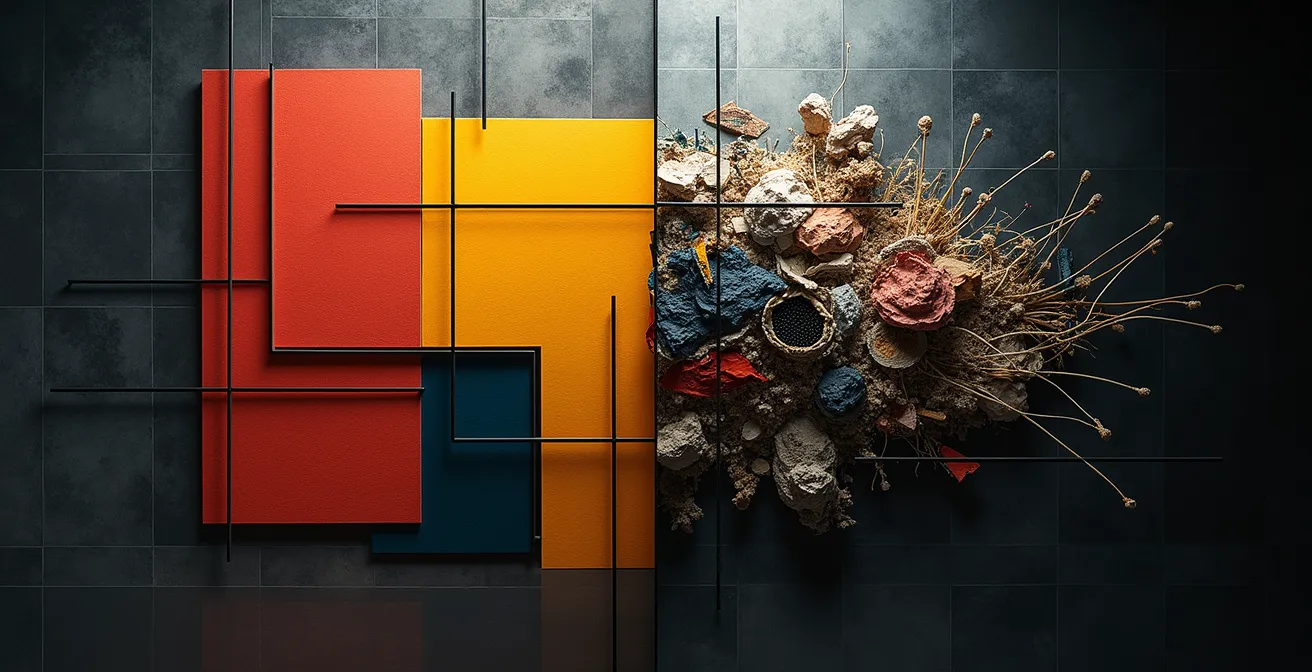
Contemporary art, which began in the latter half of the 20th century and continues today, was born from postmodern doubt and skepticism. It is often ironic, playful, and self-referential. It doesn’t provide answers; it questions the question itself. This visual and philosophical split is the key. Mistaking one for the other is like confusing a sermon for a stand-up comedy routine—a fundamental misreading of the room.
Optimism vs. Irony: Which Art Era Fits Your Personal Philosophy?
Your choice of art is a proxy for your worldview. When you hang a piece in your home, you are curating not just a wall, but a persona. The art you champion becomes an extension of the philosophy you wish to project. Are you an earnest believer in progress and emotional truth, or a detached, ironic observer of a fragmented world? The art era you favor signals your position. This isn’t about your actual beliefs, but about the performance of a coherent intellectual stance.
Modernism, with its roots in optimism, is for projecting stability, tradition, and intellectual depth. Contemporary art, by contrast, is a tool for signaling cultural fluency and a certain brand of detached cool. It emerged in a climate of philosophical skepticism, where artists adopted ironic and satirical tones to question the very nature of meaning. To appreciate contemporary art is to signal that you “get the joke”—that you are comfortable with ambiguity and are not naive enough to believe in grand narratives.
This table simplifies the social signals associated with major movements, drawn from an analysis by institutions like the Tate Modern which tracks these philosophical shifts.
| Art Movement | Philosophy | Key Artists | Social Signal |
|---|---|---|---|
| Impressionism | Optimism, Progress | Monet, Renoir | Traditional Values |
| Abstract Expressionism | Emotional Earnestness | Pollock, Rothko | Intellectual Depth |
| Pop Art | Ironic Commentary | Warhol, Lichtenstein | Cultural Awareness |
Choosing between these is a strategic decision. Aligning with the earnestness of Modernism can project gravitas, while an affinity for Contemporary irony signals you are keyed into the current cultural conversation. An inconsistent collection, however, simply signals confusion.
The Mistake of Using Jargon You Don’t Understand in an Art Gallery
In no setting is the performance of taste more scrutinized than in a commercial art gallery. Here, language is everything. The greatest mistake a novice can make is not silence, but the clumsy attempt to wield jargon they do not fully command. Casually dropping a term like “action painting” or “color field” without understanding the distinction is the equivalent of wearing a poorly tailored suit—it reveals you as an imposter immediately. The art world’s vocabulary is a tool for inclusion and exclusion, and its misuse is a clear sign of an outsider.
Within Abstract Expressionism, for example, the distinction is critical. As experts from the Tate clarify, there were two main groups: the “action painters” who used expressive brush strokes, and the “colour field painters” who focused on large, flat areas of solid color. To conflate Jackson Pollock with Mark Rothko under a single generic term is to fail a key entrance exam. The goal is not to sound like an art historian, but to demonstrate a nuanced understanding that signals genuine immersion in this world.
Silence, paired with a perceptive question, is always more powerful than confident ignorance. The true elite are often the most understated in their commentary. They don’t need to prove they belong. For those still learning the script, a defensive strategy is essential.
Your Action Plan: Safe Strategies for Art Gallery Conversations
- Start with personal, emotional reactions rather than attempting a technical analysis of the work.
- Ask perceptive questions that demonstrate curiosity without claiming a false sense of expertise.
- Use accessible, universally understood terms like ‘composition’ and ‘palette’ before trying specialized vocabulary.
- Practice linguistic code-switching by carefully adapting your language to the person you are speaking with.
- Focus your questions on the artist’s process or intention rather than making definitive statements about the piece.
How to Start a “Fine Art” Collection with a Budget of $1,000?
The notion that one needs millions to acquire cultural capital through art is a misconception. It’s not about the price tag; it’s about the narrative. A $1,000 budget, used strategically, can be far more effective for a social climber than a poorly chosen $100,000 purchase. The key is to shift from being a “buyer” to a “collector,” and the most potent narrative at this level is that of the “discoverer” of emerging talent.
Forget the established galleries for now. Your budget is your entry ticket into the world of artist studios, MFA graduate shows, and online platforms where the next generation of artists operates. The digital marketplace has democratized access, with studies showing online art sales crossed 10 billion dollars in value, and that nearly 29% of buyers have purchased directly from artists via social media. This is your hunting ground.

Purchasing a small work on paper directly from an artist in their studio does more than just get you a piece of art. It gets you a story. You are no longer just a consumer; you are a patron, a supporter with a keen eye. You didn’t buy a commodity; you invested in a person. This narrative of personal connection and early discovery is a powerful form of social currency, signaling foresight and a genuine engagement with the creative process, a much more sophisticated position than simply writing a check for a known name.
The “Guilty Pleasure” Myth That Stops You From Enjoying Romance Novels
In the rigid caste system of taste, the concept of a “guilty pleasure” is a trap for the middle class. It implies an awareness that one’s enjoyment is low-status, and the guilt is the tax paid for that transgression. For the upwardly mobile, this is a dangerous category. Enjoying a romance novel sincerely, for example, places you firmly outside the circle of “serious” culture. It is an admission of an un-curated, unsophisticated palate. The elite do not have guilty pleasures; they have either “correct” tastes or ironically-consumed “low culture.”
This is where contemporary art’s embrace of irony becomes a useful tool for the elite. As critic Tim Brinkhof observes, many contemporary artists “blur the lines between critique and complicity, between profundity and spectacle.” This allows a wealthy collector to own a kitschy, pop-culture-referencing piece by Jeff Koons or Damien Hirst without losing status. The enjoyment is filtered through a lens of irony and critical distance. The collector isn’t enjoying the kitsch itself; they are enjoying the artist’s clever commentary *on* the kitsch. It’s a performance of intellectual superiority over the material.
A romance novel offers no such protective filter. Its pleasures are earnest and emotional, qualities reserved for “high art” that has been institutionally approved. To admit enjoying one is to admit you cannot distinguish between “legitimate” emotion and mass-market sentimentality. In the game of aesthetic distinction, this is an unforgivable foul.
What Does Abstract Sculpture Actually Mean and How to Talk About It?
Abstract sculpture is perhaps the ultimate test of a collector’s performed confidence. With no discernible narrative or recognizable form, it demands a specific and practiced mode of discussion. To say “I don’t get it” is to admit defeat. To say “It looks like a…” is to reveal a naive desire for representation. Talking about abstract sculpture is not about finding a hidden meaning; it’s about demonstrating your ability to engage with form, material, and space on their own terms. It is a performance of the “gaze.”
The institutional world signals the importance of this skill through massive investment. The Metropolitan Museum’s new Tang Wing, for instance, will dramatically expand space for modern and contemporary art, a significant portion of which is sculptural. This signals that mastery over this domain is a high-value form of cultural capital. The correct way to discuss it is to follow a script that moves from the personal to the analytical.
A convincing analysis follows a three-part structure:
- Begin with an emotional or physical reaction: “This piece feels incredibly grounding,” or “There’s a sense of tension in this form.” This grounds your critique in a personal, yet controlled, observation.
- Connect the reaction to physical attributes: “Perhaps it’s the sheer mass and the raw texture of the material,” or “The way this steel element cantilevers out creates that feeling.” This proves you can link feeling to form.
- End with an open, perceptive question: “I wonder how the artist’s choice of bronze, with all its historical weight, is meant to interact with such a modern form?” This opens a dialogue, signaling collaborative intelligence rather than declarative ego.
You should also comment on the negative space—the empty areas the sculpture shapes—and the specific choice of materials, as bronze signals history and permanence while steel indicates modernity. This vocabulary shows you are reading the work, not just looking at it.
Key Takeaways
- Art is a language of social status; your taste is your accent, revealing your origins.
- The distinction between Modern (earnest) and Contemporary (ironic) art is a fundamental password for entry into elite circles.
- Misusing art jargon is more damaging than silence. A defensive, question-based strategy is safer for the novice.
Why Museums Exhaust You Faster Than a Hike?
The phenomenon known as “museum fatigue” is more than just a matter of tired feet; it is a sociological indicator. If you find yourself mentally exhausted after 30 minutes in a gallery, it is a sign that you are in an environment where you are working too hard to belong. The fatigue stems from the intense cognitive load required to process unfamiliar visual information and navigate unspoken social codes. For the uninitiated, a museum is not a place of leisure but of high-stakes, mentally draining performance.
Research confirms this rapid decline in focus. As Stephen Bitgood detailed in the journal Visitor Studies, the experience is defined by exhaustion, satiation, and information overload. Other studies show that the average visitor’s attention plummets after half an hour, spending a mere 17-27 seconds on each artwork. This is the behavior of a tourist. The elite, in contrast, have been trained since childhood to navigate these spaces. They don’t suffer from “object competition” because they have an internalized hierarchy of what is important. They know what to look at and, more importantly, what to ignore.
The physical environment, especially in world-class institutions like the Louvre, which is projected to see 12 million visitors in 2025, exacerbates this. The crowds and scale are designed to overwhelm the unprepared. True elites often bypass this entirely through private tours or curator-led viewings. Their experience is one of serene contemplation, while the masses are subjected to a stressful ordeal. Therefore, admitting to museum fatigue is admitting you are part of the masses. The sophisticated performance is one of effortless endurance, an ability to gracefully absorb high culture for extended periods without visible strain.
Ultimately, navigating the art world is a game of semiotics. Every choice is a signal, every preference a statement of allegiance. By understanding the underlying rules of this performance, you can move from being a passive audience member to an active and convincing player. The goal is not to fake it, but to become so fluent in the language of cultural capital that it becomes your own.