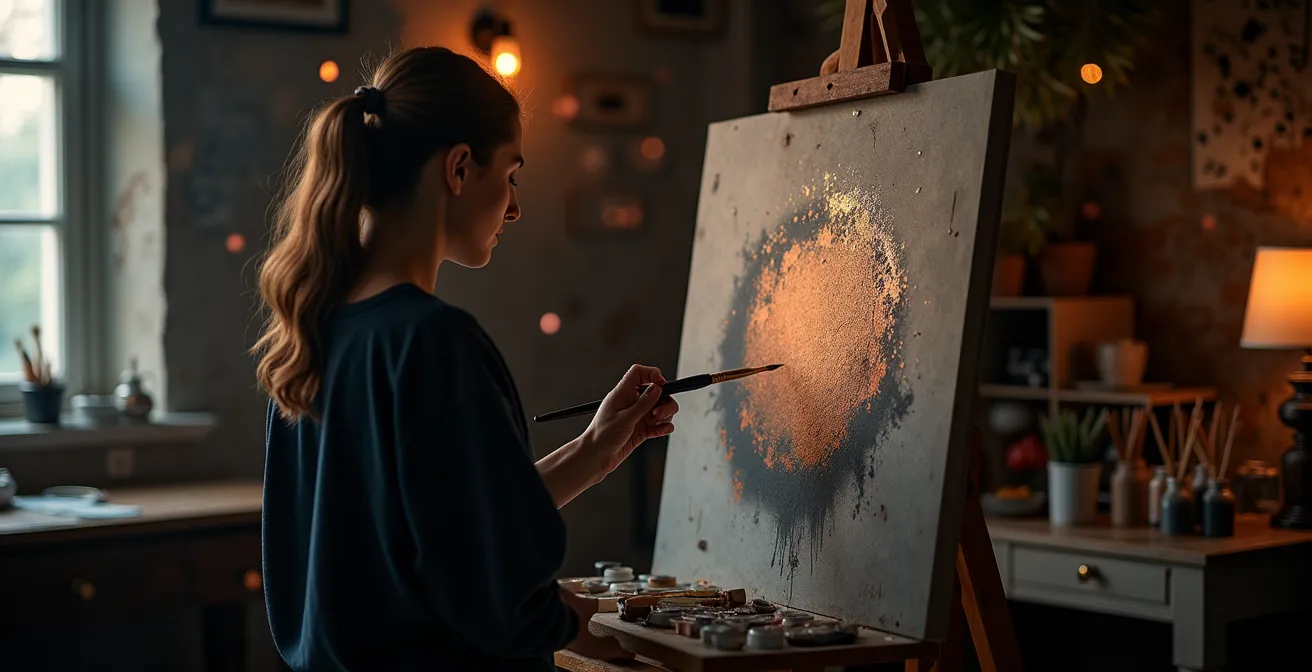
Contrary to the fear that AI will devalue artists, its infinite output actually makes verifiable human creativity a scarce and premium asset.
- The art market is shifting to prioritize provenance, where the story and verifiable human touch behind a piece are its primary value drivers.
- Artists now have access to defensive tools that disrupt AI data scraping, giving them economic leverage to protect their work.
Recommendation: Instead of competing with AI on speed, focus on building a brand around your unique, tangible process and establishing irrefutable proof of your work’s human origin.
If you’re a digital artist, your social media feeds have likely been flooded with hyper-realistic images that seem to appear from nowhere, each generated by an algorithm in seconds. This explosion of AI-generated content has sparked widespread anxiety and a recurring, often circular debate. Is AI just another tool like Photoshop? Does it lack a “soul”? While these questions are philosophically interesting, they miss the most critical shift happening right now—one that has less to do with art and more to do with economics.
The conversation is no longer about human skill versus machine efficiency. It’s about the emergence of two distinct markets: an infinite commodity market for AI-generated visuals and a finite, premium asset market for human-made art. The fear of being replaced is valid, but it’s based on the flawed premise that you are competing in the same race. The truth is, you’re not. In a world saturated with algorithmic perfection, the imperfections, intentions, and tangible processes of a human artist—what we can call the “human artifact”—become a signal of rarity and value.
This guide reframes the challenge. It’s not about how to work faster or “beat” the algorithm. It’s about how to strategically position your work in a category AI can never enter. We will explore why collectors are willing to pay a premium for authenticity, how to protect your portfolio from being scraped, and how to build an irrefutable provenance that turns your art into a lasting, valuable asset for the future.
This article explores the strategic shifts artists can make to thrive in the age of AI. The following sections break down the key economic, technical, and practical dimensions of this new creative landscape, offering a clear roadmap from anxiety to agency.
Summary: Why AI-Generated Art Scares and Excites Traditional Artists?
- Why Collectors Will Pay a Premium for “Human-Made” Art in 2030?
- How to Spot AI Artifacts in Digital Images in Less Than 5 Seconds?
- Algorithmic Randomness vs. Human Intent: Can a Machine Truly Have “Taste”?
- The Copyright Loophole That Allows AI to Scrape Your Portfolio
- How to Treat “Prompt Engineering” as a New Form of Artistic Medium?
- The Provenance Gap That Could Render Your Art Investment Worthless
- How to Start Oil Painting for Under $50 Without Buying Junk?
- Why Fine Art Can Outperform the Stock Market During Inflation?
Why Collectors Will Pay a Premium for “Human-Made” Art in 2030?
The rise of infinitely reproducible AI images doesn’t threaten the high-end art market; it reinforces its core principles. Collectors aren’t just buying an image; they are investing in a story, a tangible piece of history, and a unique human perspective. As AI floods the market with visually appealing but contextless commodities, the value of verifiable human creation skyrockets. This is because fine art functions as a distinct asset class, driven by scarcity, provenance, and emotional connection—three things an algorithm cannot manufacture.
High-net-worth (HNW) individuals increasingly view art as a stable component of their wealth management. The 2025 UBS Global Art Market Report revealed that HNW collectors planned to allocate 20% of their total wealth to art, a significant increase from previous years. This isn’t speculative day-trading; it’s long-term investment in tangible assets. This sentiment is amplified by the desire for legacy. A Bank of America study found that 78% of collectors with high-value collections considered it important to pass their art on to heirs, a figure that jumps to 90% among those with legacy wealth. An AI-generated image, lacking a singular creator or a physical story, simply cannot fulfill this fundamental human desire for a lasting cultural footprint.
Ultimately, collectors invest in the artist’s journey—the struggle, the breakthroughs, the intention. An AI can replicate a style, but it cannot replicate the lived experience that gives a piece of art its soul and, consequently, its enduring market value. In 2030, the label “human-made” won’t just be a descriptor; it will be a mark of authenticity and a key driver of premium valuation.
How to Spot AI Artifacts in Digital Images in Less Than 5 Seconds?
As the line between human and machine creation blurs, the ability to identify AI-generated content becomes a critical skill for artists and collectors alike. While models are improving, they still struggle with the complex, interconnected logic of the real world. This results in subtle but revealing errors, often called artifacts. These are the tell-tale signs that betray a non-human origin, and learning to spot them is the first step in valuing true human craftsmanship.
AI models often fail in areas that require a deep, contextual understanding of anatomy, physics, and culture. According to researchers who study these tells, the most common errors fall into consistent categories. Hands and fingers with incorrect numbers or impossible joints remain a classic giveaway. Inconsistencies in lighting, where shadows don’t match their light source, are another major red flag. But the flaws can be more subtle. Pay attention to how different textures blend; an AI might unnaturally merge fabric into skin or wood into metal. The emotional and semantic consistency is also key—does the expression on a face truly match the context of the scene? Often, AI combines elements without understanding their meaning, creating a sense of unease or “wrongness.”
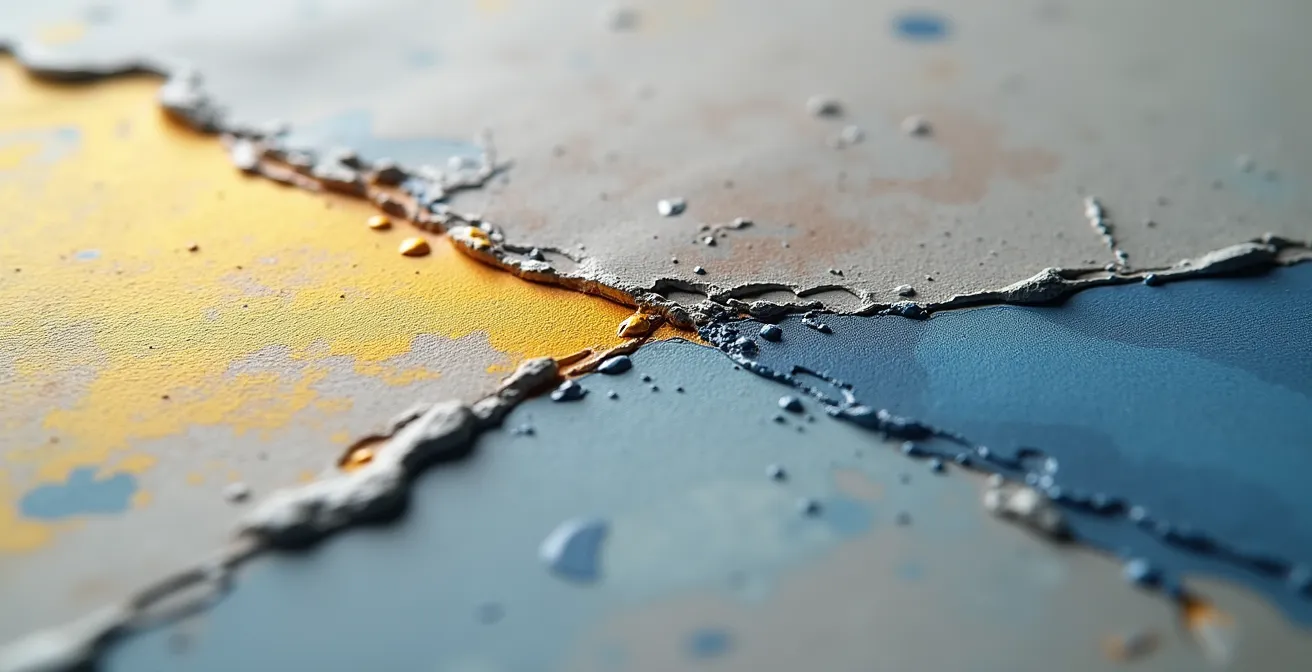
This macro photograph highlights the fundamental difference between a human artifact and a digital rendering. On one side, you see the rich, chaotic texture of a real brushstroke—a physical record of a human decision. On the other, the smooth, often imperceptibly patterned surface of a digital image. This difference is the essence of value scarcity.
Beyond these visual checks, a key area where AI falters is at the edges of an image, where generative models often run out of coherent data, leading to a deterioration of detail or bizarre artifacts. By training your eye to look for these five key indicators—anatomical errors, impossible physics, texture blending issues, semantic dissonance, and edge deterioration—you can quickly assess the likely origin of a digital image and better appreciate the coherence of human-made work.
Algorithmic Randomness vs. Human Intent: Can a Machine Truly Have “Taste”?
The debate over whether AI can create “real” art often comes down to one fundamental concept: intentionality. A human artist makes thousands of conscious and subconscious choices, driven by experience, emotion, and a specific point of view. This deliberate process is what we call “taste” or a “vision.” An AI, on the other hand, operates on stochastic (probabilistic) principles. It doesn’t “choose” in the human sense; it calculates the most likely next pixel based on the vast dataset it was trained on. This is the critical difference between intentional creation and sophisticated mimicry.
This distinction has a measurable impact on how we value art. Interestingly, our perception of an artwork’s origin directly influences its worth. A study highlighted by the National Library of Medicine found that humans rate art lower when they are told it was created by an AI. This bias isn’t just snobbery; it’s an intuitive recognition that the value of art is tied to the human story behind it. The struggle, the intent, and the cultural context are part of the product. An AI has no story, no struggle, and no lived experience to imbue its work with meaning.
As one Harvard faculty member noted in a discussion on the topic, this human element is not easily replicated. It is a process rooted in something beyond technical execution.
Art has an element that is spiritual, emotional. In terms of art created by AI, I don’t think we can call it art. I don’t see AI yet doing the kind of creative things we do.
– Harvard Faculty Member, Harvard Gazette Interview on AI Art
While an AI can generate aesthetically pleasing images, it lacks the capacity for genuine intent. It can simulate a style, but it cannot have a vision. This “intentionality gap” ensures that human-created art remains in a separate category of value, one based on the irreplaceable currency of human experience.
The Copyright Loophole That Allows AI to Scrape Your Portfolio
One of the most immediate fears for digital artists is the unauthorized use of their work to train generative AI models. The legal landscape is complex and slow-moving, creating a “copyright loophole” where tech companies scrape billions of images from the internet, often without permission or compensation, under the contested banner of “fair use.” This practice not only infringes on an artist’s rights but also trains models to replicate their unique styles, directly competing with them using their own creative labor.
However, instead of waiting for legislation to catch up, a proactive movement of artists and computer scientists is fighting back with technology. Tools like Glaze and Nightshade, developed at the University of Chicago, are designed to give artists defensive agency. Glaze works by adding barely perceptible changes to an image’s pixels. To a human eye, the artwork looks identical, but to an AI model, it appears as a completely different style, thus “cloaking” the artist’s true visual signature. Nightshade goes a step further by acting as a “data poison,” subtly corrupting the training data so that models learning from it begin to generate nonsensical images—a cat becomes a cake, a car becomes a cow.
These tools are not about sabotage but about rebalancing economic power. They are designed to make the cost of scraping unlicensed data prohibitively high, pushing AI companies towards ethical licensing. As Ben Zhao, a leader of the project, explains, the goal is to make paying artists a more viable option.
Nightshade’s goal is not to break models, but to increase the cost of training on unlicensed data, such that licensing images from their creators becomes a viable alternative.
– Ben Zhao, University of Chicago, Nightshade Project Documentation
The popularity of these tools—with millions of downloads reported—shows a powerful grassroots effort by artists to reclaim control over their digital identities. By using these technologies, artists are not just protecting their portfolios; they are actively asserting the economic value of their work in the digital age.
How to Treat “Prompt Engineering” as a New Form of Artistic Medium?
As artists grapple with the rise of AI, it’s easy to dismiss “prompt engineering”—the craft of writing text descriptions to guide AI models—as a simplistic, low-skill activity. However, treating it as a new artistic medium in its own right offers a more nuanced and forward-looking perspective. While it doesn’t involve the physical dexterity of painting or sculpting, advanced prompt engineering requires a unique combination of linguistic precision, conceptual creativity, and deep technical knowledge of how a model “thinks.”
Moving beyond simple prompts like “a cat sitting on a mat” reveals a complex world of artistic direction. Skilled prompt artists operate more like photographers or film directors, orchestrating a complex set of variables to achieve a specific vision. They employ a sophisticated vocabulary to control the outcome, using techniques that are as intricate as any traditional artistic method. This includes:
- Positive and Negative Prompts: Specifying not only what should be in the image, but also what should be excluded, to refine the output and eliminate common errors.
- Technical Modifiers: Using advanced parameters like VAEs (to alter color and mood), LoRAs (to inject specific styles or characters), and hypernetworks to fine-tune the model’s behavior.
- Parameter Tweaking: Adjusting settings like the guidance scale to balance the AI’s creativity against the prompt’s accuracy, or setting a specific seed number to control the initial randomness and create reproducible results.
- Upscalers and Inversions: Employing specialized tools to enhance resolution or teach the AI new concepts through a process called textual inversion.
Viewing prompt engineering through this lens shifts the conversation. It’s not about replacing traditional art but about a new form of creativity emerging at the intersection of language and image. It requires discernment, a strong aesthetic sense, and a willingness to experiment relentlessly. For the traditional artist, understanding this medium isn’t a threat; it’s an opportunity to expand their creative toolkit or, at the very least, to appreciate the unique value of their own hands-on, physically-grounded practice.
The Provenance Gap That Could Render Your Art Investment Worthless
In an art market increasingly flooded with AI-generated images, provenance—the documented history of an artwork’s ownership, custody, and creation—is no longer a nice-to-have for collectors. It is the single most important factor separating a valuable asset from a worthless digital file. An image without a clear and verifiable human origin story has zero investment value. This creates a “provenance gap” where AI-generated content, by its very nature, can never compete with human art in the long-term investment market.
This focus on long-term value is reflected in collector behavior. Far from the frenzied buying and selling of NFTs during their peak, serious art collectors are in it for the long haul. A 2024 survey from Bank of America’s private wealth division revealed that only 6% of collectors aged 44 and over planned to sell art in the next year, a steep drop from 25% in 2022. This demonstrates a clear shift towards treating art as a stable, legacy-building asset, not a volatile commodity. For your art to be considered part of this asset class, its human origin must be irrefutable.
As an artist, your most important job, beyond creating the art itself, is to meticulously build and maintain its provenance from day one. This isn’t just paperwork; it’s the process of embedding your story and your hand into the work’s DNA. Here is a plan to get started.
Action Plan: Establishing Digital Provenance for Your Art
- Document the Process: Use time-stamped videos and high-resolution photos to record your entire creative journey, from the first sketch to the final signature. This becomes undeniable proof of human creation.
- Leverage the Blockchain: Create blockchain-based Certificates of Authenticity (COAs) for each artwork. This generates a tamper-proof, publicly verifiable record of the art’s origin and ownership history.
- Maintain Meticulous Records: Keep detailed logs of the materials used, techniques applied, and conceptual iterations. This “artist’s log” adds depth to the work’s story and value.
- Embed Digital Signatures: Use cryptographic signatures and embed metadata directly into your digital files before they are ever published online. This permanently links the file back to you as the creator.
- Register Your Work: Before publishing online, officially register your artworks with your national copyright office and reputable artist registries. This creates a public, legal record of your claim to the work.
How to Start Oil Painting for Under $50 Without Buying Junk?
In a world dominated by digital screens and ephemeral content, embracing a tangible, traditional medium like oil painting is a powerful strategic move. It is not a retreat from technology, but a deliberate diversification of your artistic portfolio. Creating a physical object—a “human artifact”—with its own unique texture and presence is a direct counter-statement to the infinite reproducibility of AI. And contrary to popular belief, you don’t need a fortune to start. With less than $50, you can assemble a quality beginner’s kit that avoids the frustration of cheap, unusable materials.
The key is to spend smart, not big. Focus your budget on the three most important components: paint, brushes, and surface. For paint, ignore the giant, cheap sets. Instead, buy individual tubes of student-grade oil paint from a reputable brand (like Winsor & Newton’s Winton or Gamblin 1980). Start with a limited palette: Titanium White, Ivory Black, Cadmium Red, Ultramarine Blue, and Cadmium Yellow. These five colors can be mixed to create almost any hue. This is far better than having 24 low-pigment colors that produce muddy results.
For brushes, you need three workhorses: a medium-sized flat (for broad strokes), a smaller round (for details), and a filbert (a versatile oval shape). Natural bristle brushes are great, but modern synthetic brushes designed for oils are durable and more affordable. Finally, for your surface, skip the flimsy, pre-primed canvases from craft stores. Instead, buy a pad of canvas paper or an inexpensive Masonite board. The crucial step is to apply two thin coats of acrylic gesso yourself, sanding lightly between coats. This creates a superior, archival surface for a fraction of the cost and gives you a far better painting experience.
Key Takeaways
- The infinite supply of AI art inherently increases the value of scarce, verifiable human-made art.
- An artwork’s value is shifting from pure aesthetics to its “provenance”—the verifiable story and process of its human creator.
- Artists can use defensive technologies like Glaze and Nightshade to reclaim economic control over their work in the digital realm.
- Embracing tangible, traditional media is a strategic way to create physical assets that algorithms cannot replicate.
Why Fine Art Can Outperform the Stock Market During Inflation?
In times of economic uncertainty and rising inflation, investors often seek refuge in tangible assets that hold their value better than currency. While gold and real estate are traditional safe havens, fine art has emerged as a powerful, and often overlooked, alternative. Unlike stocks or bonds, which can be volatile and are tied to the performance of companies and economies, a piece of fine art has an intrinsic value rooted in its cultural significance, rarity, and, as we’ve established, its irrefutable human provenance.
The art market’s resilience is demonstrated by consistent high-level spending, even during economic headwinds. The Art Basel and UBS Survey of Global Collecting found that high-net-worth collectors maintained a median spending of $50,000 in 2023, a figure that held stable from the previous year, showing sustained confidence. This stability makes art an effective hedge against inflation. As the purchasing power of money decreases, the value of a unique, tangible object like a painting or sculpture tends to increase. It is a physical store of value that cannot be diluted by printing more currency.
This perspective is no longer limited to a small circle of established connoisseurs. A major generational shift is underway, with younger collectors fully integrating art into their financial planning. This formalizes art’s role as a serious investment vehicle.
This is a huge generational shift that we’re seeing. 98 percent of younger collectors consider art assets as part of their wealth management strategy.
– Bank of America art services specialist, Bank of America Private Wealth Survey 2024
For the modern artist, this economic reality is a source of immense excitement and opportunity. By creating work with a strong narrative, a tangible presence, and an impeccable provenance, you are not just making art—you are creating a resilient financial asset that can thrive in any economic climate.
Your creative journey, your unique vision, and your physical touch are now your most powerful assets. Start building your legacy today by meticulously documenting your process and embracing the irreplaceable value that only a human artist can provide.